The Deconstructed Heirloom: A Couture Analysis of the American Crazy Quilt
Introduction: The Quilt as Artifact and Statement
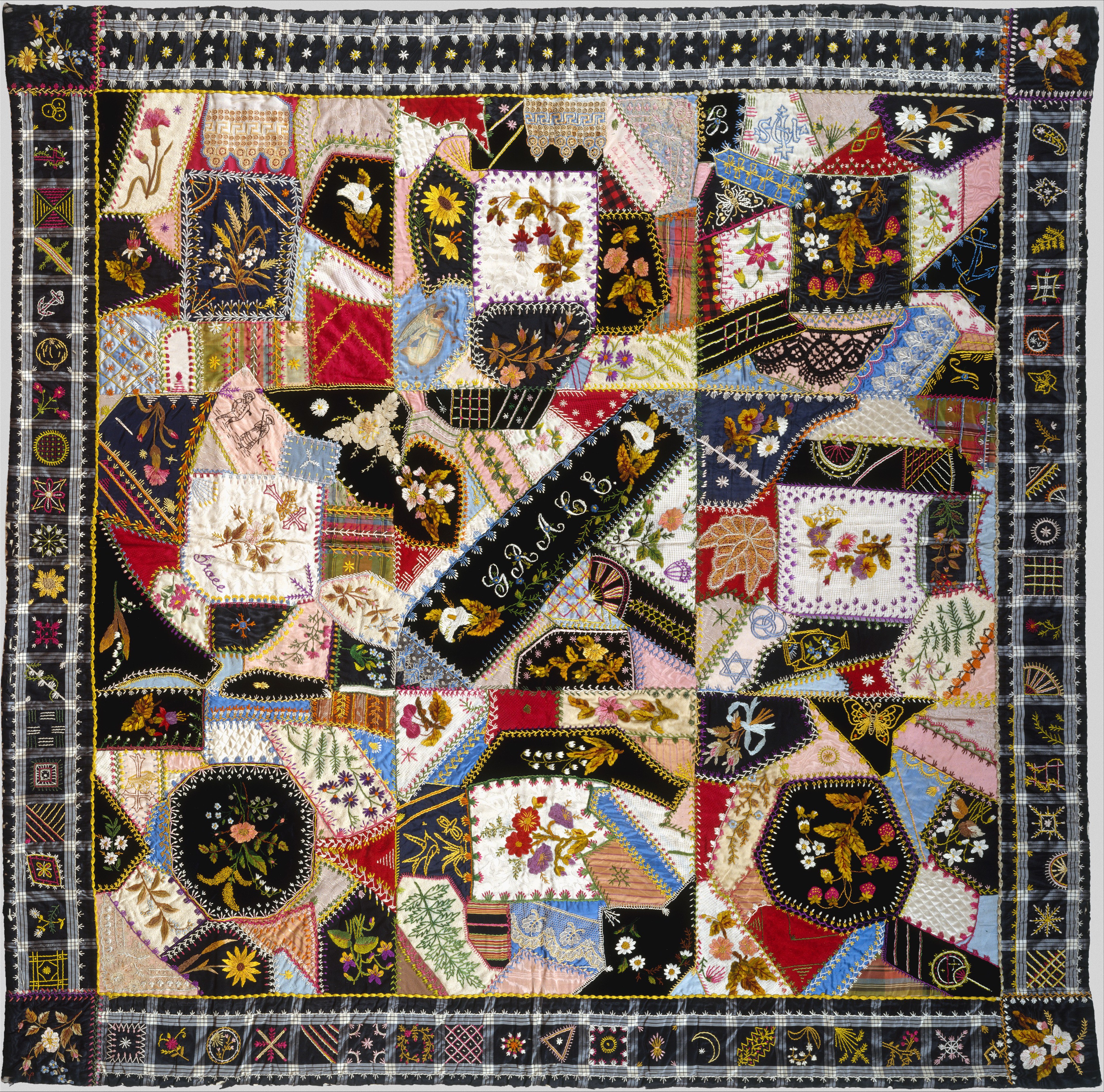
In the lexicon of American textile arts, few objects possess the narrative density of the crazy quilt. Unlike the geometric precision of traditional patchwork, the crazy quilt—with its seemingly chaotic assembly of irregular fabric shards—represents a deliberate departure from order, a celebration of asymmetry, and a deeply personal form of storytelling. At Katherine Fashion Lab, we treat such artifacts not merely as decorative throws but as standalone studies in material culture, construction philosophy, and the intersection of craft and couture. This analysis dissects a singular example: an American crazy quilt composed of silk, silk velvet, cotton, and cotton lace, examining its structural logic, material hierarchy, and its potential as a blueprint for contemporary high-fashion design.
Material Lexicon: Silk, Velvet, Cotton, and Lace
The material palette of this quilt is neither accidental nor purely decorative. Each textile contributes a distinct tactile and visual register, creating a layered dialogue between opulence and restraint. Silk, with its luminous sheen and fluid drape, forms the backbone of the composition. Its presence elevates the piece from utilitarian bedding to an object of luxury, referencing the Victorian-era fascination with exotic imports and the emerging middle-class desire for domestic refinement. The silk fragments, often salvaged from gowns, ribbons, or upholstery, carry the ghost of previous lives—each patch a remnant of a garment once worn, a curtain once drawn.
Interspersed with the silk are panels of silk velvet, a material that introduces a profound textural contrast. Velvet’s plush pile absorbs light rather than reflecting it, creating shadowed depths that offset the silk’s brilliance. This interplay of matte and sheen, of softness and slickness, generates a visual rhythm that prevents the patchwork from devolving into visual noise. The velvet also serves a structural function: its weight and density ground the lighter silk pieces, providing a counterbalance that prevents the quilt from becoming insubstantial.
Cotton appears in two distinct roles. First, as a foundational backing, where its breathable, durable nature ensures the quilt’s longevity. Second, as occasional patches of printed or plain-weave cotton, which introduce a humble, homespun quality that tempers the silk’s extravagance. This juxtaposition—the fine alongside the ordinary—is central to the crazy quilt’s ethos: it is a democratic archive of a household’s textile history, where a scrap of a work shirt can sit beside a fragment of a wedding dress.
The cotton lace is the most delicate and labor-intensive component. Applied as an overlay or trim, it functions as a decorative stitch, softening the raw edges of the patches and adding a filigree of intricacy. Lace, by its nature, implies transparency and fragility, yet here it is stitched down with surprising permanence. This tension—between the ephemeral and the enduring—is a recurring theme in the quilt’s design language.
Structural Logic: The Art of Controlled Chaos
At first glance, the crazy pattern appears random, even anarchic. However, a closer analysis reveals a rigorous, albeit unconventional, structural logic. The patches are not arbitrarily placed; they are arranged to create a balanced distribution of color, texture, and scale. The “crazy” pattern is, in fact, a system of visual counterpoint. Large velvet panels anchor the corners and center, while smaller silk fragments radiate outward, their irregular shapes interlocking like pieces of a jigsaw puzzle. The seams, far from being hidden, are celebrated through elaborate embroidery—feather stitches, herringbone, and French knots—that trace the boundaries between patches, turning the construction itself into ornament.
This technique, known as embroidery on the seam, is the quilt’s most distinctive structural feature. It serves a dual purpose: it reinforces the joins between disparate fabrics, preventing fraying and ensuring durability, and it transforms the quilt into a canvas for needlework artistry. The embroidery is not merely functional; it is a form of calligraphy, each stitch a signature of the maker’s hand. In couture terms, this is the equivalent of hand-finishing—a hallmark of bespoke construction that cannot be replicated by machine.
Cultural and Historical Context: The American Crazy Quilt as Proto-Couture
To understand this quilt as a standalone study, we must situate it within its historical moment. The crazy quilt craze peaked in the United States between the 1880s and the 1910s, a period of rapid industrialization and social change. These quilts were often made by women of means, who had access to silk remnants from imported goods and the leisure time to execute elaborate embroidery. The crazy quilt was thus a symbol of both status and sentiment—a showcase of the maker’s skill, her family’s material wealth, and her emotional connections to the fabrics she preserved.
Yet, the crazy quilt also subverted traditional gender roles. While quilting was conventionally viewed as a domestic, even trivial, pursuit, the crazy quilt’s complexity demanded a level of design sophistication and technical mastery that rivaled fine art. The use of asymmetrical, non-repeating patterns anticipated modernist abstraction by decades. In this sense, the crazy quilt can be read as a proto-couture object—a handmade, one-of-a-kind creation that privileges individuality over uniformity, and narrative over function.
Couture Implications: Lessons for Contemporary Design
For Katherine Fashion Lab, this quilt offers a rich repository of design principles applicable to high fashion. The first is material resourcefulness. In an era of sustainability, the crazy quilt’s ethos of using every scrap, of valuing the fragment as much as the whole, is profoundly relevant. A couture collection could reinterpret this patchwork logic by combining deadstock silks with velvet remnants, creating garments that are both luxurious and ecologically conscious.
The second lesson is surface embellishment as structure. The embroidery on the seams demonstrates that decoration need not be applied after construction; it can be integral to the garment’s integrity. This principle could translate into evening wear where seams are highlighted with hand-stitched lace or metallic thread, transforming structural lines into ornamental features.
Finally, the quilt teaches us about narrative layering. Each patch tells a story—of a dress, a curtain, a ribbon. In fashion, this translates to the concept of “wardrobe archaeology,” where garments are assembled from pieces with personal or historical significance. A coat made from a grandmother’s silk scarves, a skirt from vintage velvet upholstery—these are not merely garments but heirlooms in progress.
Conclusion: The Quilt as Living Document
The American crazy quilt, when examined through the lens of couture analysis, reveals itself as far more than a decorative throw. It is a material document of American domestic life, a testament to the artistry of anonymous makers, and a prescient example of sustainable, narrative-driven design. At Katherine Fashion Lab, we see in its chaotic pattern a blueprint for a fashion that values history, texture, and handcraft over mass production. This quilt is not a relic; it is a living text, one that continues to inspire and instruct. Its legacy is not in its preservation under glass, but in the stitches we choose to replicate, the fabrics we choose to honor, and the stories we choose to tell through our own creations.