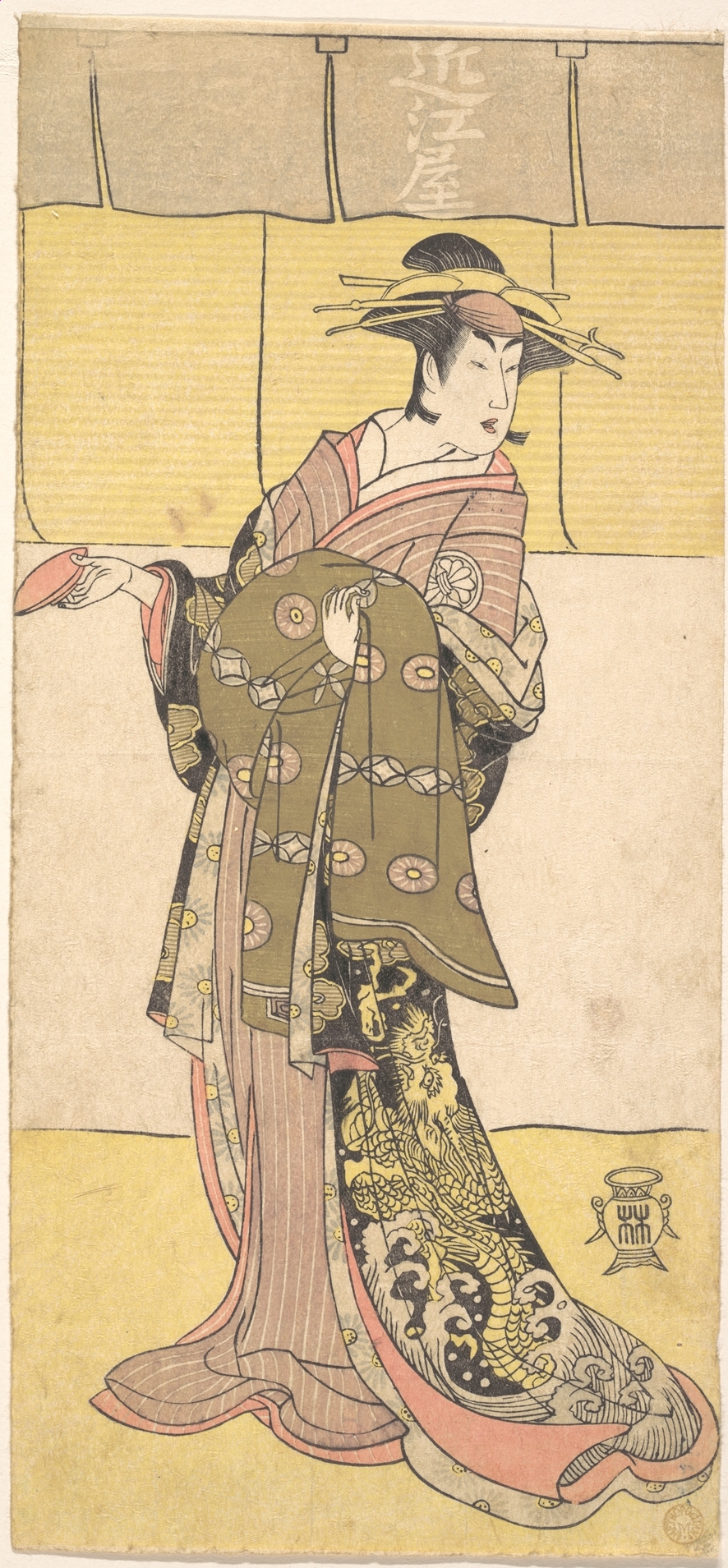
The Actor Segawa Kikunojō as a Courtesan of the Ōmiya Brothel: A Couture Analysis
Introduction: The Intersection of Kabuki and High Fashion
In the annals of Japanese visual culture, few artifacts capture the symbiotic relationship between performance and dress as masterfully as the woodblock print The Actor Segawa Kikunojō as a Courtesan of the Ōmiya Brothel. Created during the Edo period, this nishiki-e—a multicolored woodblock print—depicts the celebrated onnagata (male actor specializing in female roles) Segawa Kikunojō in the guise of a high-ranking courtesan from the Ōmiya establishment. Executed in ink and color on paper, this standalone study transcends mere portraiture; it is a sophisticated treatise on the semiotics of dress, social hierarchy, and theatrical transformation. For Katherine Fashion Lab, this print offers a profound lesson in how couture can serve as a narrative device, encoding status, allure, and identity within every fold of silk and every layered kimono.
Historical and Cultural Context: The Edo Period’s Fashion Ecosystem
To fully appreciate the couture analysis of this print, one must situate it within the socio-cultural fabric of Edo-period Japan (1603–1868). The actor Segawa Kikunojō was not merely a performer; he was a fashion icon whose onstage appearances influenced the sartorial choices of urban commoners and samurai alike. The courtesan of the Ōmiya Brothel, a fictionalized persona, represented the pinnacle of idealized femininity—a blend of eroticism, refinement, and inaccessibility. In this print, Kikunojō’s portrayal as a courtesan is a double act of artifice: the actor embodies a woman who is herself a master of performance. The kimono, obi, and accessories are not decorative afterthoughts but strategic elements that communicate wealth, taste, and social standing. The print’s medium—nishiki-e—was itself a luxury product, often marketed to fashion-conscious consumers who used such images as style guides. Thus, this artifact is both a record and a driver of Edo-period couture.
Silhouette and Structure: The Kimono as Architectural Garment
The centerpiece of this analysis is the kimono worn by Kikunojō’s courtesan. Unlike Western couture, which often emphasizes tailoring and body-conscious silhouettes, the Edo-period kimono is a study in geometry and concealment. The garment’s T-shape, achieved through straight seams and minimal draping, creates a cylindrical form that obscures the natural body. This is not a flaw but a deliberate design choice: the kimono transforms the wearer into a canvas for pattern and texture. In this print, the kimono’s sleeves (sode) are notably wide and flowing, a hallmark of the courtesan’s status. The furisode style—long, swinging sleeves—signals youth and allure, while the fabric’s weight and drape suggest high-quality silk. The obi (sash) is tied in a dramatic taiko musubi (drum knot) at the back, a style that became synonymous with courtesans and geisha. This knot, voluminous and intricate, serves as a structural counterpoint to the kimono’s linearity, drawing the eye to the wearer’s movement. For a couture house like Katherine Fashion Lab, the lesson is clear: silhouette is not about revealing the body but about creating a second architecture that amplifies presence.
Color Palette and Symbolism: The Language of Hues
The color scheme of this print is a masterclass in symbolic communication. The courtesan’s kimono features a dominant vermilion red, a hue associated with youth, passion, and the pleasure quarters. Red was also a color of protection and vitality in Japanese culture, often used in ceremonial garments. Contrasting with this is the indigo blue of the under-kimono (juban), visible at the collar and sleeves. Indigo, derived from the Polygonum tinctorium plant, was a color of the commoner class, but in this context, its layering beneath red suggests depth and complexity. The obi is rendered in gold and black, evoking luxury and formality. Gold thread (kinran) in the obi’s pattern would have indicated the courtesan’s high rank, as such materials were costly and regulated. The actor’s face, with its white oshiroi makeup, further heightens the color contrast, creating a visual hierarchy that directs the viewer’s gaze. For modern couture, this print underscores the power of strategic color blocking: red for drama, indigo for grounding, and gold for opulence.
Pattern and Motif: Nature as Narrative
The kimono’s surface is adorned with seasonal motifs, a staple of Edo-period design. Here, we observe chrysanthemums and plum blossoms, symbols of longevity and resilience. Chrysanthemums, associated with the imperial family, elevate the courtesan’s status, while plum blossoms—blooming in late winter—hint at transience and beauty. The patterns are not printed but rendered through yūzen dyeing or embroidery, techniques that required immense skill. The placement of motifs is deliberate: larger patterns near the hem create a sense of weight, while smaller motifs near the shoulders draw the eye upward. The obi features a geometric shippō (seven treasures) pattern, symbolizing good fortune and abundance. This interplay of organic and geometric forms reflects the Edo aesthetic of iki—a sophisticated, understated chic. For Katherine Fashion Lab, this print demonstrates that pattern is never arbitrary; it is a coded language that tells the wearer’s story, from personal virtues to social aspirations.
Layering and Texture: The Art of Hidden Luxury
One of the most sophisticated aspects of this courtesan’s attire is the layering of garments, a technique known as kasane. Visible at the collar and sleeve openings are multiple layers of differently colored fabrics. This is not merely a practical choice for warmth but a display of wealth and fashion knowledge. The number of layers, their colors, and their arrangement were subject to strict seasonal and social codes. In this print, the courtesan wears at least three layers: a white under-kimono, an indigo juban, and the outer red kimono. The slight asymmetry in the collar—pulled to the left—suggests a deliberate dishevelment, a hint of intimacy that contrasts with the formality of the ensemble. The texture, though implied, is crucial: the sheen of silk, the stiffness of the obi, the softness of the under-layers. For a couture house, this layering technique offers a blueprint for creating depth and intrigue in garment construction, where what is partially hidden becomes more alluring than what is fully revealed.
Accessories and Adornment: The Finishing Statements
No couture analysis would be complete without examining the accessories. The courtesan’s hair is styled in the shimada mage, a traditional updo adorned with kanzashi (hairpins). These pins, likely made of tortoiseshell or lacquered wood, feature floral and butterfly motifs, reinforcing the themes of nature and transformation. The kushi (comb) is visible, its intricate carving a mark of craftsmanship. The courtesan holds a tenugui (hand towel) in a subtle gesture, its fabric perhaps patterned with a family crest. The absence of overt jewelry—no necklaces or bracelets—is notable; in Edo fashion, the body itself was the primary canvas, with accessories serving as accents rather than focal points. This restraint is a hallmark of wabi-sabi aesthetics, where beauty is found in imperfection and simplicity. For Katherine Fashion Lab, this teaches that true luxury lies in the details—a single, exquisite kanzashi can speak louder than a cascade of diamonds.
Conclusion: Lessons for Contemporary Couture
The Actor Segawa Kikunojō as a Courtesan of the Ōmiya Brothel is more than a historical curiosity; it is a masterclass in the art of dressing for identity and impact. The print reveals how Edo-period couture functioned as a system of signs, where every color, pattern, and layer communicated a specific message. For Katherine Fashion Lab, the key takeaways are threefold: first, silhouette is a tool of presence, not just form; second, color and pattern are narrative devices that can encode status, season, and emotion; and third, layering creates a sense of depth and mystery that elevates design from mere clothing to wearable art. In an era of fast fashion, this print reminds us that couture is a dialogue between the wearer, the garment, and the culture that produces it. To design with the same intentionality as a nishiki-e artist is to honor the timeless power of dress as a medium of expression. This is the enduring legacy of Segawa Kikunojō’s courtesan—a figure who, through silk and ink, continues to teach us the language of elegance.