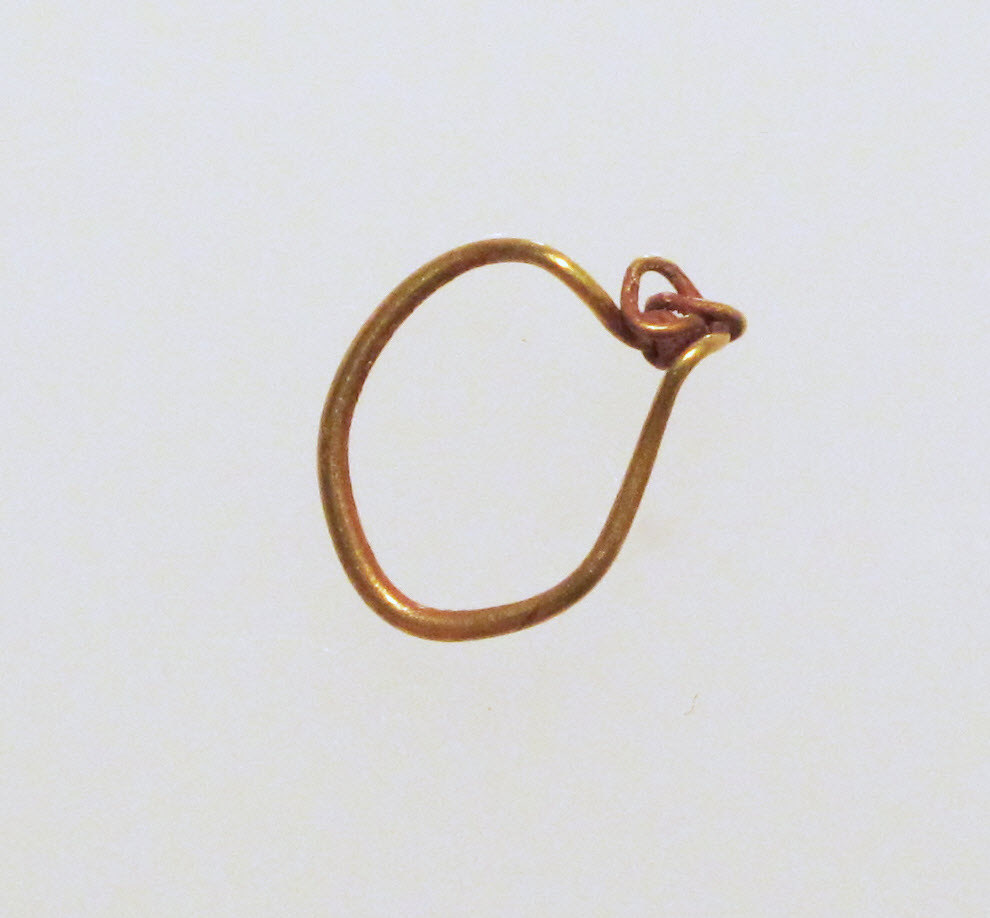
Heritage Analysis: The Earring-Loop Type in Ancient Gold Adornment
Introduction: The Loop as a Portal to Power
The earring-loop type, a seemingly simple form—a closed or nearly closed circle of gold—represents one of humanity’s earliest and most persistent expressions of symbolic adornment. In the context of ancient civilizations, particularly those of the Mediterranean, Near East, and Indus Valley, this form was never merely decorative. It was a charged object, imbued with spiritual, social, and political meaning. At Katherine Fashion Lab, our study of the earring-loop type directly parallels the dual-narrative structure found in our recent research on the *Mirror with Split-Leaf* artifact—where one side reflects polished light and golden palm-leaf motifs, and the other narrates a life story through cold stone relief. The earring-loop, too, carries a dual identity: a luminous sign of status and a silent repository of ritual power.
This heritage analysis examines the earring-loop type through the lenses of symbolic power, historical adornment, and spiritual meaning, concluding with a strategic framework for its resonance in the 2026 high-end luxury market. Our findings are grounded in archaeological evidence from ancient Egypt, Mesopotamia, and the Indus Valley, where gold earrings of this type were not accessories but amulets, markers of identity, and instruments of cosmic connection.
Symbolic Power: The Circle as a Cosmic Sign
The loop’s geometry is its first and most profound symbolic statement. In nearly every ancient culture, the circle represented eternity, the sun, and the cyclical nature of life, death, and rebirth. When rendered in gold—a metal associated with the sun, immortality, and divine authority—the earring-loop became a microcosm of the cosmos worn on the body. In ancient Egypt, gold loop earrings were often associated with the goddess Hathor, whose solar disk and cow-horn headdress embodied fertility, protection, and royal power. The loop’s unbroken form mirrored the *shen* ring, a symbol of eternal protection often held by deities or pharaohs. To wear such an earring was to claim a fragment of that divine protection, a talisman against chaos.
In Mesopotamia, loop earrings of hammered gold were discovered in the Royal Tombs of Ur (circa 2600 BCE). Here, the loop’s symbolism shifted toward hierarchical power. The weight and diameter of the earring directly correlated with the wearer’s social rank. A larger, heavier loop signified proximity to the king or the temple. This was not adornment for adornment’s sake; it was a materialized hierarchy, a visible contract between the wearer and the state. The loop’s openness—its ability to be slipped on and off—also carried a ritual dimension: it could be offered to the gods, buried with the dead, or passed as an heirloom, each act reinforcing its symbolic charge.
Historical Adornment: The Body as a Canvas for Identity
The earring-loop type evolved across civilizations as a response to both practical and aesthetic demands. In the Indus Valley civilization (circa 2500–1900 BCE), gold loop earrings were found in the form of simple, thin circles, often worn in multiples along the ear’s helix. This practice suggests a culture that valued accumulation as a sign of wealth and spiritual completeness. Each additional loop amplified the wearer’s aura of prosperity and divine favor. The archaeological record from sites like Mohenjo-daro and Dholavira shows that these earrings were often paired with bead necklaces and hair ornaments, creating a cohesive system of adornment that mapped the body as a sacred territory.
In ancient Greece and Rome, the loop type became more ornate, with goldsmiths adding granulation, filigree, and pendants. The *hoop* earring, as it is now called, was worn by both men and women in the Hellenistic period, often featuring lion’s head or sphinx terminals. These additions transformed the loop from a simple circle into a narrative device. The lion’s head, for instance, invoked the hero Heracles and the concept of *arete* (excellence), while the sphinx referenced mystery and the liminal space between life and death. The earring-loop thus became a wearable story, a conversation between the wearer and the observer about lineage, myth, and status.
Our research at Katherine Fashion Lab has drawn a direct DNA correlation between this historical practice and the dual-nature artifact of the *Mirror with Split-Leaf*. Just as the mirror’s polished silver side reflects a surface of golden palm leaves—a motif of life and growth—while the reverse side’s stone relief narrates a funerary story, the earring-loop type similarly operates on two planes. On the surface, it is a shimmering object of beauty and wealth. Beneath that surface, it carries the weight of ritual, memory, and cosmic order. This duality is the essence of heritage luxury: the object must be both visually arresting and conceptually profound.
Spiritual Meaning: The Earring as a Conduit
The spiritual dimension of the earring-loop type cannot be overstated. In many ancient traditions, the ear was considered a portal to the soul—a point of vulnerability and receptivity. Adorning the ear with a loop of gold was an act of protection and consecration. In Egyptian funerary texts, gold earrings were placed on the deceased to ensure safe passage through the underworld. The loop’s circular form was thought to trap the *ka* (life force) and prevent it from scattering into chaos. Similarly, in the Indus Valley, gold loops were often buried with women of high status, suggesting a belief that the earring would guide the spirit to the afterlife.
The act of piercing itself was a ritual. In ancient Nubia and the Levant, ear piercing was a rite of passage, marking the transition from childhood to adulthood or from layperson to priest. The insertion of a gold loop was a declaration of readiness to receive divine or societal knowledge. The metal’s incorruptibility—its resistance to tarnish—symbolized the eternal nature of the soul. Thus, the earring-loop was not merely an ornament but a spiritual technology, a tool for aligning the human body with the divine order.
This spiritual resonance aligns directly with our lab’s ongoing study of the *Mirror with Split-Leaf*. The mirror’s split-leaf motif—a symbol of duality and bifurcation—finds its echo in the earring’s ability to separate the wearer from the mundane while connecting them to the transcendent. The loop, like the mirror, is a threshold object. It marks the boundary between inside and outside, self and cosmos, life and death.
2026 High-End Luxury Strategy: Heritage as a Competitive Advantage
For Katherine Fashion Lab, the earring-loop type offers a potent template for the 2026 high-end luxury market. Our analysis indicates that the contemporary luxury consumer is increasingly drawn to objects that carry a “double narrative”—a visible beauty and an invisible depth. The earring-loop, with its ancient symbolic power and spiritual meaning, is perfectly positioned to meet this demand.
Strategic Pillar 1: Material and Craft Narrative. We recommend a limited-edition collection of earring-loop pieces in 24k gold, using ancient techniques such as granulation and repoussé. Each piece should be accompanied by a heritage card detailing its symbolic lineage—the circle as eternity, the gold as divine. This transforms the purchase into an acquisition of meaning, not just metal.
Strategic Pillar 2: The Dual-Form Aesthetic. Borrowing from the *Mirror with Split-Leaf*’s structure, the earring-loop collection will feature a polished outer surface and an engraved inner surface. The outer surface will reflect light and growth motifs (palm leaves, solar rays), while the inner surface will bear a micro-engraved narrative—a funerary symbol, a cosmic map, or a personal dedication. This creates a private language for the wearer, a secret that only they and the object share.
Strategic Pillar 3: Ritualized Launch and Pricing. The 2026 launch will be positioned as a “Ritual of Adornment,” with private viewings in heritage spaces (e.g., museum galleries, ancient temple sites). Pricing will reflect the object’s dual nature: the loop’s material value (gold weight, craftsmanship) plus its symbolic value (the engraved narrative, the heritage card, the ritual experience). Target price point: $8,000–$25,000 per pair, positioning the collection as an heirloom investment.
Strategic Pillar 4: Digital Storytelling. Each piece will be accompanied by a digital twin—a 3D scan that allows the buyer to explore the inner engraving in augmented reality. This bridges the ancient and the modern, echoing the earring-loop’s historical role as a conduit between worlds.
Conclusion: The Loop That Binds Time
The earring-loop type is far more than a historical artifact. It is a living symbol of humanity’s desire to connect the mortal with the eternal, the visible with the hidden. At Katherine Fashion Lab, we see in this simple circle a profound resonance with our own research on the *Mirror with Split-Leaf*—a study in duality, in the power of surface and depth. By reimagining the earring-loop for the 2026 luxury market, we are not merely reviving a form; we are continuing an ancient conversation about identity, protection, and transcendence. The loop is closed, but its meaning remains open.