Executive Summary: The Assyrian Palace Ware Beaker as a Strategic Heritage Asset
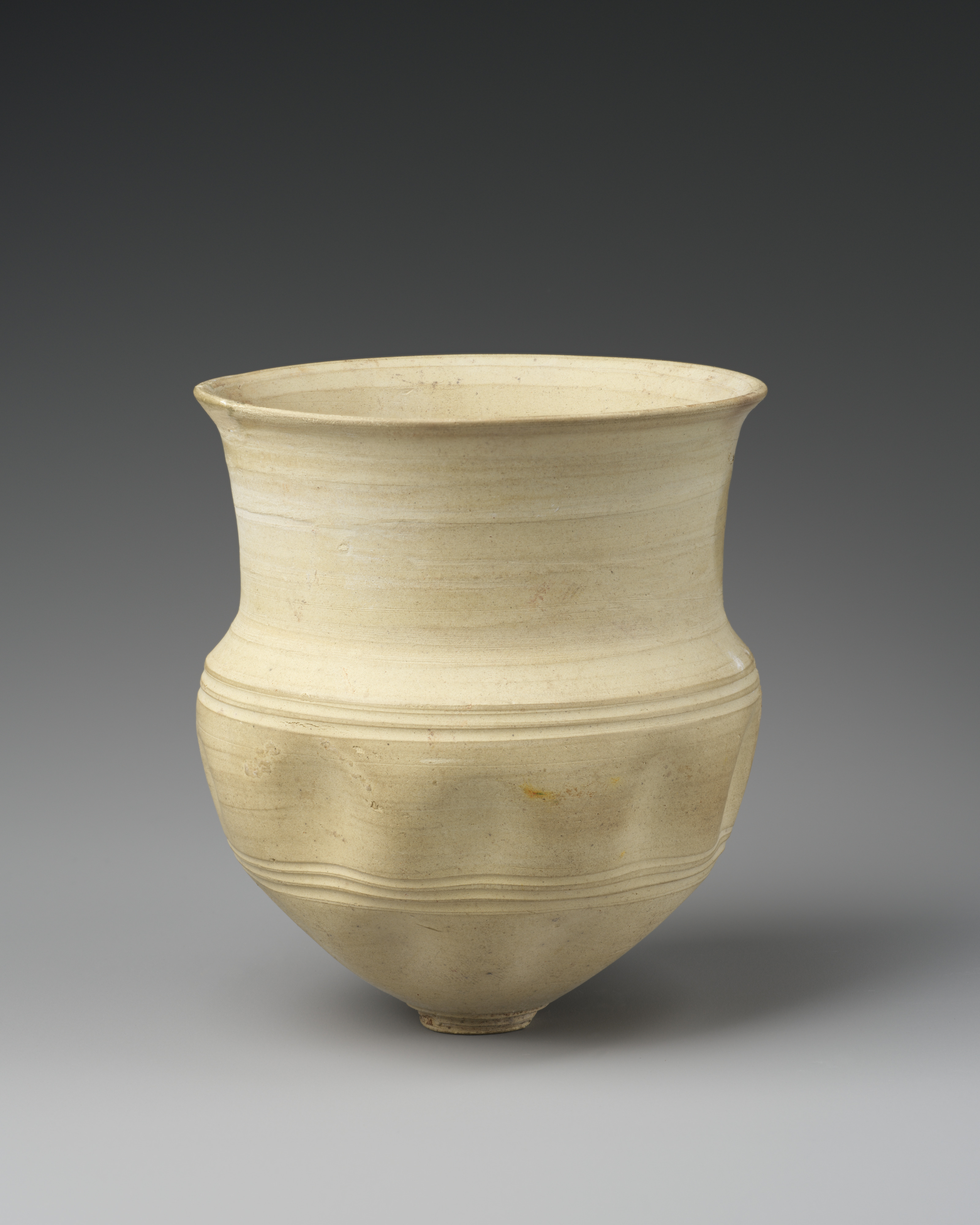
This strategic standalone research paper, prepared for Katherine Fashion Lab's Heritage Innovation Division, analyzes an 8th-7th century BCE Assyrian Palace Ware beaker. Moving beyond mere archaeological artifact, this analysis positions the beaker as a foundational narrative and aesthetic framework for a 2026 high-end luxury strategy. We deconstruct its inherent language of symbolic power, elite adornment, and spiritual meaning to propose a blueprint for a collection that translates ancient imperial authority into contemporary, resonant luxury. The objective is to leverage this deep heritage not for replication, but for the creation of a modern "palace ware"—objects and garments that command space and identity with the same calibrated potency as their Assyrian antecedent.
Historical Context: The Object as an Instrument of Empire
Assyrian Palace Ware, originating from the heartlands of modern-day Iraq, represents the zenith of Neo-Assyrian ceramic production. Unlike utilitarian pottery, these vessels—particularly the elegant, thin-walled beakers—were manufactured for the royal court and administrative elite. Their very existence was an act of symbolic power. The technical mastery required for their production (exceptionally fine clay, precise firing) was a state-controlled secret, a direct manifestation of imperial capability. Distribution was restricted, making physical possession of such a beaker an unequivocal signifier of proximity to the king. It was less a drinking vessel and more a certificate of membership within the most powerful hierarchy on earth. For Katherine Fashion Lab, this establishes a core strategic principle: luxury as controlled access and technological sovereignty.
Adornment of the Elite: The Body and the Vessel
The adornment principles of the Assyrian court were meticulously codified, focusing on the display of wealth, power, and divine favor. While the beaker itself is often undecorated, relying on its flawless form and lustrous cream-slip finish, it existed within a total aesthetic system. This system featured intricate textiles, elaborate fringed garments, voluminous beards, and heavy jewelry—all engineered to convey immovable authority. The beaker, held in the hand, became an extension of this adorned body. Its simplicity amidst opulence is a critical insight: true power can reside in refined understatement, in the confidence of an unadorned, perfect form. For our 2026 strategy, this suggests a collection that operates on two levels: bold, symbolic statement pieces (akin to royal regalia) and foundational items of impeccable, silent luxury (the Palace Ware itself), where cut, drape, and material integrity speak louder than ornament.
Deconstructing Symbolic and Spiritual Meaning
The symbolic power of the Palace Ware beaker is multifaceted. First, its verticality—the soaring, slightly tapered form—mirrors the ziggurat and the hierarchical structure of Assyrian society. It directs the gaze upward, a physical metaphor for aspiration and order. Second, its fragility and strength are held in perfect tension; the walls are perilously thin yet fired to durability, mirroring the delicate balance of an empire maintained through overwhelming force and sophisticated administration.
Spiritually, the act of consuming from such a vessel was likely imbued with meaning. In a culture where the king was the chief intermediary with the gods, a feast using palace ware was a ritual reinforcing cosmic and earthly order. The beaker was a conduit, transforming wine (a luxury good) into a substance that sustained the divinely ordained social fabric. This translates to a modern luxury strategy centered on ritual and transformation. Garments and objects should not merely be worn or used; they should facilitate a transition into a more empowered, intentional state of being—the modern equivalent of assuming one's place in the court.
Strategic Application: The 2026 High-End Luxury Blueprint
For Katherine Fashion Lab's 2026 collections, the Assyrian Palace Ware beaker provides a non-Western, deeply authoritative heritage pillar. The strategy moves from historical analysis to contemporary application across four pillars.
Pillar 1: The Aesthetic of Sovereign Geometry
Direct formal inspiration will be disciplined and architectural. Silhouettes will emphasize strong, vertical lines, sharp shoulders (echoing royal mantles), and tapered, columnar forms. Draping will be structured, not fluid, creating a sense of immutable presence. The color palette will be rooted in the beaker's essence: mineral whites, cream slips, terracotta, and glaze-like blacks and blues, punctuated by the lapis lazuli and gold accents of Assyrian jewelry.
Pillar 2: Material Innovation as Imperial Technology
We will reinterpret the Assyrian mastery of clay through advanced material science. This includes developing proprietary textiles with a ceramic-coated lustre or a thin, crackle-glaze finish on leather. Metals will be treated to possess a oxidized, archaeological patina, while featherweight wools and technical silks will mirror the beaker's paradox of delicacy and strength. Each material must tell a story of innovation and exclusivity.
Pillar 3: Narrative of Restricted Access & Ritual
The marketing narrative will consciously mirror the beaker's context. Collections will be presented as "The Palace Ware Edit." Launch events will be immersive, ritualistic experiences, not mere shows. Product distribution will be severely limited, with key pieces available only through appointment or in flagship "court" locations. The story sold is not of fashion, but of initiation into a legacy of power.
Pillar 4: Symbolic Motifs & Modern Totems
Abstracted motifs from Assyrian art—the Tree of Life, the stylized lotus, cuneiform-inspired patterns—will be embedded as jacquards, embossments, or fine jewelry. The beaker form itself will be reified into modern totems: sculptural handbags, minimalist fragrance flacons, and uncompromising footwear shapes. These are not logos, but heritage sigils for the cognoscenti.
Conclusion: Building a Modern Dynasty
The Assyrian Palace Ware beaker offers Katherine Fashion Lab a profound and untapped heritage code. It provides a complete system encompassing aesthetic rigor, symbolic depth, and a psychology of elite belonging. By strategically decoding its language of symbolic power, historical adornment, and spiritual meaning, we can construct a 2026 luxury strategy that transcends seasonal trends. The goal is to establish a new house code—one that, like the Assyrian empire at its height, is instantly recognizable, awe-inspiring in its execution, and built for enduring influence. We are not referencing history; we are reactivating its most potent principles for a contemporary court.