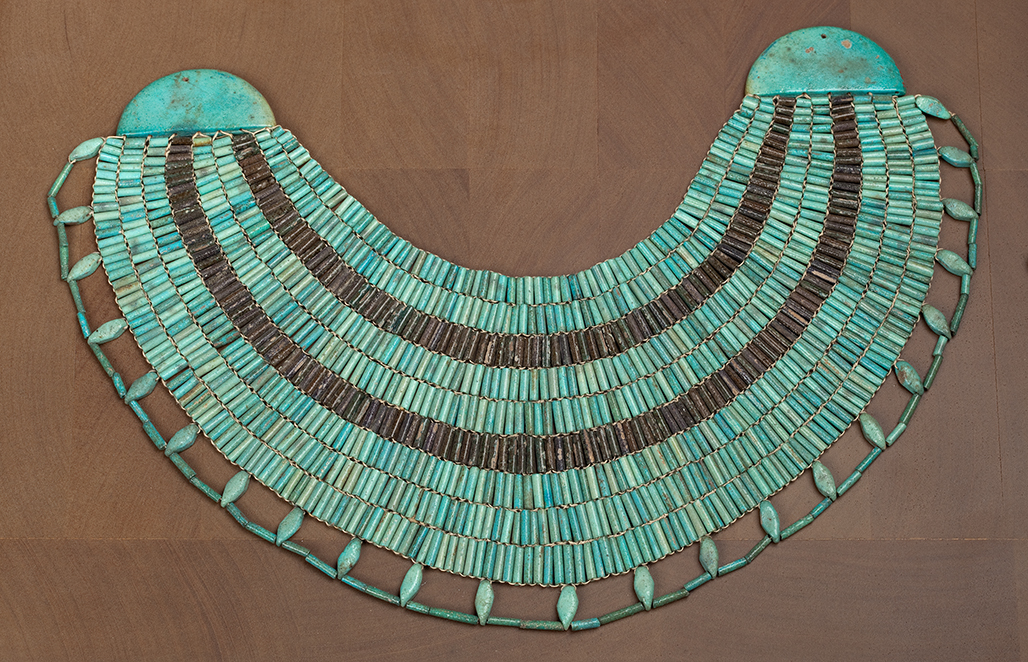
Heritage Analysis: The Model Broad Collar of Hapiankhtifi
As Lead Heritage Curator for Katherine Fashion Lab, I present a strategic research paper on the Model Broad Collar of Hapiankhtifi, an artifact from ancient Egyptian civilization, crafted from faience in blue-green and black. This analysis examines its symbolic power, historical adornment, spiritual meaning, and implications for a 2026 high-end luxury strategy. The collar, dating to the Middle Kingdom (circa 2050–1650 BCE), serves as a profound case study in the intersection of material culture, status, and transcendence—offering actionable insights for contemporary luxury branding.
Symbolic Power: The Collar as a Microcosm of Authority
Materiality and Color Symbolism
The choice of faience—a sintered quartz ceramic—was deliberate in ancient Egyptian society. Blue-green, derived from copper oxides, symbolized rebirth, fertility, and the Nile’s life-giving waters. Black, often associated with the fertile silt of the Nile floodplain, represented regeneration and the underworld. Together, these colors created a visual language of cosmic balance. The broad collar, known as wesekh, was not merely decorative; it was a symbol of divine protection and royal authority. For Hapiankhtifi, a provincial governor, the collar signified his role as an intermediary between the gods and the people, reinforcing his earthly power through celestial associations.
Hierarchy and Social Signaling
In ancient Egyptian society, adornment was a direct indicator of rank. The broad collar’s size and complexity—often comprising multiple rows of beads—communicated wealth, status, and access to rare materials. Faience, while not as precious as gold or lapis lazuli, was a sophisticated medium that mimicked these luxury goods. For Hapiankhtifi, wearing such a collar in life and placing it in his tomb as a model ensured his status persisted into the afterlife. This dual function—earthly prestige and spiritual insurance—underscores the collar’s role as a strategic tool for social stratification.
Historical Adornment: Craftsmanship and Cultural Context
Techniques of Faience Production
The production of faience required advanced kiln technology and precise control of glazing. Artisans applied a mixture of quartz, alkali salts, and colorants, then fired it to create a glassy surface. The blue-green and black palette demanded meticulous craftsmanship, as each bead had to be individually shaped and glazed. This labor-intensive process elevated the collar from mere ornament to a symbol of technological mastery. For Katherine Fashion Lab, this echoes the value of artisanal heritage in modern luxury—where handcrafted details signal authenticity and exclusivity.
Adornment in Daily and Ritual Life
Broad collars were worn during festivals, religious ceremonies, and funerary rites. They were often paired with a counterpoise to balance the weight, demonstrating an understanding of ergonomics and aesthetics. The model collar of Hapiankhtifi, found in his tomb at Meir, was likely a miniaturized version of a full-scale piece, intended for eternal use. This practice highlights the ancient belief that adornment transcended mortality—a concept that resonates with luxury’s enduring appeal as a marker of legacy.
Spiritual Meaning: The Collar as a Conduit to the Divine
Protective and Funerary Functions
In Egyptian cosmology, the broad collar was imbued with apotropaic properties. The blue-green color was linked to the god Osiris, lord of the underworld, and the goddess Hathor, patron of beauty and joy. Black, meanwhile, evoked the primordial chaos from which creation emerged. Worn in life, the collar warded off evil; in death, it guided the soul through the Duat (underworld). For Hapiankhtifi, the model collar was a spiritual anchor, ensuring his ba (soul) could reunite with his ka (life force) in the afterlife.
Ritualistic Symbolism in Adornment
The collar’s design often incorporated motifs of lotus petals, falcons, and scarabs, each with specific meanings. The lotus represented rebirth, the falcon symbolized Horus (divine kingship), and the scarab embodied transformation. These elements were not random; they formed a visual prayer for protection and immortality. For modern luxury, this integration of narrative and symbol offers a blueprint for creating pieces that transcend fashion—becoming talismans of identity and aspiration.
2026 High-End Luxury Strategy: Translating Heritage into Modern Relevance
Resonance with Contemporary Values
The Model Broad Collar of Hapiankhtifi aligns with three key trends in 2026 luxury: sustainability, storytelling, and spiritual wellness. Faience’s natural materials and handcrafted process mirror the shift toward eco-conscious production. The collar’s narrative of protection and legacy appeals to consumers seeking meaning beyond materiality. Katherine Fashion Lab can leverage this by developing a capsule collection that reimagines the broad collar’s form and symbolism using modern materials like recycled ceramics or lab-grown gemstones, while retaining the original color palette of blue-green and black.
Strategic Design and Brand Positioning
To capitalize on this heritage, I recommend a three-tiered approach:
- Heritage-Inspired Statement Pieces: Create limited-edition broad collars using artisanal techniques, positioning them as investment pieces. Each collar should include a digital provenance certificate detailing its ancient inspiration and modern craftsmanship.
- Spiritual Wellness Integration: Collaborate with contemporary artisans to produce smaller, wearable versions that double as meditative objects. Marketing can emphasize the collar’s protective symbolism, appealing to the growing demand for mindful luxury.
- Exclusive Narrative Campaigns: Launch a campaign titled “The Eternal Adornment,” featuring immersive storytelling that connects the collar’s history to modern themes of resilience and self-expression. Use augmented reality to let customers “unlock” the collar’s spiritual meanings through their smartphones.
Market Positioning and Exclusivity
Pricing should reflect the collar’s status as a cultural artifact reimagined. A starting price point of $5,000 for small-scale versions and $25,000 for full replicas aligns with high-net-worth consumers seeking distinctiveness. Distribution should be limited to flagship stores and exclusive online drops, creating scarcity and desirability. Partnerships with museums, such as the Metropolitan Museum of Art or the British Museum, can lend authenticity and elevate brand credibility.
Conclusion: The Collar as a Luxury Archetype
The Model Broad Collar of Hapiankhtifi is more than an ancient artifact; it is a blueprint for timeless luxury. Its symbolic power, historical craftsmanship, and spiritual depth offer Katherine Fashion Lab a unique opportunity to bridge past and future. By translating this heritage into a 2026 strategy, the brand can position itself as a curator of meaning, not just a purveyor of fashion. The collar’s legacy—of protecting, elevating, and transcending—becomes a metaphor for luxury’s ultimate promise: to transform the material into the eternal.