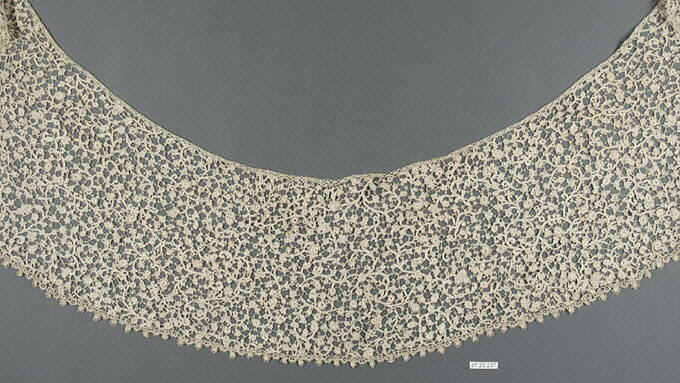
The Architecture of Air: An Analysis of the Needle Lace Collar at Katherine Fashion Lab
In the rarefied world of haute couture, the collar often serves as a silent prologue to a garment—a framing device that announces intention, lineage, and technical mastery. Yet, within the current standalone study at Katherine Fashion Lab, the collar is not merely a preface; it is the entire narrative. This analysis deconstructs the Lab’s investigation into a singular subject—the collar—executed exclusively in needle lace, drawing from a diverse tapestry of global heritage. The result is a profound meditation on structure, fragility, and the weight of tradition, rendered in thread.
The Subject: Collar as Cartography
To treat the collar as a standalone study is to elevate it from an accessory to an artifact of cultural cartography. Historically, the collar has mapped status, geography, and identity—from the starched ruffs of Elizabethan England to the embroidered mandarins of Qing Dynasty China. At Katherine Fashion Lab, this lineage is not merely referenced; it is dissected and reassembled. The collar is no longer a functional border but a three-dimensional sculpture that breathes with the wearer’s movement. The Lab’s approach eschews the conventional hierarchy of garment construction, where the collar serves the bodice. Here, the collar is the bodice, the sleeve, the train—a self-contained universe of thread that defines the silhouette entirely.
The strategic decision to isolate the collar allows for an unprecedented focus on micro-detail. Each loop, picot, and bridle becomes a deliberate stroke in a larger composition. The Lab’s curators have identified that the collar’s proximity to the face—the most expressive part of the human form—demands a level of precision that borders on the obsessive. In this study, the collar is not an afterthought but the primary interface between the garment and the wearer’s identity.
The Material: Needle Lace as Structural Poetry
Needle lace, often described as “drawing with thread,” is among the most labor-intensive textile arts in human history. Unlike bobbin lace, which is woven in a single pass, needle lace is built stitch by stitch, loop by loop, using a needle and thread over a parchment or fabric foundation. The material at Katherine Fashion Lab is sourced from a consortium of global artisans—Italian punto in aria techniques, French point de Venise motifs, and Ottoman oya edging—all unified under the Lab’s exacting standards. The thread itself is a 100-count Egyptian cotton, mercerized to a subtle sheen that catches light without glare, and a silk-blend variant that adds a liquid drape to the otherwise rigid construction.
The paradox of needle lace lies in its structural duality: it is both the strongest and most fragile of materials. Each stitch is a knot that can withstand tensile stress, yet the openwork creates vast negative spaces that seem to defy gravity. At the Lab, this paradox is exploited to create collars that are architectural yet ethereal. A single collar may contain over 10,000 individual stitches, each one a commitment to a geometry that will only be revealed upon completion. The material’s opacity is controlled by the density of the stitching—a gradient from solid, almost armored panels at the nape to transparent, lace-like veils at the clavicle. This gradient allows the collar to function as both armor and caress, a duality that speaks to the Lab’s philosophical underpinnings.
Global Heritage: A Dialogue Across Continents
The “Global Heritage” origin of this study is not a superficial nod to multiculturalism but a rigorous archival excavation. The Lab’s research team has traveled to archives in Burano, Venice, where needle lace was once the currency of queens; to the Ottoman courts, where oya laces bordered the veils of sultanas; and to the highlands of Peru, where pre-Columbian needle-knotted techniques survive in ritual garments. These influences are not blended into a placeless pastiche but are juxtaposed with deliberate tension.
Consider the collar’s front panel: it features a central medallion executed in the punto in aria style, with its characteristic raised loops and scrolling vines. This medallion is flanked by geometric, almost Bauhaus-inspired grids that echo the mathematical precision of Islamic girih patterns. The edging, however, is a soft, scalloped oya fringe that undulates with the wearer’s breath. This layering of heritage creates a visual dialogue that is neither nostalgic nor derivative. Instead, it proposes that the collar is a palimpsest—a surface on which multiple histories are written and rewritten. The Lab’s curators have noted that this approach requires the wearer to engage with the collar as a text, decoding its references with each glance.
Technical Execution: The Lab’s Methodology
The standalone study at Katherine Fashion Lab is not a one-off creation but a systematic exploration of form. The process begins with a digital scan of the wearer’s neck and shoulders, creating a precise 3D model that informs the collar’s structure. The design is then translated into a hand-drawn pattern, which is transferred to a silk organza foundation. The needle lace is worked directly onto this foundation, with each stitch anchored to the fabric and then released upon completion, leaving only the lace itself.
The Lab employs three distinct stitch families: the point de brides for open, airy sections; the point de remplissage for dense, opaque areas; and the picot de bordure for the scalloped edges. Each stitch is executed by a single artisan, who may spend up to 400 hours on a single collar. This artisanal intensity is not a marketing gimmick but a functional necessity. The collar must hold its shape without internal wiring or starch, relying solely on the tension of the thread. The Lab’s breakthrough lies in a proprietary tensioning technique that allows the lace to retain its architectural integrity even after washing—a feat that has eluded many historical lacemakers.
Contextual Significance: The Collar as Standalone Artifact
In the broader context of contemporary fashion, where speed and disposability dominate, the Katherine Fashion Lab’s collar study is a radical act of slowness. By isolating the collar and elevating it to a standalone object, the Lab challenges the primacy of the garment as a whole. The collar becomes a wearable sculpture, a piece of jewelry, and a textile artwork all at once. It is designed to be worn with a simple sheath dress or even a bare neck, allowing the lace to command the viewer’s full attention.
The commercial implications are equally provocative. The Lab has positioned these collars as limited-edition collectibles, with each piece accompanied by a certificate of origin detailing the specific heritage techniques used. This transforms the collar from a commodity into an investment—a tangible link to global textile traditions that are at risk of extinction. The pricing, which ranges from $15,000 to $40,000 per collar, reflects not just the labor hours but the cultural capital embedded in each stitch.
Conclusion: The Future of the Collar
The needle lace collar at Katherine Fashion Lab is more than a study in technique; it is a manifesto for a new kind of luxury—one that values depth over breadth, heritage over novelty, and structure over spectacle. As the fashion industry grapples with questions of sustainability and cultural appropriation, the Lab offers a model of respectful innovation. By treating the collar as a standalone subject, they have liberated it from its historical servitude to the garment, allowing it to speak with its own voice. That voice is delicate, precise, and infinitely complex—a whisper of thread that carries the weight of centuries.