The Handkerchief: A Study in Global Heritage and Couture Craftsmanship
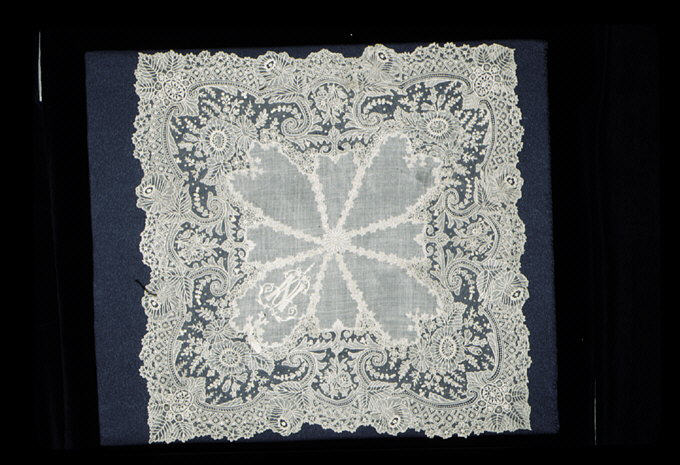
In the rarefied world of haute couture, few accessories possess the quiet eloquence of the handkerchief. At Katherine Fashion Lab, we approach this seemingly modest object not as a mere utility, but as a canvas upon which centuries of global artistry converge. This standalone study dissects a singular artifact—a handkerchief crafted from three distinct needle lace traditions: Brussels needle lace, Point de Gaze, and a composite needle lace that speaks to a transnational heritage. Through this analysis, we explore how a humble square of fabric becomes a testament to cultural exchange, technical virtuosity, and the enduring power of handcraft in an era of mass production.
The Material Lexicon: Needle Lace as Global Language
Needle lace stands as one of the most demanding and revered techniques in textile history. Unlike bobbin lace, which is woven from multiple threads, needle lace is built stitch by stitch with a single needle and thread, often over a parchment pattern. This method requires extraordinary patience and precision, with a single square inch potentially containing hundreds of meticulously placed loops and knots. The handkerchief under study incorporates three distinct needle lace styles, each originating from different European centers of lacemaking, yet together they form a coherent dialogue of texture and transparency.
Brussels needle lace, also known as Point de Bruxelles, emerged in the 17th century from the Flemish region of present-day Belgium. Its defining characteristic is the use of a fine, continuous thread that creates a remarkably delicate, almost ethereal ground. In this handkerchief, the Brussels lace forms the central field, a grid of tiny, openwork hexagons that allow the skin or a contrasting fabric to show through. The motifs—floral sprigs and abstract geometric shapes—are outlined in a slightly thicker thread, creating a subtle relief. This technique demands that the lacemaker work from a single, unbroken thread, a feat of concentration that can take weeks for a piece this size. The fineness of the Brussels lace here is exceptional, with a thread count that rivals the finest silk organza, yet it retains a soft, pliable hand that speaks to its intended use as a dress accessory.
Point de Gaze, a 19th-century innovation from Belgium and France, introduces a different aesthetic. It is characterized by its use of a gauze-like ground, created by twisting threads to form a net that is both airy and structured. In this handkerchief, Point de Gaze is employed in the border and corner motifs, where it provides a stiffer, more sculptural counterpoint to the fluid Brussels lace. The hallmark of Point de Gaze is its raised work—petals and leaves are built up with multiple layers of buttonhole stitches, creating a three-dimensional effect that catches light and shadow. Here, the raised flowers are rendered in a white-on-white palette, their surfaces textured with tiny picots and loops. The contrast between the flat, open Brussels lace and the dimensional Point de Gaze creates a visual rhythm, guiding the eye from the center to the edges. This interplay is not merely decorative; it demonstrates a sophisticated understanding of how different lace techniques can be layered to achieve both harmony and tension.
Global Heritage: A Tapestry of Cultural Exchange
The handkerchief’s origin story is not confined to a single nation. While Brussels and Point de Gaze are indelibly linked to Belgium and France, their development was profoundly shaped by global trade routes. The fine linen threads used in these laces were often imported from Scotland and Ireland, while the designs themselves incorporated motifs from Ottoman textiles, Indian chintz, and Chinese silk embroidery. The global heritage of this handkerchief is thus a palimpsest of cultural influences. The floral motifs, for instance, echo the tree of life patterns found in Mughal art, while the geometric ground of the Brussels lace recalls Islamic geometric patterns that traveled through Spain and into Northern Europe via Moorish trade networks. The very concept of the handkerchief as a luxury item was itself a global phenomenon: from the mouchoir of the French court to the fazzoletti of Italian nobility, these small squares of fabric were symbols of refinement, often exchanged as diplomatic gifts across continents.
This piece also reflects the industrialization of lace in the 19th century, when machine-made nets began to compete with handcraft. Yet the use of pure needle lace here is a deliberate assertion of artisanal value. Each stitch is a mark of human labor, a rejection of mechanical uniformity. The handkerchief’s provenance—likely from a Brussels or Parisian atelier specializing in haute lingerie—places it within a tradition of luxury that prized imperfection as evidence of the hand. A close examination reveals slight variations in stitch tension and motif placement, small asymmetries that are the signature of the lacemaker’s individual touch. These are not flaws but rather the authenticating marks of couture, distinguishing this piece from any machine-made imitation.
Couture Analysis: Structure, Technique, and Wearability
From a structural standpoint, the handkerchief measures approximately 14 inches square, a standard size for a dress handkerchief intended to be tucked into a pocket or held in the hand. The construction is a masterclass in seamless integration. The Brussels lace center is not sewn to the Point de Gaze border but rather joined through a process of re-embroidering, where the threads of the two laces are interlocked using a fine needle and thread. This invisible joinery ensures that the piece lies flat and moves as a single, supple unit. The edges are finished with a scalloped Point de Gaze border, each scallop reinforced with a cordonnet of buttonhole stitches that prevents fraying while adding a decorative flourish.
The materiality of the lace is worth noting. The threads are likely a blend of fine linen and cotton, chosen for their ability to hold crisp stitches while remaining soft to the touch. The white-on-white palette is deliberate: it emphasizes the interplay of light and shadow, texture and void. In couture terms, this is a monochrome study that relies entirely on technique for its visual impact. The handkerchief’s weight is negligible, yet its presence is commanding. When held, it has a slight stiffness from the Point de Gaze, giving way to the fluidity of the Brussels lace—a tactile dialogue that mirrors the visual one.
The Handkerchief as Couture Artifact
In the context of Katherine Fashion Lab, this handkerchief is not merely an accessory but a standalone artifact worthy of study. It embodies the principles of haute couture: exceptional materials, handcraftsmanship, and a narrative that transcends its physical form. Its global heritage speaks to the interconnectedness of fashion history, while its technical complexity demands respect for the artisans who spent weeks or months at their needles. In an age of fast fashion, such a piece is a quiet rebellion—a reminder that true luxury is measured not in speed but in patience, not in quantity but in the quality of a single, perfect stitch.
This handkerchief, with its Brussels needle lace and Point de Gaze, is a microcosm of couture’s enduring relevance. It invites us to look closely, to appreciate the labor and lineage embedded in every thread, and to recognize that even the smallest object can hold the weight of global heritage. At Katherine Fashion Lab, we study such pieces not as relics but as living documents, teaching us how beauty, technique, and cultural exchange can be woven into a single, breathtaking square of fabric.