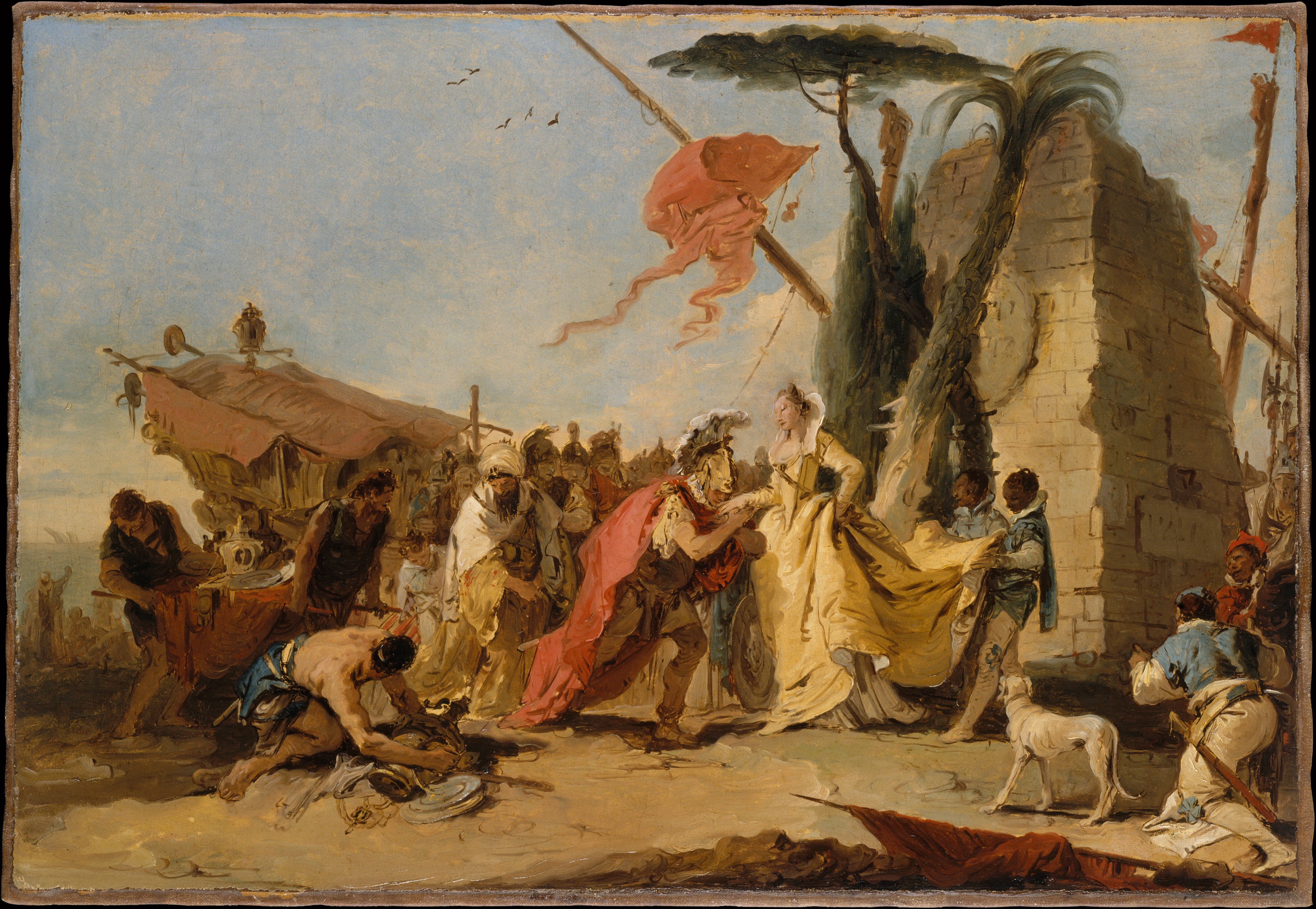
The Meeting of Antony and Cleopatra: A Couture Analysis
In the annals of fashion history, few narratives possess the dramatic tension, opulent grandeur, and tragic romance of the encounter between Mark Antony and Cleopatra VII. At Katherine Fashion Lab, we approach this legendary meeting not merely as a historical event but as a profound wellspring of aesthetic inspiration. Our latest standalone study, rendered in the medium of oil on canvas, delves into the visual and symbolic language of power, seduction, and cultural fusion that defined this pivotal moment. This analysis deconstructs how the Global Heritage of the Ptolemaic and Roman empires converges into a singular, transcendent couture statement.
The Canvas as a Couture Document
The oil-on-canvas medium serves as an exquisite analog for haute couture itself. Each brushstroke is a stitch, every pigment a fabric choice. In our study, the canvas becomes a living garment—a narrative woven with layers of meaning. The texture of the oil paint mimics the weight of silk, the sheen of gold thread, and the matte finish of linen, inviting the viewer to experience the tactile richness of ancient textiles. This is not a passive illustration; it is a couture document that captures the ephemeral nature of a single, world-altering glance.
Color Palette: The Language of Sovereignty
The palette of this work is a masterclass in strategic chromatic storytelling. Dominant tones of deep Tyrian purple, sourced from the murex snail, immediately signal Cleopatra’s divine right and Ptolemaic lineage. This hue, more expensive than gold, is juxtaposed against the stark, disciplined red of Roman military cloaks—a crimson that speaks of conquest and martial honor. The interplay is deliberate: purple seduces, red commands. Yet, the canvas introduces a third element—a shimmering gold leaf halo around Cleopatra’s silhouette, referencing the Hellenistic tradition of deifying rulers. This gold is not mere ornament; it is a declaration of her status as Isis incarnate, a living goddess whose presence outshines Antony’s temporal power.
Silhouette and Structure: East Meets West
The couture analysis hinges on the juxtaposition of silhouettes. Cleopatra’s form is draped in a chiton-inspired gown, its fabric falling in soft, asymmetrical folds that evoke the Nile’s fluidity. The garment is cinched with a kestos himas—a sacred belt—embroidered with lapis lazuli and carnelian beads, each stone a talisman of protection and fertility. In contrast, Antony’s attire is rigid, architectural: a lorica musculata (muscle cuirass) over a woolen tunic, its lines severe and unyielding. The tension between these silhouettes—fluid versus fixed, organic versus engineered—mirrors the cultural collision. The canvas captures the moment when Antony’s Roman discipline begins to soften, his posture subtly inclining toward Cleopatra’s realm. This is couture as diplomacy: the fabric of empire bending to the thread of desire.
Textile Narratives: The Silk Road in a Single Frame
Global Heritage is not a passive backdrop but an active participant in this composition. The canvas incorporates motifs from three continents: Egyptian lotus blossoms, Greek meander patterns, and Persian palmette borders. These are not random decorations; they are textile cartographies. The sheer, translucent silk of Cleopatra’s veil—imported from Han Dynasty China via the Silk Road—is rendered with translucent glazes, allowing the viewer to glimpse the gold-threaded underskirt. This veil is a metaphor for the layered identities of the queen: Greek in intellect, Egyptian in ritual, and global in ambition. Antony’s cloak, conversely, is woven from Gallic wool, dyed with Roman madder root, and fastened with a Celtic brooch. Each fiber tells a story of conquest and assimilation, of power borrowed and transformed.
Accessories as Political Statements
In haute couture, accessories are never afterthoughts. They are punctuation marks in the sentence of a garment. Cleopatra’s broad collar (wesekh) is a masterpiece of symbolic engineering. Composed of gold, turquoise, and faience, it replicates the falcon wings of Horus, affirming her divine protection. Yet, nestled within its center is a single Roman aureus coin—a subtle, audacious claim that she holds Rome’s wealth in her orbit. Antony’s signet ring, engraved with a she-wolf suckling Romulus and Remus, is worn on his right hand, but his left hand rests on the hilt of a Greek xiphos sword. This asymmetry signals his internal conflict: the Roman patriarch versus the Hellenistic lover. The canvas freezes this accessory-laden tension, inviting the viewer to decode the political semiotics of adornment.
The Gaze: The Invisible Garment
Perhaps the most potent couture element in this study is the unseen: the gaze. Cleopatra’s eyes, painted with kohl and highlighted with malachite, are not merely looking at Antony; they are draping him in her narrative. Her stare is a fabric woven from confidence, cunning, and vulnerability—a garment no tailor could cut. Antony’s response is equally telling: his pupils are slightly dilated, his brow relaxed, as if her gaze has already begun to reshape his armor-clad identity. In couture terms, this is the intangible weave—the energy that transforms fabric into fetish, history into myth. The canvas captures the moment when two global powers meet not on a battlefield but in a single, charged glance, and the result is a new textile of destiny.
Conclusion: The Standalone Study as a Blueprint for Modern Couture
This oil-on-canvas analysis of The Meeting of Antony and Cleopatra is not a relic of the past. It is a blueprint for contemporary couture that respects heritage while embracing transformation. At Katherine Fashion Lab, we see in this meeting the eternal dance of form and fluidity, power and passion, East and West. The canvas teaches us that true luxury is not in the material alone but in the story it tells—the silken thread of history that binds us all. As we translate these visual lessons into wearable art, we honor the Global Heritage that clothes every civilization in its unique, irreplaceable narrative. The meeting of Antony and Cleopatra is, in the end, a meeting of every garment’s soul: the moment when fabric becomes fate.