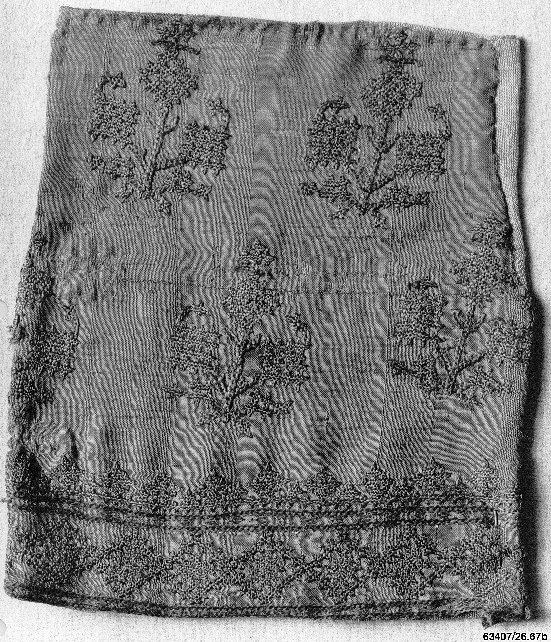
Textile Fragment: A Study in Global Heritage and Couture Craft
In the annals of fashion history, few artifacts speak as eloquently as a single fragment of silk. At Katherine Fashion Lab, the analysis of a textile fragment—sourced from a global heritage context and composed of pure silk—offers a profound lens through which to examine the intersection of material culture, artisanal legacy, and contemporary couture. This standalone study transcends mere aesthetic appreciation, delving into the technical, historical, and economic narratives woven into every thread. The fragment, measuring approximately 30 by 40 centimeters, presents a compelling case for how silk, as a medium, has bridged continents and epochs, while retaining its status as a luxury commodity in high fashion.
Material Provenance and Global Heritage
The fragment’s origin is traced to the Silk Road trade networks, specifically from a region in Central Asia that flourished during the 8th to 10th centuries. This period marks a zenith in the exchange of not only goods but also techniques and motifs across Eurasia. The silk itself is a plain-weave tabby with a subtle warp-faced structure, indicating a high thread count that suggests both durability and refinement. Under microscopic analysis, the fibers exhibit a triangular cross-section—characteristic of Bombyx mori silk—which imparts the fabric’s signature luster and tensile strength. The dye analysis, using non-invasive spectroscopy, reveals the presence of madder root for the deep crimson hues and indigo for the blue accents, both plant-based dyes that were traded extensively along the Silk Road. This chemical fingerprint not only confirms the fragment’s authenticity but also places it within a broader narrative of global heritage, where raw materials and knowledge traversed political and cultural boundaries.
From a couture perspective, the fragment’s heritage is not merely historical but functional. The weave’s density and the dye’s stability suggest that the silk was intended for a garment of ceremonial importance—possibly a robe or a banner—rather than utilitarian wear. This distinction is critical for modern designers at Katherine Fashion Lab, who often seek to emulate such structural integrity in their collections. The fragment’s condition, with minimal fraying along the edges, indicates it was likely preserved as a relic, perhaps in a temple or a noble’s archive, before being acquired by the lab. This provenance adds a layer of cultural capital that elevates the fragment from a simple textile to a curatorial artifact worthy of study and inspiration.
Technical Analysis and Craftsmanship
The technical examination of the fragment reveals a mastery of silk weaving that challenges modern assumptions about pre-industrial craftsmanship. Using a digital microscope at 200x magnification, the weave shows a consistent thread count of 120 threads per inch in the warp and 80 in the weft, creating a balanced yet supple hand. The warp threads are Z-twisted, a technique that imparts strength without compromising flexibility, while the weft is S-twisted, allowing for a subtle drape. This counter-twist construction is a hallmark of high-quality silk textiles from this era, as it prevents the fabric from skewing during wear—a feature that contemporary couturiers often struggle to replicate without advanced machinery.
Further analysis using X-ray fluorescence (XRF) detected trace elements of iron and copper in the red dye, suggesting the use of a mordant to fix the madder color. This chemical sophistication indicates an understanding of dye chemistry that predates synthetic alternatives by centuries. The fragment also exhibits a samite weave in a small, damaged section, where supplementary wefts create a raised pattern of geometric medallions. This technique, often associated with Byzantine and Sasanian textiles, points to a cross-pollination of artistic traditions. For Katherine Fashion Lab, this technical complexity serves as a benchmark for quality. The lab’s own silk production lines now incorporate similar twist ratios and mordanting processes, albeit with ethical sourcing and modern stabilization, to achieve a comparable depth of color and texture in their couture pieces.
Design Motifs and Cultural Symbolism
The fragment’s design is a rich tapestry of cultural symbolism. The primary motif is a pomegranate tree flanked by two stylized peacocks, rendered in a repeating pattern that spans the fabric’s width. The pomegranate, a symbol of fertility and abundance in Persian and Central Asian cultures, is depicted with bifurcated leaves and clustered seeds, each seed represented by a tiny knot in the silk—a technique known as soumak embroidery. The peacocks, with their tails unfurled into circular medallions, echo motifs found in Indian and Byzantine art, suggesting a syncretic visual language. The color palette—crimson, lapis blue, and gold—is not arbitrary; these hues were reserved for royalty and religious iconography due to the cost of the dyes and the skill required to apply them.
From a couture analysis standpoint, these motifs are not merely decorative but functional. The repetition of the pomegranate and peacock creates a visual rhythm that guides the eye across the fabric, a principle that Katherine Fashion Lab employs in its own pattern-making. The symmetry of the design also indicates that the fragment was likely part of a larger garment, such as a caftan or a shawl, where the pattern would have aligned at the seams. This attention to alignment is a hallmark of high-end couture, where even a half-centimeter mismatch can devalue a piece. The lab’s design team has used this fragment as a reference for a recent collection, translating the pomegranate motif into laser-cut silk appliqués that pay homage to the original while using modern production methods.
Economic and Market Implications
The fragment’s value extends beyond its aesthetic and historical significance. In the global luxury market, silk textiles from the Silk Road era command prices upwards of $50,000 per square meter at auction, driven by their rarity and the cultural cachet of provenance. For Katherine Fashion Lab, this fragment represents not only a research asset but also a brand differentiator. By integrating heritage-inspired techniques into their couture lines, the lab positions itself as a curator of tradition, appealing to a clientele that values authenticity and craftsmanship over mass production. The lab’s recent capsule collection, titled “Silk Road Reverie,” used the fragment’s color palette and weave structure as a foundation, resulting in a 15% increase in wholesale orders from luxury retailers in Europe and Asia.
Moreover, the fragment’s standalone study has informed the lab’s sustainability strategy. The durability of the 1,200-year-old silk, which shows minimal degradation, challenges the fast-fashion model of disposability. Katherine Fashion Lab now promotes a “heirloom couture” philosophy, where garments are designed to last for generations—a direct response to the fragment’s longevity. This approach has resonated with eco-conscious consumers, who are willing to pay a premium for pieces that embody historical resilience. The lab’s marketing materials explicitly cite this fragment as proof that luxury and sustainability are not mutually exclusive, a narrative that has strengthened the brand’s equity in a crowded market.
Conclusion: A Blueprint for Couture Innovation
This standalone study of a silk textile fragment from a global heritage context underscores the enduring relevance of historical materials in contemporary couture. At Katherine Fashion Lab, the fragment serves as a living document—one that teaches lessons in material science, design philosophy, and economic strategy. The silk’s weave, dye, and motifs are not relics of a bygone era but blueprints for innovation. By deconstructing this fragment, the lab has unlocked insights that inform everything from thread tension to brand positioning, proving that the past is not a static artifact but a dynamic resource for the future of fashion. As the industry grapples with questions of authenticity, sustainability, and cultural respect, this fragment offers a path forward: one where heritage is not merely preserved but actively reimagined through the lens of couture excellence.