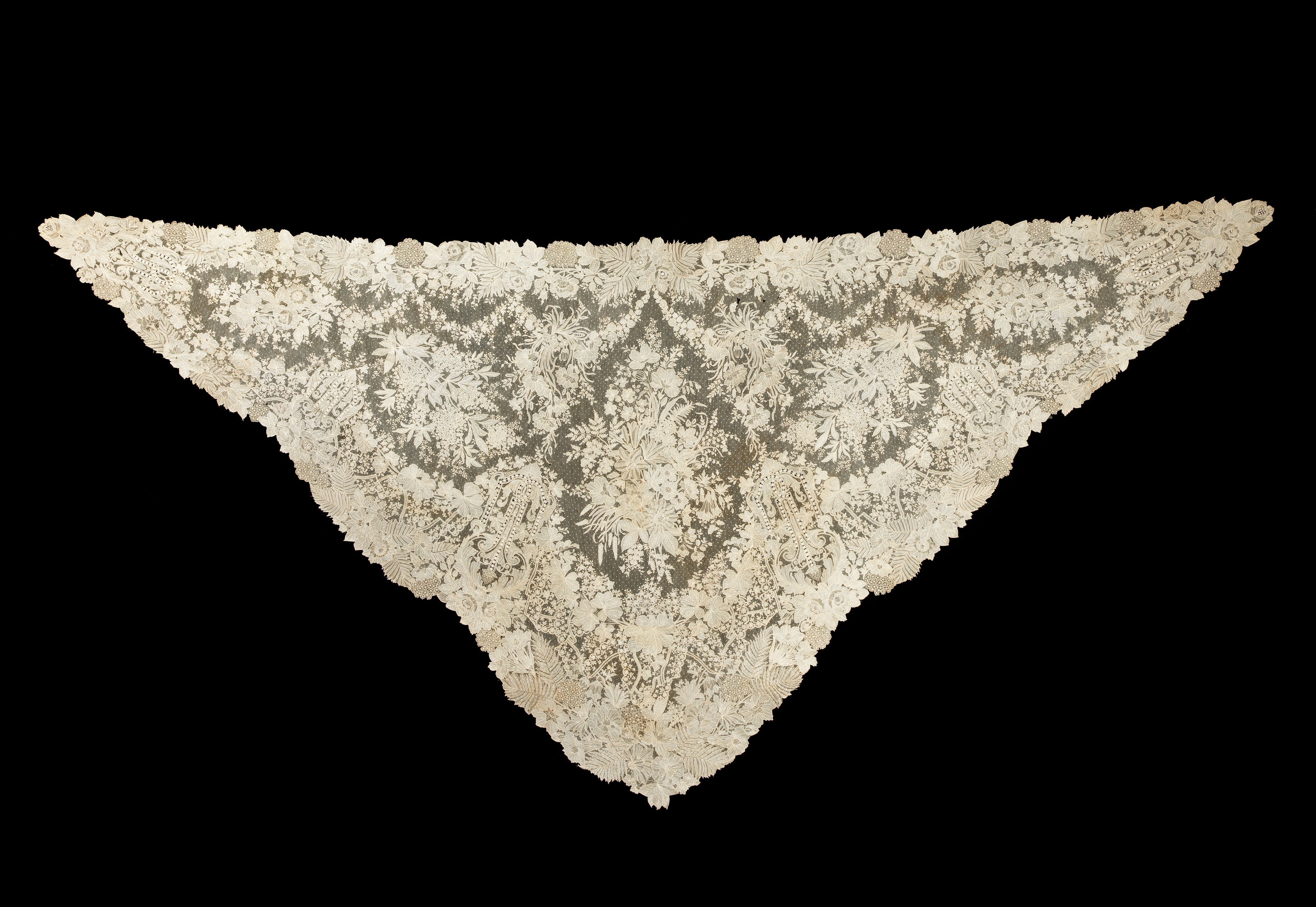
The Belgian Shawl: A Study in Textural Duality and Artisanal Lineage
In the rarefied world of couture, the shawl is often relegated to the periphery—a mere accessory, an afterthought of warmth or modesty. Yet at Katherine Fashion Lab, we recognize the shawl as a canvas of profound narrative potential, particularly when its origins are rooted in the meticulous textile traditions of Belgium. This standalone study examines a singular piece: a shawl born from the interplay of Belgian linen and silk, a garment that transcends its utilitarian function to become a statement of architectural softness and heritage-driven innovation.
The choice of Belgium as the provenance is no accident. The region’s flax—cultivated in the fertile soils of Flanders and Wallonia—is globally revered for its long, strong fibers, yielding linen of exceptional luster and durability. This shawl harnesses that legacy, weaving it with silk to create a dialogue between the rustic and the refined. The result is a fabric that breathes with the earthiness of linen yet drapes with the fluidity of silk, a paradox that demands analysis.
Material Alchemy: Linen and Silk as Counterpoints
The shawl’s primary material, Belgian linen, is a study in controlled asymmetry. Its natural slubs and irregularities are not imperfections but deliberate signatures of artisanal authenticity. Linen’s inherent stiffness—often a challenge in couture—is here recalibrated through a proprietary weaving technique that introduces silk weft threads at strategic intervals. This hybrid construction achieves a tensile strength that allows the shawl to hold sculptural folds while simultaneously offering a whisper-soft hand against the skin.
Silk, sourced from the same Belgian mills that supply haute couture houses, introduces a chromatic depth that linen alone cannot achieve. The interplay of matte and sheen creates a visual rhythm: under direct light, the silk threads catch and scatter luminosity, while the linen absorbs it, producing a chiaroscuro effect. This is not a mere accessory; it is a study in light and shadow, a wearable chiaroscuro that evolves with the wearer’s movement.
The material synergy is further enhanced by a natural dye process—using pigments derived from Belgian madder root and woad—that ensures the shawl’s color palette remains sophisticated yet grounded. The resulting hues, ranging from a muted ecru to a deep, almost charcoal indigo, are neither stark nor faded but exist in a liminal space of muted luxury. This chromatic restraint allows the textile’s texture to command attention, a hallmark of Katherine Fashion Lab’s design philosophy.
Structural Deconstruction: The Shawl as Architectural Volume
Unlike traditional shawls that rely on simple rectangular cuts, this piece employs a trapezoidal silhouette with asymmetric hemline variations. The longer edge, finished with a hand-rolled hem, cascades over the shoulder, while the shorter, raw-edged side invites a deliberate fraying that echoes the unpolished beauty of Belgian linen. This structural choice is not arbitrary; it is a nod to the deconstructivist tendencies of contemporary couture, where the garment’s construction is laid bare as an aesthetic statement.
The shawl’s weight distribution is meticulously calculated. The silk content, concentrated in the central panel, provides a subtle counterbalance to the linen’s heft, ensuring the shawl drapes without pulling or slipping. A hidden internal pleat, invisible to the casual observer, allows the fabric to gather and release in organic waves, mimicking the natural folds of a landscape. This engineering precision elevates the shawl from a simple wrap to a piece of kinetic sculpture.
Functionally, the shawl offers multiple styling permutations: it can be draped asymmetrically for a Grecian-inspired silhouette, folded into a structured stole for formal occasions, or even worn as a head wrap that frames the face with architectural precision. The versatility is not an afterthought but an integral design principle, reflecting the modern couture client’s demand for pieces that adapt to diverse contexts without sacrificing aesthetic integrity.
Cultural and Historical Resonance
Belgium’s textile heritage is deeply entwined with its identity as a crossroads of European trade and craftsmanship. The shawl, as an object, has historically been a marker of status and mobility—from the Paisley shawls of the 19th century to the Art Deco-inspired wraps of the 1920s. This piece recontextualizes that history through a minimalist lens, stripping away ornamentation to reveal the purity of the material and construction.
The choice to forgo embroidery, beading, or any embellishment is deliberate. In an era where couture often equates luxury with excess, this shawl argues for a quieter form of opulence—one rooted in the tactile and visual richness of the fabric itself. It is a meditation on the concept of “slow luxury,” where the value lies not in what is added but in what is refined. The shawl becomes a repository of time: the time of flax growth, the time of silk cultivation, the time of hand-weaving and finishing.
Market Positioning and Curatorial Vision
As the Lead Curator of Katherine Fashion Lab, I position this shawl within the context of a standalone study—a focused exploration of a single garment’s potential to redefine a category. It is not intended for mass production but as a limited-edition piece, available exclusively through private consultations. The target client is the discerning connoisseur who values provenance and craftsmanship over trend cycles, someone who sees a shawl not as a seasonal accessory but as an heirloom.
Pricing reflects the artisanal labor involved: the hand-weaving alone requires over 40 hours, with an additional 15 hours for finishing and quality control. The cost of Belgian linen and silk, coupled with the natural dye process, positions this piece in the upper echelon of couture accessories—yet it remains accessible to those who understand that true luxury is measured in narrative, not price tags.
Conclusion: The Shawl as a Manifesto
This Belgian shawl is more than a garment; it is a manifesto for a return to material honesty. It challenges the couture industry to reconsider the hierarchy of accessories, elevating the shawl from a supporting player to a lead role. In its linen-silk union, we find a blueprint for sustainable luxury: a piece that respects its raw materials, honors its cultural lineage, and invites the wearer into a dialogue with history. At Katherine Fashion Lab, we do not merely design; we curate conversations between fabric, form, and function. This shawl is the opening statement.