Border as Conceptual Framework: Deconstructing the Seam in Global Heritage
In the lexicon of fashion, the 'border' is often reductively interpreted as a hem, a fringe, or a literal periphery. For Katherine Fashion Lab's latest standalone study, however, the border is elevated to a central, multidimensional thesis. It is examined not as an endpoint but as a generative threshold—a site of negotiation, translation, and profound cultural dialogue. By sourcing inspiration from a global heritage, rather than a singular origin, the Lab interrogates the very idea of sartorial boundaries. This analysis posits that through the meticulous application of embroidered net and the supremely technical punto à rammendo (darning stitch), the collection performs a critical operation: it makes visible the intricate, often invisible labor of connection, rendering the border not as a barrier but as the most densely articulated, and therefore most significant, plane of the garment.
The Material Dialectic: Embroidered Net as Woven Geography
The choice of embroidered net is a masterstroke of conceptual and material intelligence. Net, by its very structure, is a matrix of borders—a web of intersections where threads meet, creating apertures and connections in equal measure. It is inherently permeable, a fabric that defines space by framing it. To embroider upon this ground is to impose narrative upon a structure of limits. The Lab’s approach references global techniques: the delicate shadow work of Chikankari from Lucknow, where the stitch resides on the fabric's reverse, creating a subtle, bordered illusion on the surface; the precise, geometric hardanger of Scandinavia, where threads are cut and rewoven within the cloth itself; and the flowing, botanical motifs of Irish Carrickmacross lace, where appliqué meets net.
This synthesis does not result in pastiche but in a new, hybrid language. The net becomes a cartography of influence, with each embroidered motif acting as a node in a non-hierarchical network. The border is thus embedded into the entire field of the garment, challenging the Eurocentric couture tradition that often treats 'ethnic' embellishment as an exotic trim applied to a solid, 'neutral' base. Here, the foundation and the ornament are inseparable, arguing that heritage is not an appliqué to modernity but its very substrate.
Punto à Rammendo: The Metaphysics of Mending
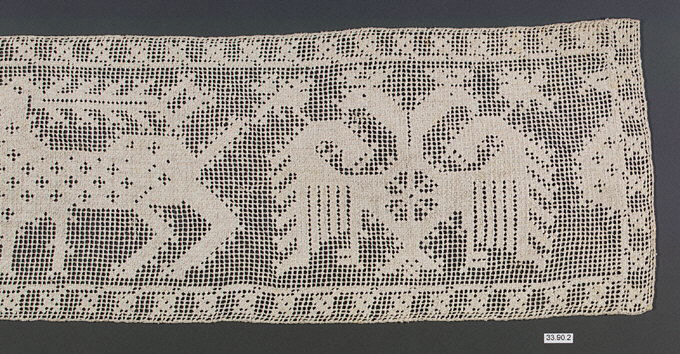
If the embroidered net provides the conceptual map, the application of punto à rammendo is the profound, philosophical engine of the study. This is not merely a stitch; it is a method of repair so meticulous that it aims to restore the fabric to an integrity that often surpasses its original state. In the context of 'Border,' this technique is radically repurposed from restitution to conscious construction.
The Lab employs punto à rammendo to 'mend' the gaps in the net, not by closing them off, but by building intricate new architectures within them. A hexagon of net might be filled with a delicate web of darning that echoes a Japanese sashiko pattern, historically used to reinforce and decorate workwear. Another aperture might be 'repaired' with a motif inspired by the fine khipu knots of the Andes, a system of recording information without writing. This process transforms the border from a line into a deep space—a liminal zone where different textile memories converge and are rewoven into a cohesive whole. The stitch becomes an act of translation, a patient, thread-by-thread negotiation between one cultural lexicon and another. It embodies the idea that global heritage is not a static archive but a living, often fractured tapestry that requires active, respectful engagement to be understood and advanced.
From Periphery to Core: The Silhouette as Contested Territory
The implications of this material research manifest in silhouettes that redefine the garment's power dynamics. A gown may appear to be constructed from solid, sculpted panels, but upon closer inspection, these panels are revealed to be vast, interconnected borders—broad bands of densely embroidered net, joined by seams that are celebrated as rivers of punto à rammendo, rather than concealed. The armhole, the neckline, the waistline—all traditional borders of the body—are expanded into wide, intricate passages that demand scrutiny.
This design strategy performs a critical fashion historiography. It rejects the colonialist practice of extracting a 'motif' from its cultural context and relegating it to the periphery of a Western silhouette. Instead, it suggests that if we are to engage with a global heritage ethically, that engagement must restructure the very core of our design thinking. The silhouette itself becomes a map of confluence, its shape emerging from the dialogue between techniques. A sleeve might taper not due to a conventional pattern cut, but because the density of the darning stitch contracts the net, creating organic, topographic form. The body moves not against borders, but through them.
Conclusion: The Border as a Site of Generation
Katherine Fashion Lab's "Border" study is a formidable contribution to contemporary couture discourse. It moves beyond superficial multicultural referencing to propose a sophisticated methodology for creation in a globally connected world. By leveraging the metaphorical richness of embroidered net and the deeply intentional craft of punto à rammendo, the Lab re-frames the border as the most fertile ground for innovation. This is not a collection about erasing differences, but about highlighting the seams—and investing those seams with such beauty, skill, and meaning that they become the focus of value and understanding.
In the end, the study posits that true luxury in the 21st century lies in this depth of engagement. It is the luxury of time—manifest in countless hours of hand-darning—and the luxury of intellect—manifest in a respectful, synthesizing curatorship of world traditions. The border, therefore, is no longer a limit. It is the laboratory itself: a space of meeting, mending, and relentless, beautiful re-creation.