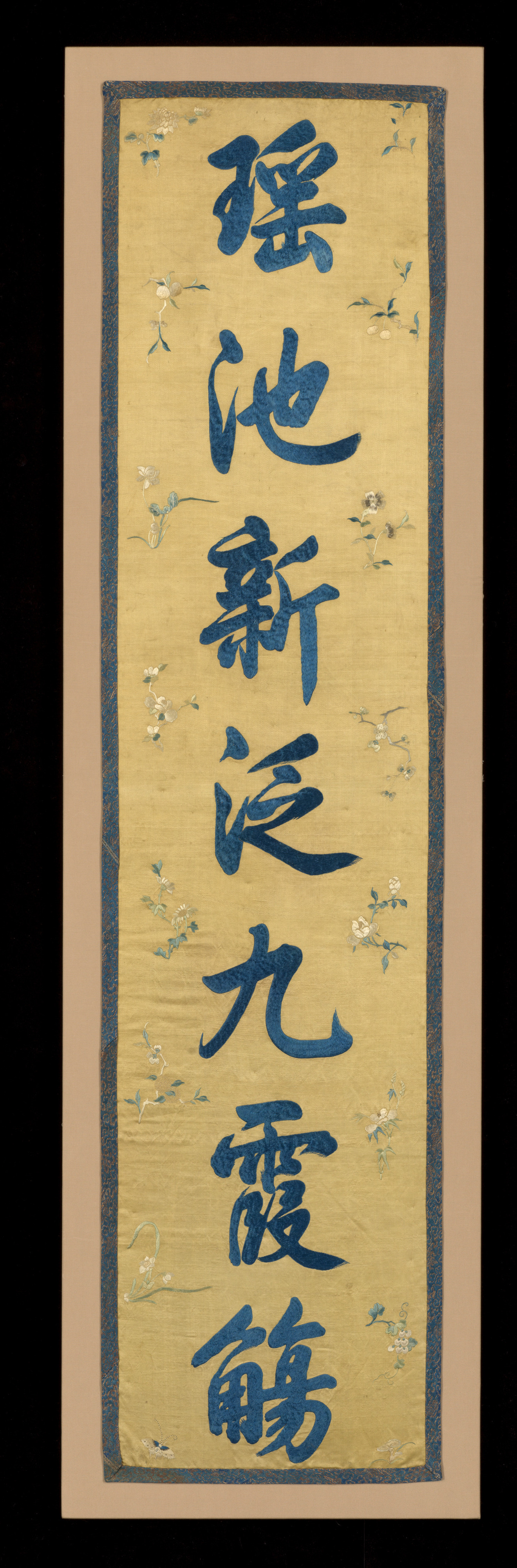
Poetic Duality: The Couture Alchemy of Silk and Script
In the rarefied realm of haute couture, where fabric becomes narrative and thread transforms into verse, Katherine Fashion Lab presents a standalone study that redefines the boundaries between textile artistry and literary expression. This analysis dissects a singular piece—a silk embroidery on silk satin—whose conceptual genesis lies in the Chinese poetic couplet. By isolating this garment from a collection, the Lab invites a focused examination of how material, technique, and cultural symbolism converge into a wearable artifact of profound sophistication.
The Conceptual Architecture of the Poetic Couplet
The Chinese poetic couplet, or duilian, is a form of classical verse characterized by strict parallelism: two lines of equal length, each character meticulously paired in meaning, tone, and grammatical structure. Historically inscribed on scrolls or doorways during festivals, the couplet embodies harmony and balance—a microcosm of cosmic order. Katherine Fashion Lab’s couture interpretation transposes this linguistic precision onto a garment, where the left and right panels of the silk satin serve as the couplet’s two lines. The embroidery does not merely illustrate the poem; it becomes the poem, with each stitch functioning as a character in a silent, tactile lexicon.
This translation is not literal. Instead of replicating calligraphy, the Lab’s artisans deconstruct the couplet’s structural essence: antithesis, symmetry, and rhythmic flow. The garment’s silhouette—a floor-length, A-line gown with a high mandarin collar—mirrors the verticality of a scroll. The left panel features embroidered motifs of willow branches and migratory swallows, symbols of parting and longing in classical Chinese poetry. The right panel responds with plum blossoms and a crescent moon, evoking resilience and renewal. Together, they form a visual couplet: absence and presence, departure and return.
Materiality as Text: Silk Satin and the Language of Light
The choice of silk satin as the base fabric is deliberate. Satin’s high-luster surface, achieved through a filament weave that reflects light unevenly, creates a dynamic interplay of shadow and illumination. This optical effect mimics the tonal variations in ink brushwork—the way a single stroke can convey both weight and ethereality. The satin’s weight (approximately 19 momme, a standard for luxury gowns) provides structure without rigidity, allowing the fabric to drape like flowing ink across a page.
Embroidery thread, sourced from Suzhou’s legendary silk workshops, undergoes a proprietary dyeing process that yields gradated hues. The willow leaves transition from celadon to jade green, while the plum blossoms shift from pearl white to blush pink. This technique, known as yiran or “dip-dyeing,” mirrors the calligrapher’s ability to modulate ink density. Each thread is a line of verse, and the embroidery needle becomes the brush. The result is a surface that reads as both textile and text—a palimpsest where the poem is inscribed not in ink, but in light and shadow.
Technique as Poetic Device: The Art of Invisible Stitching
Katherine Fashion Lab employs a technique called “hidden stitch” or yinfeng, where the thread is passed through the fabric’s inner layers, leaving no visible knots on the surface. This method, traditionally reserved for imperial court robes, ensures that the embroidery appears to float atop the satin, unanchored by human intervention. The effect is deliberately paradoxical: the most labor-intensive process (each square centimeter requires 200 to 300 stitches) yields the most ethereal result. The garment’s surface becomes a poetic field where materiality dissolves into meaning.
The couplet’s characters themselves are not embroidered. Instead, the Lab deconstructs the calligraphic strokes into abstract forms—a curved line for a descending stroke, a cluster of tiny knots for a dot. These elements are arranged in non-linear sequences, inviting the wearer to reconstruct the poem through tactile exploration. The left sleeve, for instance, features a spiral of gold thread that alludes to the character “心” (heart), while the right sleeve’s parallel lines evoke “月” (moon). The poem is not read; it is felt—a haptic experience that bypasses linguistic cognition.
Cultural Resonances and the Standalone Study
By presenting this piece as a standalone study, Katherine Fashion Lab challenges the conventional hierarchy of couture, where garments are typically contextualized within a collection’s narrative arc. Here, the absence of context becomes the context. The viewer is forced to engage with the garment as a singular artifact, much like a scroll mounted in a gallery. This curatorial decision echoes the Chinese tradition of “appreciating alone” (du shang), where a poem or painting is contemplated in solitude to deepen personal resonance.
The cultural implications are layered. The poetic couplet, historically a communal art form displayed during festivals, is reimagined as an intimate, wearable object. The garment does not celebrate public joy but private reflection—a meditation on transience and permanence. The willow and plum motifs, staples of Chinese literati painting, reference the cyclical nature of seasons and emotions. The satin’s sheen, when viewed under different lighting, alters the embroidery’s visibility, symbolizing how memory reshapes the past. This is not a garment for spectacle; it is a garment for contemplation.
Conclusion: The Couture Couplet as a New Lexicon
Katherine Fashion Lab’s poetic couplet study transcends the boundaries of fashion, entering the realm of material poetry. By translating the structural and philosophical principles of Chinese verse into silk and thread, the Lab creates a garment that functions as both object and text. The silk satin’s luminosity, the hidden stitch’s invisibility, and the couplet’s visual parallelism coalesce into a unified aesthetic statement: that couture, at its highest form, is a language of its own. This standalone study does not merely analyze a cultural artifact; it generates a new one—a wearable couplet that speaks without sound, and endures without ink.