The Four-Cornered Hat: A Study in Wari Prestige and Textile Technology
Introduction: The Object as Cultural Archive
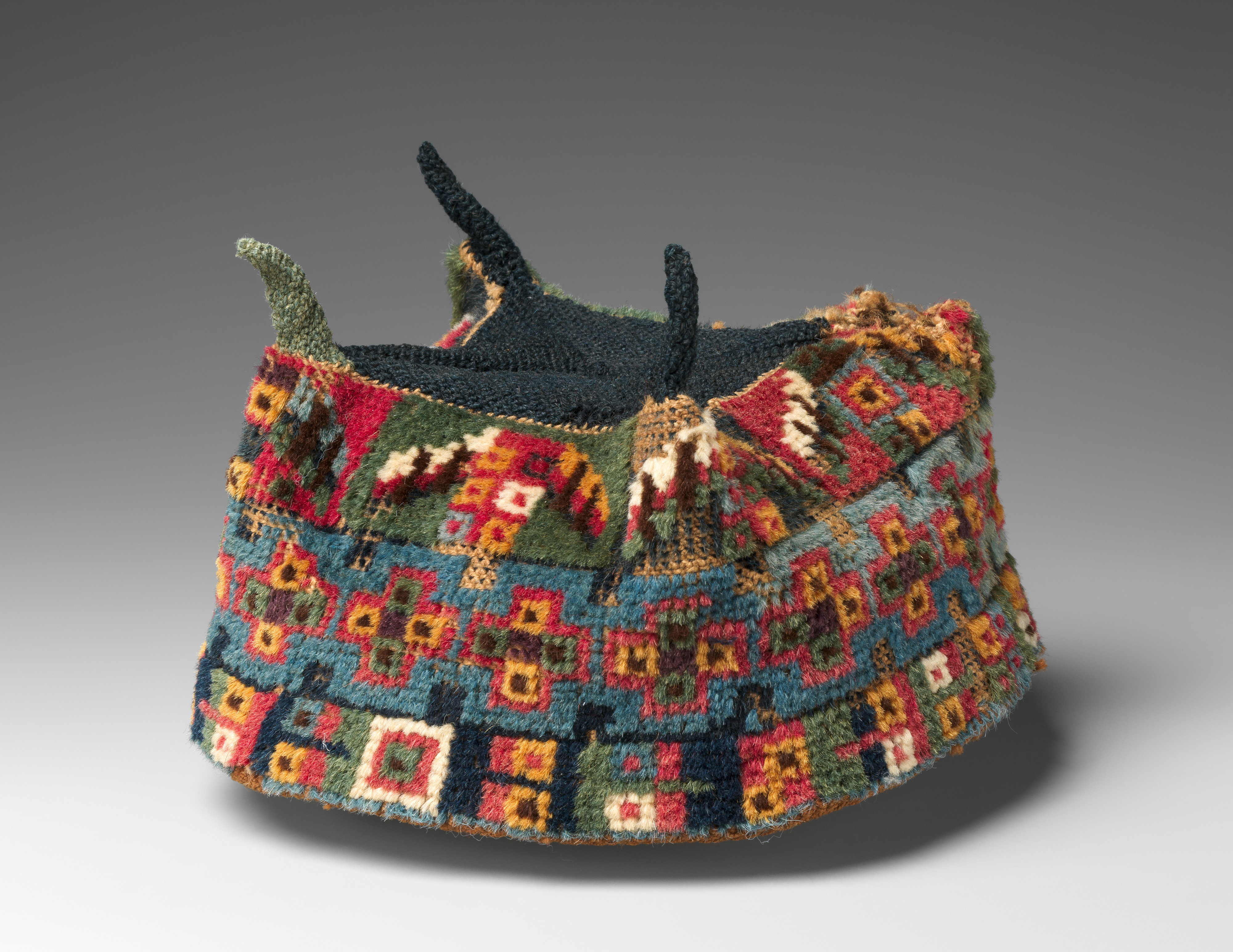
The Four-Cornered Hat, a hallmark of the Wari civilization (circa 600–1000 CE) from the central Andes of present-day Peru, represents far more than a mere head covering. As a standalone study within the Katherine Fashion Lab, this artifact—crafted from camelid hair—demands a rigorous analysis that transcends its materiality. It is a testament to the sophisticated textile engineering, social stratification, and cosmological beliefs of a pre-Columbian empire that predated the Inca. For the modern couture analyst, the Wari hat offers a profound lesson in how structure, material, and symbolism converge to create an object of enduring prestige.
Material Mastery: The Significance of Camelid Hair
The choice of camelid hair—derived from alpacas, llamas, or vicuñas—is not incidental. In the arid highlands of the Wari heartland, camelids were the primary source of fiber, yet not all fibers were equal. The hat’s construction likely utilized the finest grades of alpaca or vicuña hair, prized for its softness, thermal properties, and natural lustrous sheen. Unlike sheep’s wool, camelid fibers are hollow, providing exceptional insulation without bulk—a critical adaptation to the dramatic temperature swings of the Andean environment.
From a technical standpoint, the material’s structural integrity is remarkable. Camelid hair possesses a high tensile strength and elasticity, allowing for intricate, dense weaves that resist deformation over centuries. The hat’s survival into the present day, often with minimal degradation, speaks to the fiber’s resilience. For the Wari, the acquisition and processing of this material were labor-intensive, involving herding, shearing, cleaning, and hand-spinning—often dyed with natural pigments from plants, minerals, and insects like cochineal. The resulting palette of earthy browns, deep reds, ochres, and blacks was not merely decorative but encoded status and ritual significance.
Structural Innovation: The Four-Cornered Form
The defining feature of this headwear is its four-cornered silhouette, a geometric departure from the more common conical or rounded Andean caps. This shape is achieved through a sophisticated weaving technique known as tapestry weave, often executed on a backstrap loom. The hat is typically composed of a crown and a brim, with the four corners formed by deliberate structural pleats or tucks that create a crisp, almost architectural profile. This design is not arbitrary; it required the weaver to calculate tension, warp placement, and weft insertion with precision to achieve symmetry.
From a couture perspective, the four-cornered hat represents a triumph of structural engineering over soft material. Unlike felted or knitted hats that rely on shaping after construction, the Wari version is woven to shape, with the corners integrated into the fabric’s very structure. This demands a mastery of float weaves and interlocking tapestry, where discontinuous wefts are used to create patterned bands. The resulting textile is both flexible and rigid—flexible enough to conform to the head, yet rigid enough to maintain its geometric integrity. This duality is a hallmark of high-end millinery, where form and function are inextricably linked.
Symbolic Semiotics: Status, Cosmology, and Identity
The hat’s iconography is as significant as its form. Wari four-cornered hats are often adorned with abstract geometric motifs: stepped diamonds, zigzags, and stylized animal figures such as felines, birds, or serpents. These patterns are not mere ornamentation; they are a visual language. The stepped diamond, for instance, is widely interpreted as a representation of the Andean cross or chakana, symbolizing the three tiers of the cosmos—the underworld, the earthly realm, and the heavens. The four corners of the hat may correspond to the cardinal directions, reinforcing the wearer’s connection to cosmic order and sacred geography.
In the context of Wari society, this hat was likely reserved for elite individuals—priests, warriors, or administrators—who served as intermediaries between the human and divine. The hat’s prominence in burial contexts, where it is often found adorning mummy bundles, suggests it functioned as a marker of social identity and ancestral lineage. To wear such a hat was to claim authority, wisdom, and a direct lineage to the Wari state’s ideological core. For the modern fashion scholar, this underscores how clothing can function as a non-verbal contract of power, a concept that resonates in contemporary luxury branding.
Comparative Couture: The Wari Hat in a Global Millinery Context
Placing the Wari four-cornered hat within a global couture framework reveals both its uniqueness and its universal principles. Unlike the soft, draped turbans of the Ottoman Empire or the rigid, structured top hats of 19th-century Europe, the Wari hat occupies a middle ground. Its geometric precision anticipates the architectural millinery of designers like Philip Treacy or Stephen Jones, who manipulate materials to defy gravity and expectation. Yet, unlike these modern creations, the Wari hat is not a one-off piece; it is part of a standardized yet customizable tradition, where each weaver imbued the form with regional or personal variations.
In terms of material, camelid hair offers a texture and drape that is distinct from silk, wool, or synthetic fibers. Its natural luster and warmth create a tactile experience that is both humble and opulent—a paradox that luxury fashion often seeks to replicate. The hat’s durability also challenges the fast-fashion paradigm, serving as a reminder that true couture is built to last generations, not seasons.
Preservation and Contemporary Relevance
The survival of Wari four-cornered hats in museum collections, such as those at the Museo Nacional de Arqueología, Antropología e Historia del Perú or the Dumbarton Oaks Research Library, is a testament to their material and cultural resilience. However, their study is complicated by looting and the loss of contextual data. Many hats were removed from tombs without documentation, obscuring their precise social function. For the Katherine Fashion Lab, this underscores the importance of ethical curation and interdisciplinary collaboration—combining archaeology, textile science, and fashion theory to reconstruct lost narratives.
Today, the Wari hat inspires contemporary designers who seek to honor indigenous techniques while innovating within sustainable frameworks. The use of natural dyes, hand-weaving, and local fibers aligns with the slow fashion movement, offering a blueprint for ethical luxury. Moreover, the hat’s geometric purity has influenced minimalist aesthetics in modern millinery, proving that ancient design can speak to modern sensibilities.
Conclusion: The Enduring Legacy of Wari Couture
The Four-Cornered Hat of the Wari civilization is a masterclass in the convergence of material science, structural ingenuity, and symbolic depth. As a standalone study within Katherine Fashion Lab, it challenges us to expand our definition of couture beyond Western paradigms, recognizing that the pinnacle of textile art has been achieved across cultures and millennia. In its camelid hair fibers, we trace the hands of Andean herders and weavers; in its four corners, we read the cosmos; and in its survival, we witness the enduring power of clothing to encode identity, authority, and artistry. This hat is not merely an artifact—it is a living lesson in the timeless dialogue between fabric and form.