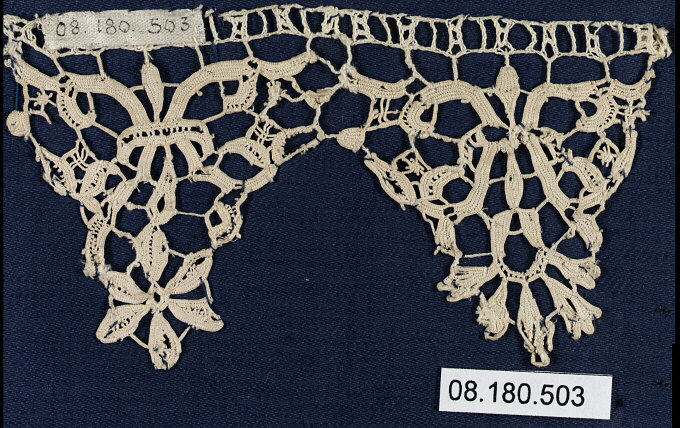
Deconstructing the Fragment: A Couture Analysis of Katherine Fashion Lab’s Needle Lace Study
Introduction: The Fragment as a Complete Universe
In the rarefied realm of haute couture, where garments are often conceived as grand narratives, Katherine Fashion Lab’s standalone study titled “Fragment” presents a provocative counterpoint. This piece, rooted in the technical lexicon of Global Heritage, is not a remnant of a larger whole but a deliberate, self-contained exploration of absence and presence. By isolating the fragment as the subject, the Lab challenges the conventional hierarchy of garment construction, where a sleeve or a panel is merely a component. Here, the fragment becomes the entirety—a philosophical and material statement that interrogates the boundaries of completion. The choice of punto in aria (“stitch in the air”) needle lace, a technique born from the desire to create lace without a ground fabric, is a masterstroke of conceptual alignment. This study is not merely a demonstration of craft; it is a meditation on the nature of form, the weight of history, and the audacity of incompleteness.
The Material Lexicon: Punto in Aria and the Architecture of Air
The materiality of this study is its primary narrative. Needle lace, specifically the Venetian punto in aria technique, is the sole medium. Originating in 16th-century Italy, this method involves building intricate patterns stitch by stitch over a temporary parchment or thread foundation, which is then removed, leaving the lace to float as a self-supporting structure. In the context of “Fragment,” Katherine Fashion Lab elevates this historical craft from mere ornament to architectural principle. The lace is not applied to a base; it is the base. Each loop, buttonhole stitch, and picot is a load-bearing element in a tensile network.
The fragment’s dimensions are modest—approximately 30 by 40 centimeters—but its visual impact is monumental. The design eschews symmetrical floral motifs typical of historical punto in aria, instead embracing an asymmetrical, almost geological formation. Dense clusters of stitching give way to open, web-like voids. This is not a lace of delicate floral garlands; it is a lace of erosion and accretion. The threads—a single ply of 100% silk, bleached to an ivory white—are worked with a tension that varies from taut, almost rigid, to gossamer fine. The result is a surface that oscillates between the solidity of bone and the transparency of mist. The Lab’s treatment of the raw edges is particularly telling: they are not hemmed or finished, but left as raw, unraveling threads, as if the fragment has been torn from a larger, unseen tapestry of time.
Global Heritage: A Dialogue Across Cultures
While the technique is Venetian, the “Global Heritage” origin of this study is a deliberate curatorial framing. Katherine Fashion Lab does not treat heritage as a static repository of national identity but as a fluid, migratory set of practices. The fragment’s design vocabulary borrows from non-European sources. The open, net-like sections recall the teneriffe lace of the Canary Islands, while the dense, coiled motifs echo the needle lace traditions of China’s Suzhou region, where similar techniques were used to create decorative panels for court robes. The Lab’s designers have synthesized these influences into a visual language that is neither purely Venetian nor purely Asian, but a third, hybrid aesthetic.
This hybridization is not a superficial fusion but a deep structural integration. The fragment’s composition references the Japanese concept of ma—the intentional use of negative space as a positive element. The voids in the lace are not holes to be filled; they are equally weighted as the stitched areas. In a Western couture context, this is a radical departure from the tradition of lace as a dense, ornamental surface. Here, the empty spaces are where the garment’s narrative breathes. The fragment becomes a map of absence, a testament to what is left unsaid. This global dialogue is further emphasized by the thread color—ivory white—which in many cultures symbolizes both purity and mourning, a dualism that resonates with the fragment’s status as both a beginning and an end.
Contextual Analysis: The Standalone Study as a Statement
Positioning “Fragment” as a standalone study is a strategic curatorial decision that reframes the object’s value. In a fashion system obsessed with the runway show, the collection, and the complete look, a single, unmounted piece of lace hanging on a wall forces a different mode of engagement. This is not a garment to be worn; it is a textile artifact to be read. The Lab invites the viewer to consider the fragment as a micro-narrative—a concentrated dose of couture intelligence that eschews the spectacle of the full silhouette. The study format allows for an intense focus on technique and concept, free from the distractions of fit, body, and movement.
This approach aligns with contemporary movements in slow fashion and critical craft, where the process of making is as significant as the final object. The fragment’s creation required over 200 hours of handwork by a single artisan, a duration that is itself a statement against fast-paced production. The absence of a garment form also liberates the lace from the constraints of the human body. It is not shaped to a shoulder or a waist; it exists as pure, abstract form. In this sense, “Fragment” functions as a sculptural study, closer to a work of textile art than a conventional fashion item. The Lab’s decision to present it under museum-quality glass further reinforces this reading, elevating the fragment to the status of an archival piece.
Technical Mastery: The Stitch as a Sentence
Examining the fragment’s technical execution reveals a level of mastery that is the hallmark of true couture. Each stitch is a deliberate act of composition. The punto in aria technique here is executed with a precision that borders on the obsessive. The foundation threads—a grid of silk threads stretched over a frame—are worked with a buttonhole stitch that varies in density. In some areas, the stitches are so close they create a solid, almost woven surface; in others, they are spaced to create a diaphanous lattice. The cordonnet—a heavier thread outlining the design—is worked in a subtle raised effect, giving the fragment a three-dimensional topography.
The Lab has also introduced a contemporary innovation: the use of variable thread gauges within the same piece. While traditional punto in aria typically uses a single thread weight, this study alternates between a fine 100-denier silk and a heavier 200-denier thread. This creates a textural rhythm that mimics the natural irregularity of organic forms—a leaf’s veins, a spider’s web, the fractured edge of a stone. The result is a lace that feels alive, as if it is still growing or decaying. The picots—small loops that edge the design—are not merely decorative; they function as structural nodes, distributing tension across the fragment’s delicate framework. This is engineering as much as artistry.
Philosophical Underpinnings: The Fragment and the Whole
At its core, this study engages with a philosophical question: Can a fragment be complete? In the context of Global Heritage, fragments are often seen as ruins—remnants of a lost, idealized whole. Katherine Fashion Lab subverts this notion. The fragment here is not a relic; it is a prototype for a new way of thinking about structure and form. The Lab suggests that the fragment is not a reduction but a concentration. By removing the context of a full garment, the viewer is forced to confront the material’s essence: its texture, its transparency, its tension.
This aligns with the Japanese aesthetic of wabi-sabi, which finds beauty in the imperfect, the incomplete, and the impermanent. The fragment’s raw edges, the slight irregularities in stitch tension, the subtle asymmetry—these are not flaws but features. They are evidence of the human hand, the mark of time, and the resistance of material. In a world of digital perfection, this fragment stands as a testament to the tactile, the temporal, and the true. The Lab’s choice to title the study simply “Fragment” is a deliberate act of naming that refuses to define or limit. It is a fragment of what? The answer is left open, inviting each viewer to complete the narrative in their own mind.
Conclusion: A New Canon for Couture
Katherine Fashion Lab’s “Fragment” is not merely a study in needle lace; it is a manifesto in thread. By isolating a single piece of punto in aria, the Lab challenges the fashion industry’s obsession with the complete, the wearable, and the commercial. It argues that the fragment—the isolated detail, the concentrated technique, the standalone study—carries as much weight, if not more, than a full garment. In doing so, it repositions couture as a discipline of intellectual and material rigor, equally concerned with philosophy as with fashion.
For the discerning collector or curator, this fragment offers a rare opportunity to own a piece that is both a historical homage and a forward-looking provocation. It is a reminder that the most powerful statements in fashion often come not from the grandiose but from the fragmented, the focused, and the unfinished. As the fashion world accelerates toward the next season, the next trend, the next “complete” collection, “Fragment” stands still—a quiet, durable, and infinitely complex object that demands to be studied, not just seen. It is, in the truest sense, a fragment of the future.