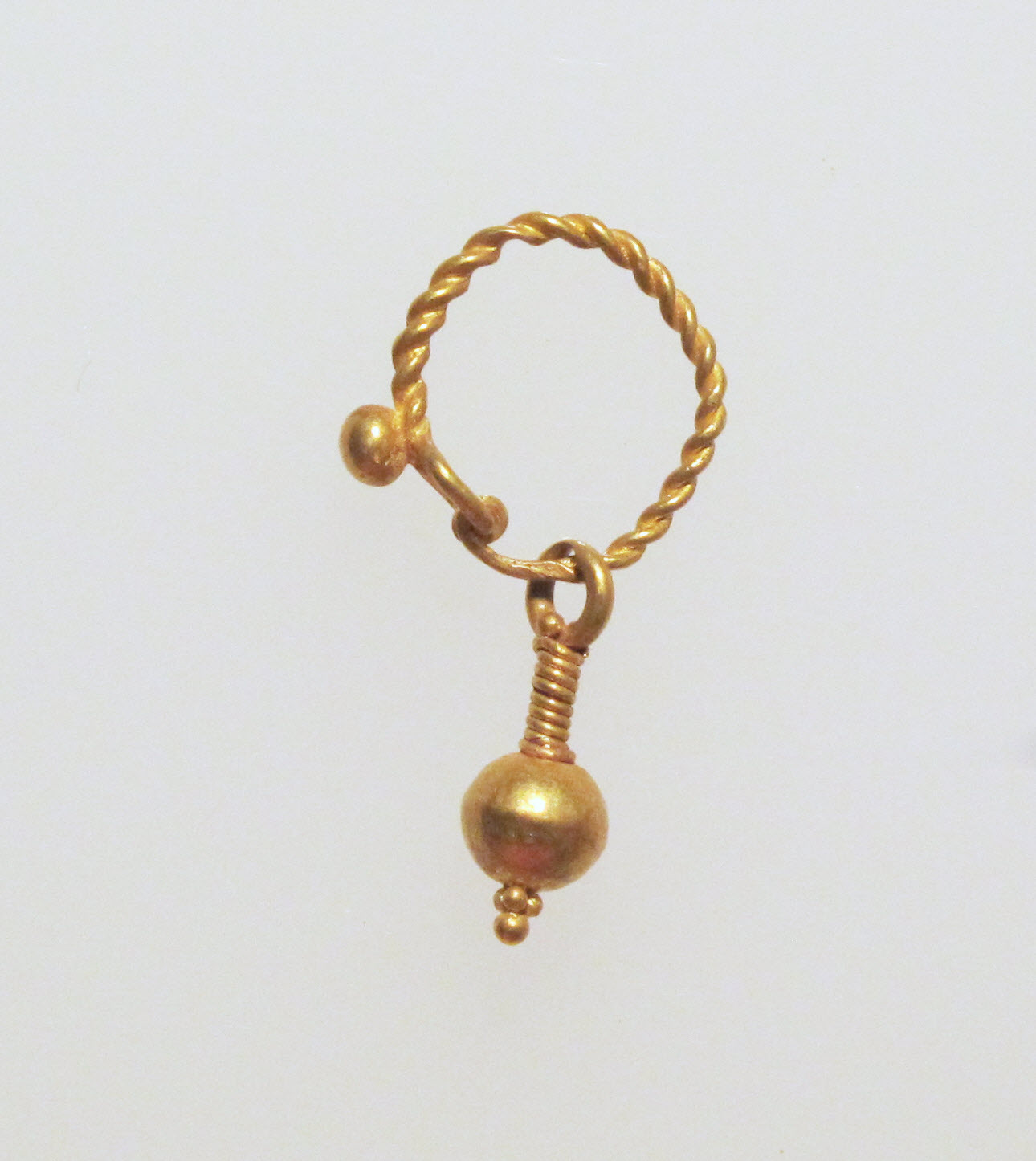
Heritage Analysis: Gold Earring with Ball Stud and Pendant — Roman Cultural Symbolism and 2026 Luxury Strategy
Introduction: The Artifact as a Portal to Imperial Identity
The Roman gold earring with a ball stud and pendant, dating from the 1st to 3rd century CE, represents a sophisticated convergence of material wealth, spiritual symbolism, and social articulation. Crafted from high-carat gold, this adornment was not merely decorative but functioned as a portable signifier of status, piety, and cultural belonging within the Roman Empire. For Katherine Fashion Lab, this artifact offers a resonant DNA correlation with our ongoing study on the dual-narrative object: “一面是光洁银镜上以黄金镶嵌的纷繁棕叶纹,另一面是冰冷石棺板上以浮雕诉说的生命叙事” (on one side, a polished silver mirror inlaid with intricate gold palm-leaf motifs; on the other, a cold sarcophagus panel narrating life through relief). This duality—between luminous reflection and somber commemoration—mirrors the Roman earring’s own tension between earthly opulence and transcendent meaning.
Symbolic Power: Gold as Imperial and Divine Authority
In Roman culture, gold was inextricably linked to the divine and the state. The ball stud—a spherical element—evoked the globus cruciger, a symbol of universal dominion, while the pendant often featured motifs such as the lunula (crescent moon) or bullae (protective amulets). The earring’s design thus encoded a dual authority: imperial power (gold as tribute and wealth) and spiritual protection (the pendant as a talisman against evil). For the Roman elite, wearing such an earring was a performative act of aligning oneself with the Pax Romana and the favor of the gods. This symbolic power resonates with Katherine Fashion Lab’s 2026 strategy, where high-end luxury must transcend mere aesthetics to embody narrative sovereignty—a piece that tells a story of lineage, protection, and dominion.
Historical Adornment: The Earring as Social Currency
The Roman gold earring was a gendered yet class-defining accessory. While men in the early Republic avoided earrings as “effeminate,” by the Imperial period, both sexes—particularly among the equites and senatorial classes—adopted such adornments as markers of economic capital and cosmopolitan identity. The ball stud, often hollow to reduce weight, demonstrated masterful goldsmithing: a technique called opus interrasile (openwork) allowed light to play across the surface, creating a shimmering effect that signaled the wearer’s access to skilled artisans. The pendant, frequently a lunula or phallus shape, served as a fascinum—a protective charm against envy. Historically, this earring was worn during public ceremonies, banquets, and religious rites, reinforcing the wearer’s place within the social hierarchy. For Katherine Fashion Lab, this historical context informs a 2026 strategy of exclusivity through craftsmanship: the earring’s value lies not only in material but in the invisible labor and symbolic literacy it demands from the wearer.
Spiritual Meaning: Between Mortal Glitter and Eternal Rest
The Roman gold earring’s spiritual dimension is profoundly dualistic. On one hand, its gold surface reflected the sunlight—a metaphor for Sol Invictus, the unconquered sun god, and the transient glory of earthly life. On the other, its pendant often referenced chthonic deities like Dis Pater or Proserpina, connecting the wearer to the underworld and the cycle of death and rebirth. This echoes the split narrative in our mirror-sarcophagus study: the silver mirror (light, vanity, the living) versus the gold-inlaid palm leaves (victory, eternity, the dead). The earring, worn by the living, simultaneously invoked the protective spirits of ancestors (Lares) and the hope for a blessed afterlife. In burial contexts, such earrings were often placed with the deceased as grave goods, ensuring the soul’s safe passage. For Katherine Fashion Lab, this spiritual duality offers a powerful 2026 positioning: luxury as a memento mori—an object that celebrates life while acknowledging its finitude, creating a deeper emotional connection with discerning clients.
2026 High-End Luxury Strategy: Translating Roman DNA into Contemporary Desire
Based on this heritage analysis, Katherine Fashion Lab’s 2026 strategy for the gold ball-stud-and-pendant earring should focus on three pillars:
1. Narrative Craftsmanship as Brand Equity
The earring’s Roman origins provide a provenance story that modern luxury consumers crave. Katherine Fashion Lab must emphasize the artisanal techniques—such as hand-forging the ball stud and engraving the pendant—as a direct lineage to Roman goldsmithing. This can be communicated through limited-edition collections with numbered pieces, each accompanied by a digital heritage dossier that includes 3D scans of the original artifact and a curator’s note on its symbolic meaning. The brand should position this as “wearable archaeology,” appealing to clients who value cultural capital over mere fashion.
2. Dual-Narrative Design Language
Inspired by the mirror-sarcophagus study, the 2026 collection should feature pieces that reveal two faces: one polished, reflective, and public (the ball stud as a symbol of status); the other hidden, engraved, and private (the pendant as a personal talisman). For example, the earring could have a removable pendant that the wearer can touch or reveal only in intimate settings. This duality of experience—between display and concealment—creates a ritualistic relationship with the object, elevating it from accessory to personal artifact. Marketing campaigns should juxtapose light and shadow, gold and silver, life and death, echoing the original Roman spiritual tension.
3. Spiritual Protection as Emotional Luxury
The Roman earring’s protective function—its role as a fascinum—can be reimagined for 2026 as a luxury amulet for contemporary anxieties. Katherine Fashion Lab should collaborate with cultural historians and gemologists to embed subtle protective symbols (e.g., a tiny engraving of a lunula or a phallus in a discreet location) that only the owner knows. This hidden meaning aligns with the growing trend of quiet luxury and personal significance. Pricing strategy should reflect this intangible value—the earring is not just a gold object but a talismanic investment in well-being. The 2026 launch should include a private viewing event at a museum with Roman artifacts, reinforcing the brand’s authority in heritage curation.
Conclusion: The Eternal Resonance of Gold
The Roman gold earring with ball stud and pendant is not a relic of the past but a living archetype for luxury in 2026. Its fusion of symbolic power, historical adornment, and spiritual meaning offers Katherine Fashion Lab a blueprint for creating objects that are culturally literate, emotionally resonant, and commercially viable. By honoring the artifact’s dual narrative—between the glittering mirror of life and the solemn relief of death—the brand can transcend transient trends and occupy a space of timeless relevance. The gold earring, once worn by a Roman patrician to signal both earthly status and divine protection, can now, through Katherine Fashion Lab, become a signal of refined consciousness for the 21st-century connoisseur.