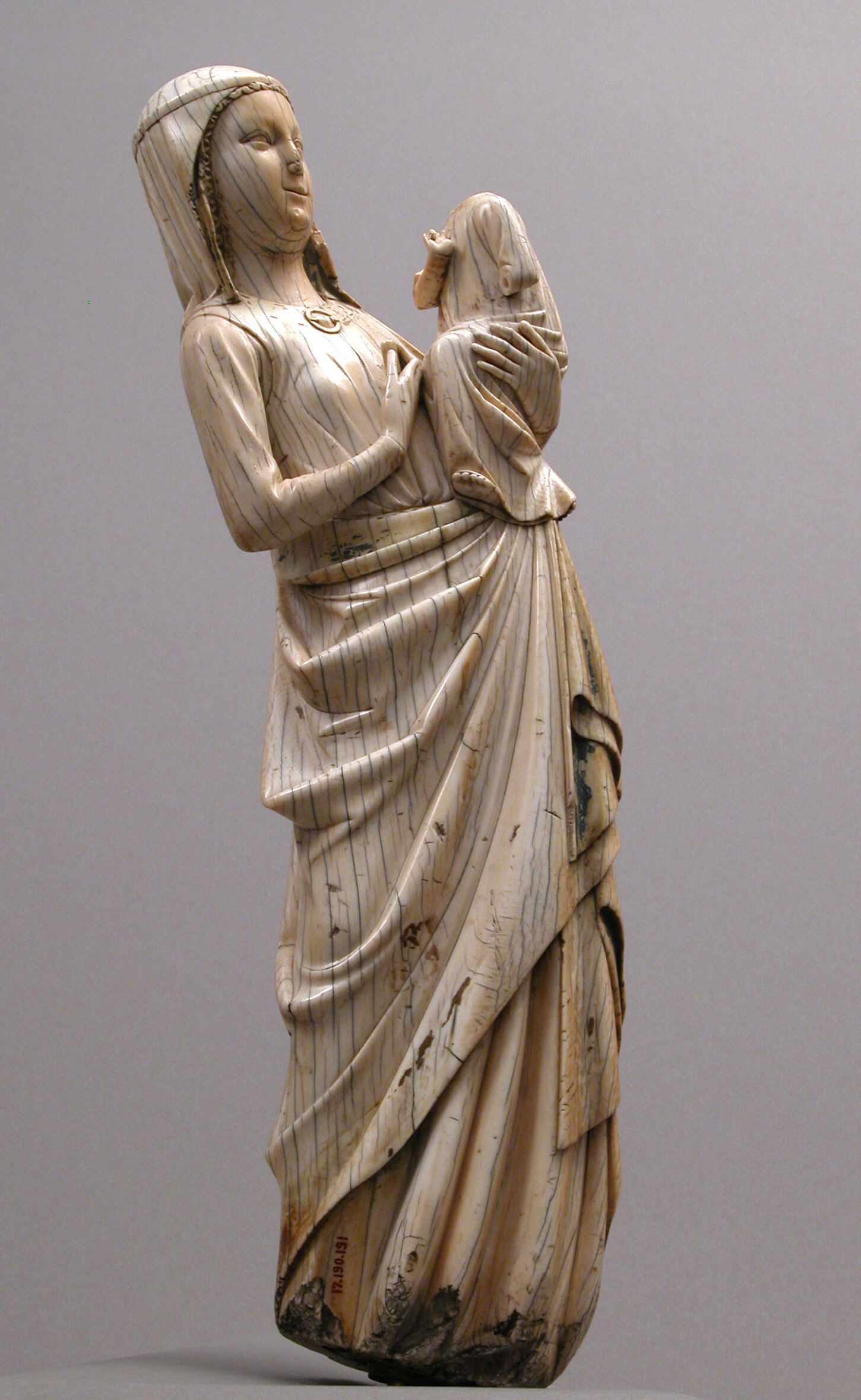
Heritage Analysis: The Virgin and Child in Elephant Ivory, North French
This strategic heritage analysis examines a singular artifact: a North French depiction of the Virgin and Child, crafted from elephant ivory with traces of paint and gilding. As Lead Heritage Curator for Katherine Fashion Lab, I position this object not merely as a religious icon but as a sophisticated lexicon of symbolic power, historical adornment, and spiritual meaning. The following research synthesizes these dimensions to derive actionable insights for a 2026 high-end luxury strategy that transcends mere aesthetic appropriation, embedding deep cultural reverence and narrative authority.
Symbolic Power and Hierarchical Adornment
The Virgin and Child motif, central to medieval Christian iconography, functions as a potent symbol of divine authority, maternal protection, and royal lineage. In this North French example, the Virgin is typically depicted as the Throne of Wisdom (Sedes Sapientiae), where she physically supports the Christ Child, who in turn offers a blessing. This posture is not passive; it is a deliberate assertion of spiritual sovereignty. The Child’s raised hand, often in a gesture of benediction, signifies the transfer of grace and the legitimacy of the Church’s earthly power. For Katherine Fashion Lab, this symbolic architecture translates into a design language of conferred authority—a visual narrative where the wearer is both a vessel and a sovereign. The interplay of protection and power offers a rich vein for luxury branding, suggesting collections that balance soft, maternal silhouettes with structured, regal elements that command reverence.
Historically, ivory itself was a material of immense symbolic weight. Sourced from African or Asian elephants, it represented the exotic, the sacred, and the rare. In North French workshops, ivory carving reached a peak of technical and artistic refinement during the 13th and 14th centuries. The material’s luminous, warm surface was often enhanced with delicate paint and gilding, as seen in this piece. The gold leaf, applied to halos or borders, was not mere decoration; it was a theological statement, reflecting the divine light and the eternal. The paint, now often faded, originally rendered the Virgin’s robes in deep blue (lapis lazuli) and crimson (carmine), colors associated with royalty, purity, and the Passion of Christ. For a 2026 luxury strategy, this material hierarchy—ivory as the primary, rare substrate, with gilding as the accent of ultimate value—suggests a material philosophy of using ethically sourced, precious mediums (e.g., responsibly sourced mother-of-pearl, fossilized ivory alternatives, or high-polish metals) with selective, hand-applied metallic finishes to create a sense of sacred rarity and artisanal mastery.
Historical Adornment and Craftsmanship
The technical execution of this piece reveals a sophisticated understanding of form and function. Ivory, a dense yet carveable material, allowed for intricate undercutting and delicate detailing—the folds of the Virgin’s mantle, the curls of the Child’s hair, the subtle tilt of their heads. This craftsmanship was not merely decorative; it was a sacred act, often performed in monastic or courtly workshops under commissions from royalty or high-ranking clergy. The object was intended for private devotion, perhaps in a chapel or a noblewoman’s oratory, where its intimate scale invited close contemplation. This intimate luxury—an object of profound personal meaning, not public display—is a critical insight for modern high-end strategy. It challenges the current trend of ostentatious branding, instead advocating for pieces that reveal their value through tactile experience and hidden details, much like a fine watch or a bespoke garment with invisible seams.
The gilding on this piece is applied using a water gilding technique, where thin sheets of gold leaf are adhered to a prepared gesso ground, then burnished to a mirror-like finish. This process required immense skill and patience, as any imperfection would be magnified. The paint, often egg tempera, was layered in thin glazes to achieve luminosity. For Katherine Fashion Lab, this suggests a 2026 strategy that prioritizes slow craft and atelier techniques—hand-embroidery, hand-painted details, and artisanal metalwork that cannot be replicated by machine. This aligns with the luxury consumer’s growing demand for authenticity, heritage, and the story behind the object. The historical adornment of the Virgin and Child—crowns, halos, richly embroidered textiles—also offers a visual vocabulary for jewelry and embellishment: not as afterthoughts, but as integral components of the garment’s spiritual and aesthetic narrative.
Spiritual Meaning and Emotional Resonance
Beyond its material and symbolic layers, this object served a deeply spiritual function. It was a mediator of the divine, a physical point of contact for prayer and intercession. The Virgin’s serene expression and the Child’s focused gaze created an emotional bridge between the earthly and the heavenly. In a world marked by plague, war, and uncertainty, this icon offered comfort, hope, and a tangible assurance of salvation. For the 2026 luxury consumer, who increasingly seeks meaning and emotional connection in a fragmented world, this spiritual dimension is profoundly relevant. A high-end brand can no longer rely solely on status signaling; it must offer emotional sanctuary and ritualistic value. This might translate into limited-edition collections released in alignment with seasonal or astrological cycles, or garments designed to be worn during personal rituals—meditation, reflection, or significant life transitions.
The spiritual meaning also resides in the act of donation and patronage. Many such ivories were commissioned as acts of piety, often inscribed with the donor’s name or crest, linking personal identity with divine favor. For luxury strategy, this suggests a model of co-creation and legacy, where clients can commission bespoke pieces that embed personal symbols or family histories, transforming a garment or accessory into a heirloom with spiritual and emotional weight. The Virgin and Child, as a universal archetype of motherhood and protection, also resonates with contemporary themes of care, vulnerability, and strength—emotions that can be woven into marketing narratives and design concepts, particularly for collections targeting women in positions of power who seek both softness and authority.
2026 High-End Luxury Strategy: Strategic Implications
Integrating these heritage insights, Katherine Fashion Lab can develop a 2026 strategy that is both historically grounded and forward-looking. The core proposition should be Sacred Craft—a brand ethos that positions each piece as a modern icon, imbued with symbolic power and artisanal integrity. This requires a multi-pronged approach:
1. Material Ethics and Rarity: Replace elephant ivory with ethically sourced alternatives such as tagua nut, fossilized mammoth ivory (legally traded), or high-tech ceramics that mimic the luster and weight of ivory. Gilding should be reserved for signature pieces, using 24k gold or palladium leaf applied by master artisans. This creates a material hierarchy that mirrors the original object’s value system.
2. Narrative-Driven Design: Each collection should be anchored in a specific historical or spiritual narrative, drawn from the Virgin and Child iconography but recontextualized for modern life. For example, a “Throne of Wisdom” line could feature structured outerwear with sculptural shoulders and hidden pockets (symbolizing protection), while a “Mater Misericordiae” (Mother of Mercy) line could use draped, enveloping fabrics with subtle gold-thread embroidery.
3. Ritual and Experience: Launch a bespoke service called the Atelier of Icons, where clients work with a curator and artisan to design a garment or accessory that carries personal symbolic elements—a birthstone, a family crest, or a protective motif. This transforms the purchase into a meaningful ritual, echoing the medieval commission process.
4. Emotional Marketing: Shift from lifestyle imagery to iconographic storytelling. Campaigns should feature solitary figures in contemplative settings, emphasizing the garment’s role as a source of inner strength and serenity. Use language of “protection,” “grace,” and “legacy” rather than “trend” or “exclusivity.”
5. Heritage Certification: Each piece should come with a detailed provenance document, explaining the historical inspiration, the materials, and the artisan’s process. This adds a layer of intellectual and emotional value, appealing to the discerning collector who seeks depth beyond aesthetics.
In conclusion, the North French Virgin and Child in ivory is not a relic of the past but a blueprint for a luxury strategy that honors the sacred, the rare, and the emotionally resonant. By translating its symbolic power, historical adornment, and spiritual meaning into tangible design and brand practices, Katherine Fashion Lab can lead the 2026 market in offering not just fashion, but modern icons of enduring value.