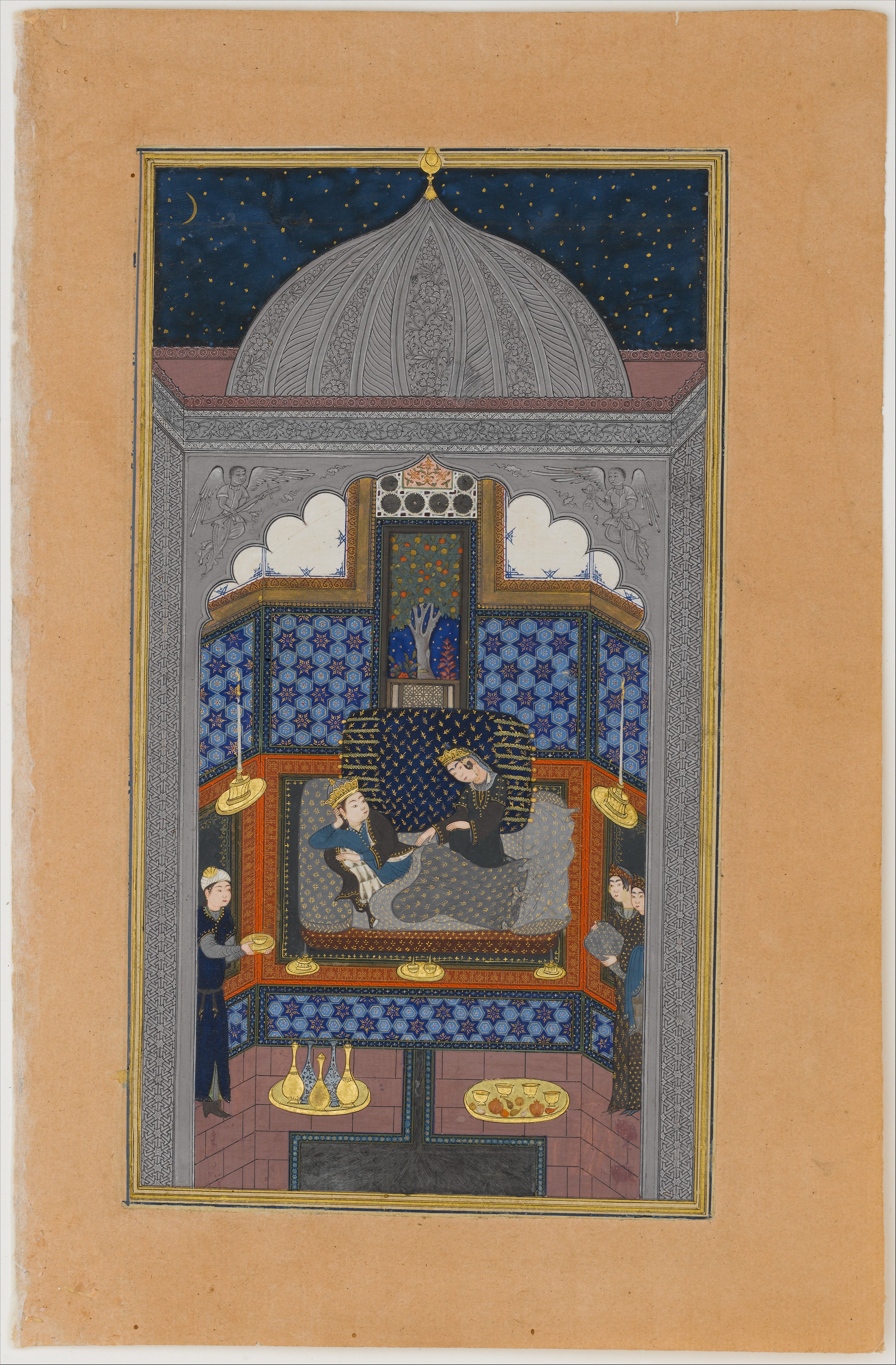
Heritage Analysis: Bahram Gur and the Indian Princess in the Dark Palace on Saturday
Folio 23v from a Haft Paikar (Seven Portraits) of the Khamsa (Quintet) of Nizami of Ganja
This illuminated manuscript folio, dating from the late 15th to early 16th century Persianate world, represents a pinnacle of courtly artistic patronage and spiritual allegory. As a strategic heritage asset for Katherine Fashion Lab, the work offers profound insights into the intersection of symbolic power, historical adornment, and spiritual meaning—elements that can inform a 2026 high-end luxury strategy rooted in narrative depth and cultural resonance.
Symbolic Power: The Sovereign as Cosmic Mediator
The scene depicts the Sasanian king Bahram Gur visiting the Indian princess in her dark palace on Saturday, the sixth of seven narrative episodes in Nizami’s Haft Paikar. Each day of the week corresponds to a specific color, planet, and moral lesson. Saturday, governed by Saturn and associated with black, represents the liminal space between earthly desire and divine truth. Bahram Gur’s journey through seven palaces is not merely romantic; it is a symbolic progression through the seven climes of the world and the seven stages of spiritual ascent. The king, adorned in regal gold and seated on a throne, embodies the ideal ruler who balances justice, wisdom, and sensory experience. For a luxury brand, this narrative suggests that true power is not asserted through dominance but through mastery of symbolic language and spiritual maturity. The 2026 strategy can leverage this by positioning the brand as a mediator between heritage and modernity—a custodian of stories that elevate consumption to a form of self-cultivation.
Historical Adornment: Textiles, Gems, and the Language of Status
The folio is a masterclass in the semiotics of adornment. Bahram Gur wears a richly embroidered robe with intricate floral and geometric motifs, likely inspired by Safavid silks that were traded along the Silk Road. His crown, set with pearls and rubies, signifies both earthly kingship and divine favor. The Indian princess, draped in translucent veils and gold jewelry, represents the allure of the exotic and the refined. Every garment, every jewel, carries specific cultural and astrological meaning: black silk for Saturn’s melancholy, gold for the sun’s vitality, and pearls for lunar purity. For Katherine Fashion Lab, this historical precision offers a template for adornment as narrative architecture. A 2026 luxury collection could draw upon the color symbolism of the Haft Paikar—black, white, red, green, blue, sandalwood, and yellow—to create a capsule wardrobe that tells the story of a week-long spiritual journey. The use of gold leaf and lapis lazuli in the manuscript’s pigments can inspire material choices: gilded hardware, deep ultramarine silks, and hand-embroidered motifs that evoke cosmic order. This is not decoration; it is a lexicon of status that the discerning consumer can read.
Spiritual Meaning: The Soul’s Ascent Through Material Beauty
Nizami’s Haft Paikar is a Sufi allegory in which the seven princesses personify planetary influences and moral virtues. The Indian princess, associated with Saturday and the color black, represents the soul’s encounter with the shadow self—the necessary confrontation with mortality and desire before enlightenment. Bahram Gur’s ultimate purpose is to transcend sensory pleasure and achieve spiritual union with the divine. This tension between material beauty and spiritual transcendence is the central paradox of luxury. For a high-end brand, the 2026 strategy must address this by offering not just objects, but rituals of meaning. A fragrance line, for example, could be structured around the seven palaces, each scent corresponding to a day and a virtue—black amber for Saturday’s introspection, white musk for Sunday’s purity. The packaging could unfold like a manuscript, revealing layers of poetry and symbolism. The spiritual meaning here is that luxury is a vessel for inner transformation, not an end in itself. This positions the brand as a guide for the consumer’s own journey, elevating the purchase from transaction to initiation.
2026 High-End Luxury Strategy: Narrative Sovereignty and Craftsmanship
Drawing from this heritage analysis, Katherine Fashion Lab can develop a 2026 strategy that distinguishes itself through narrative sovereignty—the ability to control and convey a story that is both historically authentic and emotionally resonant. The Haft Paikar offers a ready-made framework: a seven-part collection released over seven months, each chapter tied to a color, a planet, and a spiritual lesson. The black palace of Saturday could launch the collection, featuring evening wear in deep charcoal silks, black diamonds, and onyx, with hand-embroidered celestial motifs referencing Saturn’s rings. The marketing narrative would emphasize the value of introspection in a hyper-visible world, appealing to the high-net-worth individual seeking depth over spectacle.
Craftsmanship must mirror the manuscript’s precision. The original folio required multiple artisans: calligraphers, illuminators, gold-leaf specialists, and border painters. Similarly, a luxury piece should involve sustainable, artisanal processes—hand-dyeing, hand-embroidery, and collaboration with master jewelers. The use of 24-karat gold thread and natural pigments (indigo, madder, cochineal) can be marketed as a return to pre-industrial authenticity, a counterpoint to mass production. The price point must reflect not just materials, but the hours of human skill and the depth of cultural knowledge embedded in each piece.
Finally, the strategy should include experiential retail inspired by the manuscript’s narrative structure. A flagship store could be designed as a seven-room palace, each chamber themed to a different day and princess, with interactive elements that reveal the spiritual meaning of each space. VIP clients could receive a limited-edition facsimile of the folio with their purchase, creating a collectible that bridges art and fashion. This transforms the brand from a purveyor of goods into a custodian of cultural heritage, a role that commands premium loyalty in the 2026 luxury landscape.
Conclusion: The Eternal Currency of Story
The Folio 23v from the Haft Paikar is not merely a historical artifact; it is a strategic blueprint for meaningful luxury. Its symbolic power teaches that adornment is a language of cosmic order. Its historical adornment demonstrates that craftsmanship is the physical manifestation of cultural intelligence. Its spiritual meaning reminds us that the ultimate luxury is not possession, but transformation. For Katherine Fashion Lab, the 2026 strategy should be to become the Bahram Gur of the luxury world—a sovereign who navigates the seven palaces of consumer desire and emerges with a story worth telling. In an era of fleeting trends, the manuscript’s gold-leaf brilliance endures. So too will a brand that dares to embed its identity in the eternal currency of story.