The Architectural Sublimation of Silk: A Couture Analysis of a Japanese Compound-Weave Masterpiece
Context of the Study: Beyond Garment, Toward Artifact
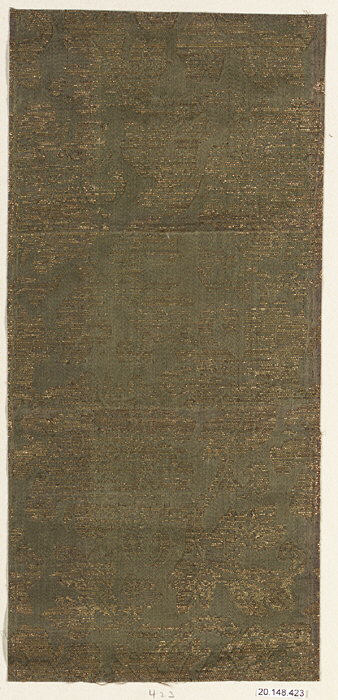
In the rarefied domain of haute couture, where fabric transcends utility to become a medium of cultural storytelling, the piece under analysis at Katherine Fashion Lab demands a singular lexicon. This is not a garment designed for the transient rhythms of seasonal trends; it is a standalone study—a frozen moment of textile alchemy that originates from Japan and is executed in a silk compound weave. To approach this piece is to engage with a paradox: a material renowned for its fluidity and softness, here rendered with an almost architectural rigidity and sculptural precision. The compound weave, a structural technique where two or more sets of warp and weft interlace to create a fabric with distinct front and back faces, elevates silk from a mere surface to a complex, three-dimensional system. This analysis dissects the piece’s material provenance, its technical audacity, and its philosophical resonance as a bridge between Japanese textile tradition and the avant-garde ethos of contemporary couture.
Material Provenance: The Paradox of Rigid Silk
Silk, in its natural state, is a protein fiber known for its tensile strength, luster, and drape. Yet, the silk used in this piece is not the gossamer charmeuse or supple crepe de chine familiar to Western couture. Instead, the compound weave introduces a structural density that redefines the fabric’s behavior. The term “compound weave” often refers to techniques like damask, brocade, or double cloth, where the interplay of warp and weft creates patterns that are not merely printed but *woven into the fabric’s core*. In this Japanese piece, the compound weave likely employs a shibori-inspired resist-dyeing technique integrated into the weaving process, or a nishijin-ori heritage, a Kyoto-based tradition that uses gold and silver threads alongside silk to create fabrics of extraordinary weight and dimensionality. The result is a silk that stands—literally—as a sculptural entity, resisting the gravitational pull that defines most silk garments.
This paradox is intentional. The fabric’s stiffness is not a flaw but a design choice, evoking the armor-like *kimono* of feudal Japan, where layered silks signified status and protection. However, unlike historical armor, this piece is not meant to be worn in a conventional sense. It is a standalone study, a textile *objet d’art* that invites the viewer to examine its structural logic. The compound weave allows for a double-faced construction: one side may present a matte, almost paper-like texture, while the reverse reveals a glossy, iridescent surface. This duality speaks to the Japanese aesthetic of *omote* (front) and *ura* (back), where hidden beauty is as significant as the visible facade.
Technical Audacity: The Weave as Narrative Architecture
To understand the technical mastery of this piece, one must deconstruct the compound weave’s mechanics. In a standard silk weave, the warp and weft intersect at right angles, creating a single layer. In a compound weave, additional warp or weft systems are introduced, allowing for patterns that can be raised, recessed, or even detached from the base structure. In this piece, the compound weave is used to create a topographical surface—a landscape of raised ridges and recessed valleys that mimic the undulating forms of a Japanese mountain range or the ripples of a Zen rock garden. This is not a flat textile; it is a relief sculpture.
The use of kumihimo-inspired braided threads within the weave further enhances the architectural quality. These braids, traditionally used for cordage in *obi* (kimono sashes), are here integrated as structural ribs, reinforcing the fabric’s ability to hold its shape without the need for internal boning or interfacing. The piece’s silhouette—a voluminous, cocoon-like form with sharp, angular pleats—is entirely self-supporting. This is a radical departure from the Western couture tradition of using corsetry or padding to achieve volume. Instead, the fabric itself becomes the armature.
Additionally, the dyeing process is integral to the weave’s narrative. The color palette—a gradient from deep indigo at the base to a pale, almost translucent white at the apex—is achieved through a kasuri (ikat) technique, where the threads are resist-dyed before weaving. The compound weave ensures that the color transitions are not merely surface-level but are embedded in the fabric’s matrix. When light hits the piece, the colors shift depending on the angle, revealing hidden hues of silver and vermilion. This chromatic depth is a hallmark of Japanese textile mastery, where the interplay of light and shadow (*komorebi*) is revered as a design principle.
Philosophical Resonance: Wabi-Sabi and the Imperfect Perfect
Beyond its technical brilliance, this piece embodies the Japanese philosophy of wabi-sabi—the appreciation of imperfection, transience, and the beauty of the incomplete. The compound weave, by its nature, introduces irregularities: a thread may be slightly thicker in one area, a color may bleed subtly into an adjacent section. These are not errors but intentional expressions of the artisan’s hand. In the context of couture, where precision is often paramount, this embrace of controlled imperfection is a radical act. It challenges the Western obsession with flawlessness and instead elevates the fabric’s organic life.
The piece also engages with the concept of ma—the negative space that gives form and meaning to objects. The raised ridges of the compound weave create pockets of shadow and void, inviting the viewer to contemplate what is not there. This is not a fabric that clamors for attention; it is a fabric that demands stillness. In a world of fast fashion and digital saturation, this piece functions as a meditative object, a counterpoint to the ephemeral. It is a textile that has taken months to weave, and its presence insists on a reciprocal investment of time from the observer.
Conclusion: The Future of Couture as Textile Scholarship
As a standalone study, this Japanese silk compound-weave piece at Katherine Fashion Lab redefines the boundaries of couture. It is not a garment to be worn but a thesis to be read—a testament to the fact that fabric can be both a medium and a message. The compound weave, often relegated to the realm of decorative textiles, is here elevated to a structural and philosophical tool. The silk, typically associated with softness, is transformed into a material of strength and permanence. The Japanese origin is not a mere geographical footnote but the foundational ethos that governs every thread, every dye, every pleat.
For the couture industry, this piece signals a return to the roots of haute couture as a laboratory for textile innovation. In an era dominated by digital prints and synthetic blends, the handwoven, compound-weave silk stands as a defiant reminder of what is possible when craftsmanship is given primacy. The piece is not a relic of the past but a blueprint for the future—a future where fashion is not merely about covering the body but about revealing the soul of a culture through the language of thread and weave. At Katherine Fashion Lab, we do not just observe this piece; we study it, honor it, and let it reshape our understanding of what couture can be.