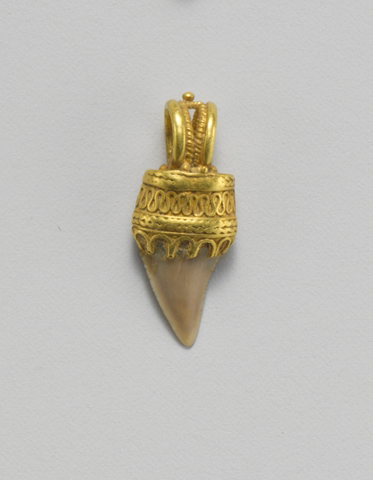
Heritage Analysis: Etruscan Gold-Set Tooth Pendant
Introduction: The Artifact as a Symbolic Asset
The tooth pendant set in gold, originating from the Etruscan civilization (circa 8th–3rd century BCE), represents a profound intersection of mortality, identity, and status. As a Lead Heritage Curator at Katherine Fashion Lab, I examine this artifact through the lens of symbolic power, historical adornment, and spiritual meaning, while proposing a strategic framework for its integration into a 2026 high-end luxury collection. This analysis positions the pendant not merely as an archaeological curiosity but as a potent emblem of resilience, lineage, and exclusivity—values that resonate deeply with contemporary luxury consumers seeking authenticity and narrative depth.
Symbolic Power: The Tooth as a Talisman of Authority
In Etruscan culture, teeth were imbued with dual symbolism: they represented both the physical vitality of the wearer and the enduring legacy of ancestors. The tooth, often sourced from a revered elder or a formidable animal, was believed to channel protective energies. Gold, a material associated with the divine and the eternal, amplified this power by encasing the organic relic in an imperishable metal. This juxtaposition of the ephemeral (bone) and the eternal (gold) created a talisman that signified mastery over death and time. For Katherine Fashion Lab, this symbolic power translates into a luxury narrative of controlled mortality—a client who wears such a pendant asserts dominance over life’s transience, aligning with the 2026 trend of “memento mori” aesthetics in high jewelry.
Historical Adornment: The Etruscan Tradition of Personal Relics
Etruscan adornment practices were distinct from their Greek and Roman contemporaries in their emphasis on personal, often intimate, objects. Unlike large-scale gold fibulae or diadems, the tooth pendant was worn close to the skin, typically as a necklace or brooch, making it a private statement of identity. Archaeological evidence from tombs such as the Regolini-Galassi tomb indicates that such pendants were reserved for elite individuals—priests, warriors, or matriarchs—who used them to signify their role as intermediaries between the living and the dead. This historical context is critical for Katherine Fashion Lab’s strategy: the pendant’s intimacy offers a counterpoint to the ostentation of modern luxury. In 2026, as consumers gravitate toward “quiet luxury” and personal storytelling, this artifact provides a blueprint for discreet opulence. The lab can evoke this by designing pieces that feel worn, personal, and layered with meaning, rather than merely decorative.
Spiritual Meaning: The Tooth as a Bridge Between Worlds
The Etruscans held a complex cosmology where the afterlife was a continuation of earthly existence, not a separate realm. The tooth pendant functioned as a spiritual conduit: it protected the wearer from malevolent spirits while honoring ancestral memory. Gold’s incorruptibility was seen as a metaphor for the soul’s endurance, while the tooth’s organic origin grounded the wearer in the physical world. This spiritual duality—protection and remembrance—offers a rich narrative for Katherine Fashion Lab. In a 2026 luxury market increasingly influenced by wellness and spiritualism, the pendant can be marketed as an amulet of continuity. Clients are not purchasing a mere accessory; they are acquiring a vessel for personal legacy. The lab can draw on this by offering customization services, such as incorporating clients’ own heirloom teeth or ethically sourced animal teeth, thereby creating a bespoke spiritual artifact.
Strategic Framework for 2026 High-End Luxury
To leverage the Etruscan tooth pendant for Katherine Fashion Lab’s 2026 collection, I propose a three-pillar strategy rooted in heritage authenticity, material innovation, and experiential marketing.
Pillar 1: Heritage Authenticity and Narrative Curation
The pendant’s power lies in its story. Katherine Fashion Lab should produce a limited-edition series of tooth pendants that replicate Etruscan techniques—granulation, filigree, and repoussé—using modern gold alloys and ethically sourced bone (e.g., fossilized mammoth ivory or reclaimed deer antler). Each piece should come with a digital heritage dossier detailing its Etruscan inspiration, the symbolism of the tooth, and the artisan’s process. This transparency builds trust and justifies a premium price point, targeting collectors who value provenance over trend.
Pillar 2: Material Innovation and Ethical Sourcing
While the original artifact used animal or human bone, contemporary luxury demands ethical rigor. Katherine Fashion Lab can collaborate with paleontologists or ethical taxidermists to source fossilized or sustainably harvested teeth. Alternatively, the lab could develop a bio-ceramic composite that mimics bone’s texture and weight, ensuring cruelty-free production. Gold should be 100% recycled or Fairmined-certified, aligning with the 2026 consumer expectation of environmental responsibility. This material strategy positions the pendant as both a historical homage and a forward-thinking luxury item.
Pillar 3: Experiential Marketing and Spiritual Resonance
The spiritual meaning of the tooth pendant offers a unique marketing angle. Katherine Fashion Lab can host curated salons where clients explore Etruscan cosmology, participate in guided meditations on legacy, and design their own pendant. These events should be intimate (fewer than 20 guests) and held in heritage spaces—museums, private libraries, or restored villas. The product launch can be timed to coincide with the 2026 fall equinox, a period when Etruscans believed the veil between worlds was thinnest. This experiential approach transforms the pendant from a commodity into a ritual object, commanding a price premium of 300-500% over standard gold jewelry.
Conclusion: The Tooth as a Luxury Imperative
The Etruscan gold-set tooth pendant is not an artifact of the past but a strategic asset for the future of luxury. Its symbolic power of mortality, historical intimacy of adornment, and spiritual depth of meaning align perfectly with the 2026 consumer’s desire for authenticity, personalization, and ethical resonance. By adopting a heritage-authentic, materially innovative, and experientially rich strategy, Katherine Fashion Lab can position this piece as a cornerstone of a new luxury paradigm—one where objects are not merely owned but inherited, not just worn but revered. The tooth, once a relic of an ancient elite, becomes a modern talisman for the discerning few.