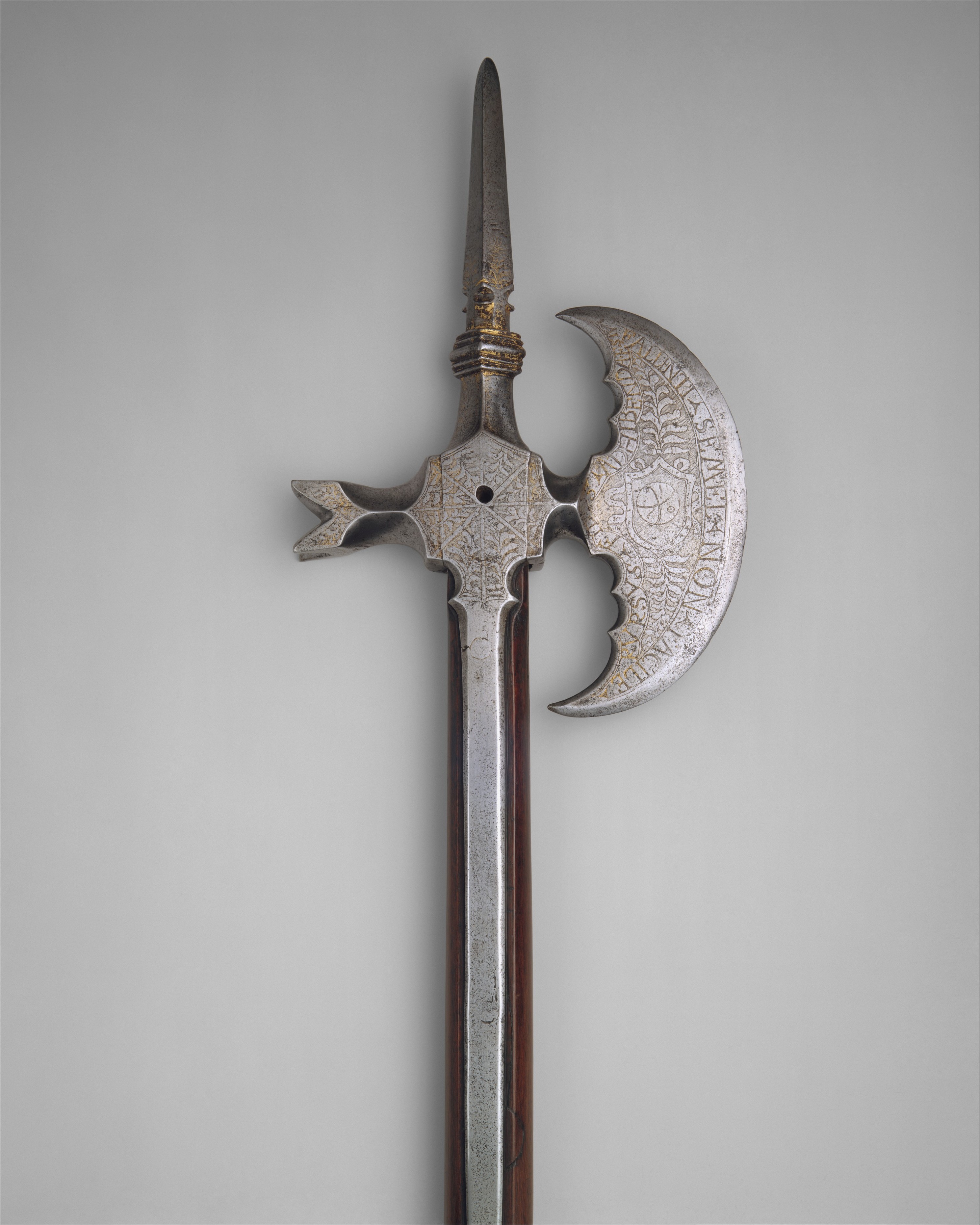
An Instrument of Power: Decoding the Couture Narrative of the Horseman’s Ax
The Horseman’s Ax of Cardinal Ippolito de’ Medici, crafted in the crucible of the Italian Renaissance, presents a formidable paradox. It is an object of brutal utility, yet its surface is a manuscript of exquisite artistry. For Katherine Fashion Lab, this artifact is not merely a weapon; it is a seminal case study in the language of power dressing at its most literal and symbolic. In an era where personal adornment was a direct extension of political, social, and intellectual identity, this ax transcends its martial function to become a wearable manifesto. Our analysis deconstructs its elements as one would a groundbreaking collection, revealing a narrative of dynastic ambition, humanist erudition, and calculated personal branding, where steel and gold communicate as eloquently as any silk or velvet.
The Silhouette of Authority: A Deconstruction of Form and Function
The very form of the horseman’s ax establishes its primary vocabulary: controlled aggression and hierarchical dominance. Its elongated haft, designed for reach from horseback, creates a vertical line of command, a literal extension of the rider’s arm and will. The Lab examines this as the foundational silhouette—one of imposing scale and undeniable presence. The axe blade, a sweeping curve of hardened steel, introduces a contrasting, decisive arc. This is not the ragged tear of a battlefield tool; its edge is precise, its shape almost elegant in its lethality. It speaks to a specific kind of violence: not chaotic, but administered, judicial, and coldly efficient. The complementary hammerhead on the reverse reinforces this notion of multifaceted authority—the blade to cleave, the hammer to crush, a complete toolkit of secular and martial power. This functional duality is the cornerstone of the garment’s, or rather, the artifact’s, statement. It is power articulated through perfect, fearsome utility, a silhouette meant to be seen and understood at a distance.
The Embellishment Codex: Heraldry as Brand Identity
If the form is the tailored suit of armor, the gold damascening is the embroidered insignia, the bespoke lapel pin, and the family crest woven into the lining. The application of gold to steel is an alchemical transformation, turning a tool of war into a carrier of ideology. The prominent display of the Medici palle, the six (often five, here strategically placed) balls, is the ultimate exercise in brand placement. This is not subtle branding; it is a declaration of ownership and lineage. Every swing of the ax, every moment it is held aloft or rested against a saddle, propagates the Medici name. The Lab interprets this through the lens of contemporary logo-mania, but with higher stakes. This was not about commercial appeal but about asserting a right to rule, connecting the wielder to a dynasty that bankrolled popes and controlled Florence. The intricate foliate scrolls that accompany the heraldry are equally significant. They anchor the piece firmly within the Renaissance aesthetic, referencing a revival of classical art and a celebration of natural beauty—even on an instrument of death. This juxtaposition is the core tension and genius of the piece: the marriage of humanist refinement with raw political force.
The Patron as Muse: Ippolito de’ Medici and the Performance of Identity
Understanding this piece requires a profile of its intended wearer. Cardinal Ippolito de’ Medici was a man of profound contradictions: a prince of the Church who was also a celebrated military commander, a patron of artists like Michelangelo who lived a life marked by intrigue and ambition. He was, in essence, curating a public persona. This ax was a key accessory in that performance. For the militant cardinal, it resolved the cognitive dissonance of his roles. It allowed him to present as a warrior-prince without fully abandoning the symbolic trappings of his ecclesiastical rank, which would have forbidden the carrying of a sword in many contexts. The horseman’s ax occupied a more ambiguous, and thus useful, space. It communicated martial readiness and secular authority while perhaps being seen as more of a command staff or a tool of travel than a formal weapon of personal combat. It was, in the Lab’s view, the perfect prop for a man navigating the highest echelons of both the Vatican and the battlefield, a sartorial solution to a complex identity crisis.
Material Allegory: The Semiotics of Steel, Gold, and Wood
A couture analysis is incomplete without a meditation on materials. Here, each element is a loaded signifier. Steel represents the unyielding reality of power—its strength, its edge, its cold permanence. It is the base truth of the Renaissance state: force ultimately underpins rule. Gold is the soft, malleable language of legitimacy, wealth, and divine favor. Its inlay onto the steel is a visual metaphor for the gilding of raw power with culture, religion, and tradition. The wood of the haft, now lost to time but originally present, connects the object to the earthly and the organic. It provides the grip, the point of human contact, reminding us that this instrument, for all its symbolism, was meant to be held and wielded by a man. Together, this material trilogy creates a holistic statement: power is multifaceted, requiring physical might (steel), economic and cultural capital (gold), and human agency (wood) to be fully realized.
Conclusion: A Legacy in the Language of Objects
The Horseman’s Ax of Cardinal Ippolito de’ Medici stands as a masterclass in integrated personal branding. It demonstrates that the most powerful statements are those where form, function, and decoration are in complete, relentless alignment. Every element, from the curve of the blade to the placement of each gold ball, serves a dual purpose: practical and propagandistic. For Katherine Fashion Lab, it underscores a fundamental principle: true couture is not merely about aesthetics worn on the body; it is about the construction of an identity that is *performed* through objects. This ax is Ippolito’s thesis on his own right to power, crafted in a workshop but destined for the theater of politics and war. It reminds us that in the high-stakes couture of statecraft, the most enduring garments are sometimes forged, not sewn, and their message, though silent, was designed to echo through history.