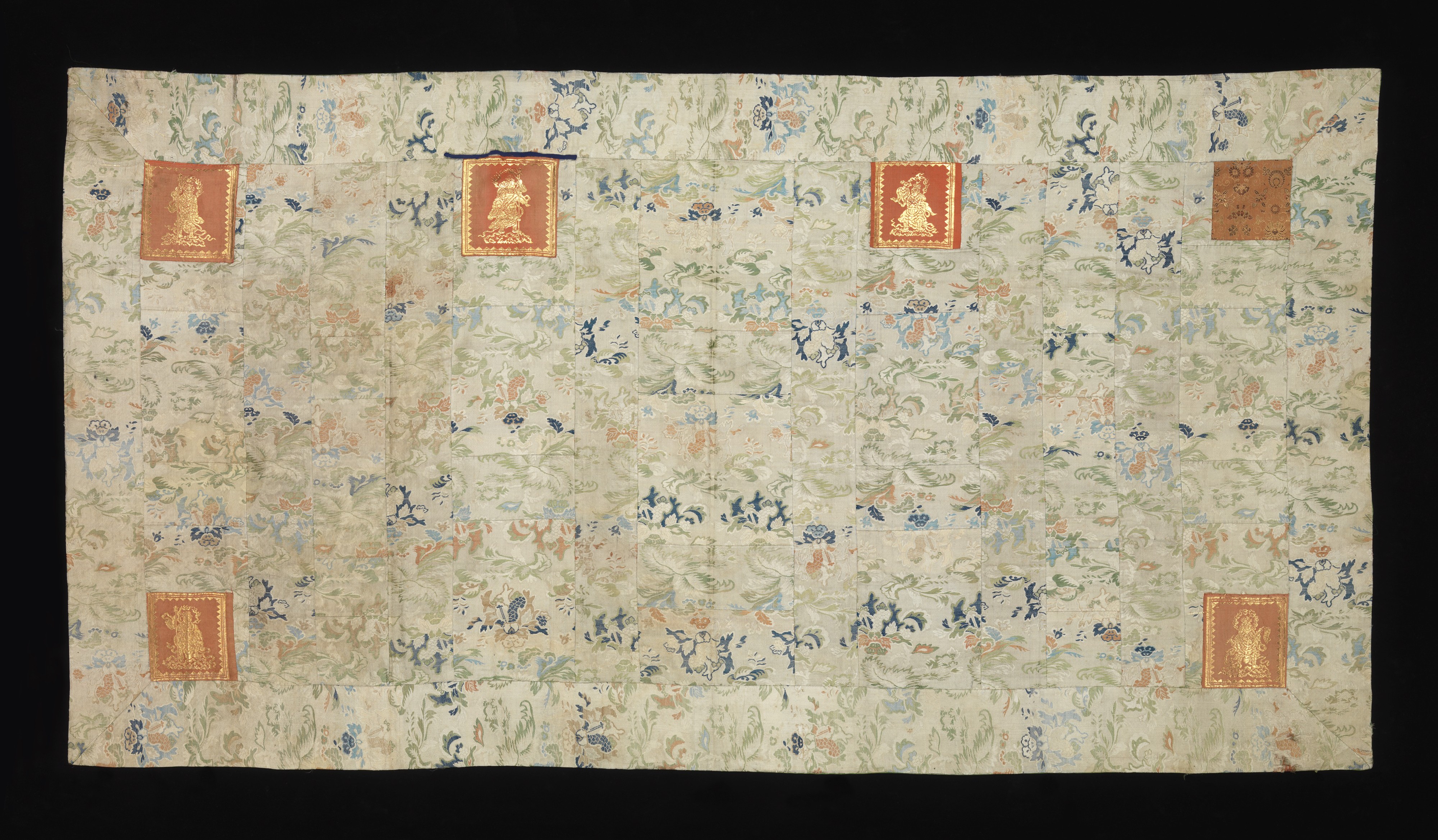
Deconstructing the Sacred Weave: A Couture Analysis of the Japanese Buddhist Kesa with Figural Squares
The intersection of sartorial artistry and spiritual devotion finds few expressions as profound as the Japanese Buddhist kesa, a vestment that transcends mere garment to become a portable reliquary of faith and craftsmanship. At Katherine Fashion Lab, we approach this artifact not simply as a historical textile but as a masterclass in material storytelling, where every thread, weave, and motif is a deliberate act of aesthetic and theological precision. This analysis dissects the kesa’s construction—specifically a variant featuring a body of silk lampas and squares of silk twill with supplementary weft patterning in metallic thread—to illuminate how its design principles resonate with contemporary couture’s most rigorous standards of luxury, symbolism, and structural integrity.
The Architectural Body: Silk Lampas as Sacred Foundation
The kesa’s primary body, woven from silk lampas, establishes a foundational lexicon of opulence and restraint. Lampas, a compound weave structure that allows for a pattern to emerge on a contrasting ground, is historically associated with elite ecclesiastical and courtly textiles. In this vestment, the lampas technique creates a subtle, allover pattern—often geometric or floral—that serves as a visual and tactile anchor. The silk’s natural luster, with its ability to capture and reflect ambient light, imbues the garment with a luminescent humility; it is rich without being ostentatious, sacred without being inaccessible.
From a couture perspective, the choice of lampas is a strategic one. Unlike simpler weaves, lampas requires a sophisticated loom setup and a high degree of skill to ensure the pattern’s clarity across the garment’s dimensions. This echoes the contemporary luxury atelier’s insistence on bespoke fabrication. The kesa’s body, therefore, is not a blank canvas but a meticulously composed ground, its pattern acting as a rhythmic pulse that prepares the eye for the more dramatic figural squares. The weight and drape of the silk lampas also serve a functional purpose: the fabric’s density allows the kesa to fall in structured, sculptural folds when worn, a quality that any haute couture designer would recognize as essential to a garment’s architectural presence.
The Figural Squares: Narrative Embellishment in Silk Twill and Metal
Attached to the lampas body are individually woven squares, each a concentrated universe of iconography and technique. These squares are constructed from silk twill, a weave known for its diagonal ribbing and excellent drapability, which provides a stable yet supple substrate for the elaborate supplementary weft patterning. The use of twill is deliberate: its subtle texture contrasts with the lampas’s smoother face, creating a tactile dialogue between the base garment and its applied elements. More critically, the twill’s structure allows the metallic threads—typically silver or gold-wrapped silk or paper—to sit prominently on the surface without distorting the fabric’s integrity.
The supplementary weft technique, wherein additional weft threads are woven into the ground fabric to create a pattern, is a hallmark of precision craftsmanship. In these squares, the metallic threads form figural representations: often Buddhas, bodhisattvas, or celestial beings, each rendered with an economy of line that belies the complexity of the weave. The metallic thread catches light at varying angles, causing the figures to appear to shimmer or recede depending on the viewer’s perspective. This dynamic visual effect is not accidental; it mirrors the Buddhist concept of impermanence and illusion (maya), where the sacred is both revealed and elusive. For the modern couturier, this technique offers a lesson in tactile storytelling: the garment does not merely display an image; it performs it, changing with every movement of the wearer.
Symbolic Cartography: The Grammar of Placement and Color
The arrangement of the figural squares on the kesa’s body follows a strict hierarchical grammar. Typically, a larger central square depicts the primary Buddha or a key figure, flanked by smaller squares representing attendants or scenes from scripture. This layout mirrors the mandala, a cosmic diagram used in meditation, where the center represents the axis mundi. The squares are not randomly placed but are sewn onto the lampas body with precise spacing, creating a visual rhythm that guides the viewer’s gaze from periphery to core. This is a lesson in editorial composition: every element has a designated weight and relationship to the whole, a principle that underpins high-end collection planning.
Color, too, is a critical semantic vector. While the lampas body may be a subdued gold, ochre, or deep indigo, the squares often introduce contrasting hues—vermilion, emerald, or lapis blue—that are amplified by the metallic threads. These colors are not arbitrary; they correspond to Buddhist iconographic codes: gold for enlightenment, red for life force, blue for compassion. In couture terms, this is akin to a color story that communicates a brand’s ethos without a single word. The kesa demonstrates that color is not merely decorative but symbolically charged, a tool for encoding meaning into the garment’s very surface.
Structural Integrity: Joining the Sacred and the Secular
The method of attaching the squares to the lampas body is a study in invisible engineering. The squares are typically appliquéd using fine silk thread, with stitches that are nearly imperceptible. This technique ensures that the squares lie flat against the body fabric, maintaining the kesa’s overall silhouette without buckling or distortion. The edges of the squares are often finished with a narrow metallic braid or couched thread, which serves both as a decorative border and as a structural reinforcement. This attention to seamless integration is a hallmark of couture construction, where the joining of disparate materials must appear effortless while withstanding the stresses of wear.
Furthermore, the kesa is assembled from multiple panels of lampas, each joined with flat-felled or French seams to create a smooth, unbroken surface. This is particularly significant given the garment’s rectangular form, which is designed to be draped over the left shoulder and under the right arm. The seams must align with the body’s movement, allowing the kesa to drape elegantly without pulling or sagging. This is a direct parallel to the pattern-making discipline in haute couture, where a garment’s fit and fall are predicated on precise seam placement and fabric grain.
Couture Implications: Timeless Lessons in Material Mastery
For the contemporary fashion house, the Japanese kesa offers a masterclass in material integrity and narrative depth. Its use of silk lampas demonstrates how a base fabric can be elevated through weave complexity, while the figural squares in silk twill and metallic thread show that embellishment need not be heavy-handed to be impactful. The garment’s symbolic coding—through color, placement, and iconography—provides a blueprint for how luxury brands can embed meaning into their collections without resorting to overt branding.
Moreover, the kesa’s construction methods—invisible appliqué, precise seam engineering, and the integration of metallic threads—are directly applicable to modern couture’s pursuit of technical perfection. The vestment challenges the notion that sacred textiles are static artifacts; rather, they are dynamic systems of design that respond to light, movement, and context. At Katherine Fashion Lab, we view this kesa not as a relic but as a living document of design intelligence, one that continues to inform how we conceive of luxury as a synthesis of the material, the symbolic, and the transcendent.
In an era where fashion often prioritizes speed over substance, the kesa stands as a testament to the enduring power of slow, intentional making. Its squares of figural silk twill, woven with metallic precision, are not just adornments but meditations on form. For the discerning curator or designer, this garment offers an inexhaustible well of inspiration, proving that the most profound couture is, at its heart, a dialogue between the hands that weave and the spirit that wears.