The Unadorned Guest: A Couture Analysis of Divine Disruption
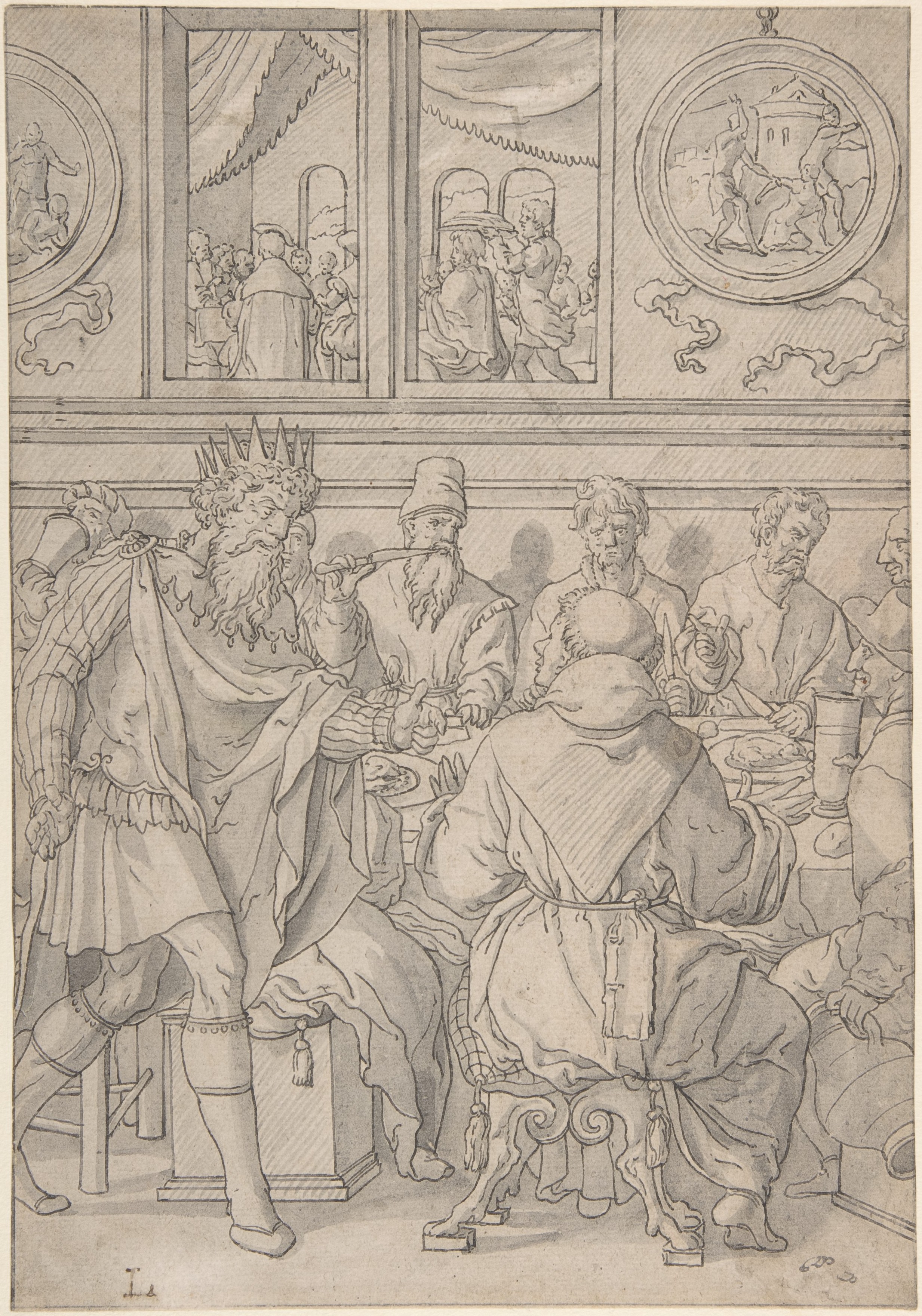
In the hallowed halls of Katherine Fashion Lab, where the ephemeral meets the eternal, we dissect not merely fabric, but the very fabric of human destiny. The subject before us is a striking standalone study—a pen-and-brush rendering in gray ink and wash—depicting a pivotal scene from the Parable of the Marriage Feast (Matthew 22:11-14). The king, his posture a thundercloud of regal indignation, denounces a man who stands conspicuously unadorned, bereft of the required wedding robe. This is not a simple illustration of ancient hospitality; it is a profound meditation on the sartorial contract between the individual and the divine, a moment where couture becomes cosmic judgment.
The King’s Garment of Authority
The king’s figure is rendered with a deliberate, almost architectural weight. His robe is not merely a garment; it is a statement of sovereignty, a materialization of the kingdom’s law. The artist’s use of gray wash creates a layered, volumetric effect, suggesting heavy brocade or velvet, possibly shot with threads of silver. The folds are deep and angular, like the crevices of a mountain, conveying an immovable authority. His posture—a slight lean forward, a pointing finger that is both accusatory and decisive—is a study in kinetic power. The garment’s collar rises sharply, framing a face that is less angry than it is implacably just. This is a king who does not negotiate; he judges. The gray ink, applied with swift, confident strokes, lends his form a sense of moral gravity, as if the very atmosphere around him has thickened with consequence.
The Unrobed Man: A Study in Sartorial Nakedness
Contrast this with the guest. He is depicted in a state of profound vulnerability. His clothing—what little there is—appears common, perhaps a simple tunic or the worn garb of a traveler. The artist has deliberately left his form less defined, the wash applied with a lighter, more hesitant hand, as if his very existence is fading in the face of the king’s scrutiny. His posture is defensive, arms slightly raised, palms open in a gesture of futile explanation. He is not dressed in rags; he is dressed in the everyday, which, in this context, is the ultimate transgression. The study highlights a critical couture principle: context dictates appropriateness. A garment that is perfectly acceptable at a roadside inn becomes a mark of profound disrespect in a royal wedding hall. The man’s failure is not one of poverty, but of situational awareness. He has failed to read the dress code of the divine, a code written not in fabric but in the soul’s readiness.
The Wedding Robe as Metaphysical Couture
This parable, as interpreted through this study, elevates clothing from the physical to the metaphysical. The wedding robe is not a literal garment that could be purchased or borrowed; it is a symbol of spiritual preparation, of inner transformation made manifest. In the language of haute couture, we might call it the “garment of grace.” The king’s denunciation is not about the absence of cloth, but the absence of a certain state of being. The man has entered the sacred space—the feast—without undergoing the necessary internal alchemy. He has brought his mundane self into a realm of elevated celebration. The gray ink, with its monochromatic austerity, underscores this point: there is no color, no ornament, no personal expression that can substitute for the required spiritual attire. The study’s starkness forces the viewer to confront the emptiness of the man’s soul, a void that no earthly fabric can fill.
Pen and Brush: The Art of Moral Linework
The choice of medium—pen and brush with gray ink and wash—is itself a powerful narrative tool. The pen provides the linework of judgment: precise, unyielding, and defining. The brush offers the wash of ambiguity: soft, atmospheric, and suggestive. Together, they create a visual tension between clarity and obscurity. The king’s form is defined by crisp, almost calligraphic lines; he is the law made visible. The guest’s form, by contrast, is softened by the wash, his edges blurring into the background, as if he is already being erased from the narrative. This technique mirrors the parable’s theological stakes: the king’s word is final, a line drawn in the sand of eternity, while the guest’s protest is a fading whisper. The artist’s hand, in this sense, becomes the hand of judgment itself, rendering the scene with both artistic precision and moral clarity.
Global Heritage and the Universal Code
Though the parable is rooted in a specific Judeo-Christian tradition, the study’s classification under “Global Heritage” invites a broader interpretation. The concept of a required garment for a sacred event is nearly universal. From the white robes of initiation in ancient mystery cults to the formal attire demanded at imperial courts across Asia and Europe, the wedding robe represents a universal human need to signal readiness and respect. This study, therefore, transcends its biblical origins to speak to a fundamental truth: that every culture, every society, has a sartorial threshold that must be crossed for entry into its most sacred spaces. The man’s failure is a failure of cultural literacy, a blindness to the non-verbal language of honor. The king’s denunciation is a reminder that ignorance of the code is not an excuse; the code is written into the very fabric of the event.
Implications for Contemporary Couture
What does this 17th-century-style study offer the modern fashion professional? A stark lesson in intentional dressing. In an age of casualization and personal expression, the parable challenges us to consider the power of the robe. It asks: What are you communicating when you enter a space? Are you dressing for the occasion, or for yourself? The study suggests that true couture is not about personal preference; it is about honoring the context. The wedding robe is the ultimate act of respect—a surrender of the self to the greater narrative. It is a garment that says, “I understand the importance of this moment, and I have prepared myself to be part of it.” The king’s anger is not at the man’s poverty, but at his presumption—the arrogance of showing up to a royal feast as if it were a casual gathering.
Conclusion: The Unforgiving Mirror of the Robe
This standalone study, with its masterful use of gray ink and wash, is a mirror held up to the soul of the viewer. It forces us to ask: What is our wedding robe? Have we prepared ourselves for the feasts we are invited to—be they professional, spiritual, or relational? The king’s denunciation is not a moment of petty anger; it is a moment of divine disappointment. The man had access to the feast, but he did not have access to the transformation required to fully participate. In the language of Katherine Fashion Lab, we might say he had the invitation but not the attitude. The study’s enduring power lies in its simplicity: a line, a wash, a gesture, and a truth that no amount of fabric can hide. The wedding robe is not worn on the body; it is worn in the spirit. And when that spirit is absent, no couture can save you.