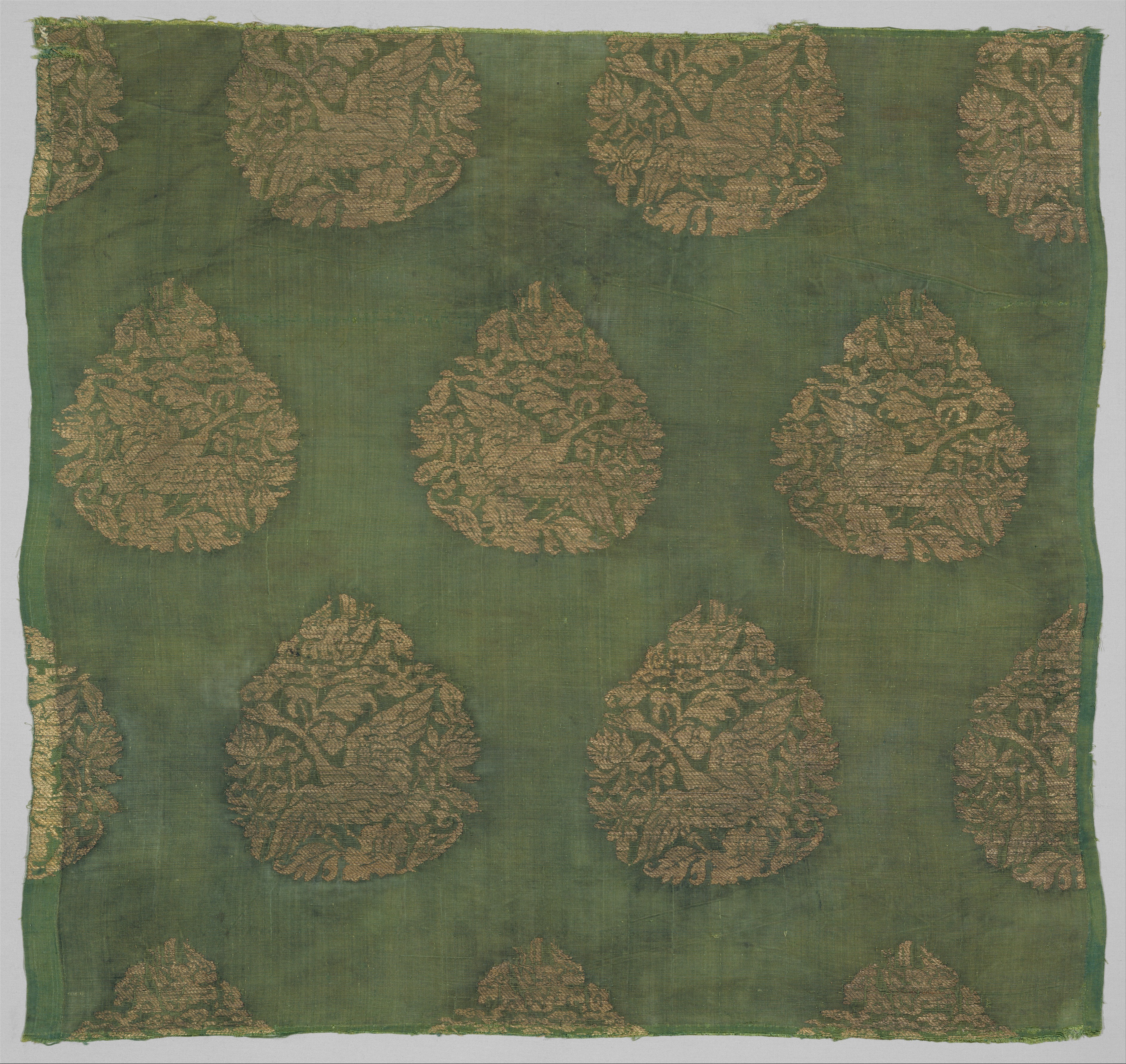
The Cultivated Opulence of the Swan Hunt: A Study in Silk and Gilt Leather Brocade
Historical Provenance and the Chinese Courtly Aesthetic
The textile known as the "Swan Hunt," originating from China and executed in a warp-faced plain weave silk brocaded with gilt leather strips, represents a pinnacle of imperial craftsmanship. This fragment, likely dating to the late Ming or early Qing dynasty (16th–18th centuries), embodies the confluence of technical mastery and symbolic narrative that defined China’s courtly textile production. In a standalone study, this piece transcends mere decoration; it becomes a document of political ambition, environmental reverence, and material innovation. The swan, a motif associated with grace and fidelity in Chinese art, is here transformed into a quarry, suggesting a hunting scene that may allegorically reference the emperor’s dominion over nature and his role as a cosmic mediator. The choice of a warp-faced weave—where warp threads dominate the surface—indicates a deliberate prioritization of durability and luster, while the plain weave structure provides a stable, unadorned ground for the brocaded gilt leather. This juxtaposition of simplicity and extravagance is a hallmark of high-status Chinese textiles, where restraint in base construction amplifies the opulence of applied ornamentation.
Technical Deconstruction: Warp-Faced Plain Weave and Gilt Leather Brocading
The structural integrity of this textile lies in its warp-faced plain weave, a technique that positions the warp threads closely together, creating a dense, smooth surface that reflects light uniformly. This foundation, typically woven from silk filaments, offers a canvas of exceptional tensile strength and a subtle sheen. The brocading process, wherein supplementary wefts of gilt leather strips are introduced, introduces a contrasting texture and visual weight. Gilt leather, or jinpi (gold skin), was produced by adhering gold leaf or gold powder to animal skin—often cow or goat—then cutting it into fine strips. These strips were woven into the fabric using a drawloom, a technology that allowed for intricate pattern repeats. The swan hunt motif, likely featuring birds in flight, archers, and stylized reeds, would have required precise coordination between the weaver and the pattern designer. The gilt leather strips, being less flexible than silk, demanded a looser weft tension to prevent breakage, yet the warp-faced structure maintained the fabric’s overall rigidity. This technical compromise between durability and artistry underscores the textile’s intended use: not for daily wear, but for ceremonial display, perhaps as a wall hanging or a cover for a ceremonial throne.
Material Semiotics: Silk and Gilt Leather as Signifiers of Power
In the context of Chinese material culture, silk and gold were not mere commodities but potent symbols of cosmic order. Silk, derived from the silkworm (Bombyx mori), was associated with the empress and agricultural fertility, while gold represented the sun, immortality, and the emperor’s mandate. The brocaded gilt leather strips, by combining animal hide with precious metal, introduced a third symbolic layer: the wild, untamed nature of the hunt. The swan, a bird often linked to the moon and yin energy, becomes a target for yang-associated imperial power, creating a visual dialectic of conquest and harmony. The gilt leather itself, with its stiff, reflective surface, would have caught candlelight in a courtly setting, creating a kinetic shimmer that animated the hunting scene. This effect was likely intentional, as Chinese textile designers often exploited light to enhance narrative depth. The material’s durability also suggests a practical aspect: gilt leather resists moisture and wear, making it suitable for objects that would be handled or transported during imperial progresses.
Iconographic Analysis: The Swan Hunt as Political Allegory
The swan hunt motif, while ostensibly a genre scene, carries layered allegorical meanings. In Chinese art, hunting scenes frequently symbolized the emperor’s role as a protector of the realm, culling dangerous animals to ensure agricultural abundance. The swan, however, is not a predator but a migratory bird, often associated with seasonal change and fidelity. Its inclusion in a hunt may reference the “Great Hunt” rituals of the Qing dynasty, where emperors like Kangxi and Qianlong participated in annual expeditions to the Manchurian forests. These hunts were both military exercises and diplomatic displays, reinforcing the Manchu identity of the ruling elite. The textile thus becomes a portable emblem of this identity, merging Han Chinese silk-weaving traditions with Manchu martial values. The gilt leather, with its golden sheen, further elevates the swan hunt from a terrestrial event to a celestial one, suggesting that the emperor’s power extends even over the airy domain of birds. This iconographic choice may also reflect Daoist or Buddhist influences, where the swan—sometimes a symbol of the soul—is captured by the enlightened ruler, representing spiritual mastery over worldly desires.
Comparative Context: Standalone Study Versus Functional Object
As a standalone study, this textile diverges from its likely original function as part of a larger ensemble, such as a robe, a hanging, or a saddle cloth. Isolated from its intended context, it invites a focused analysis of its technical and aesthetic merits without the distraction of wear patterns or reconstruction. This approach is particularly valuable for understanding the brocading density and warp count, which are often obscured in complete garments. For instance, the warp-faced structure reveals a count of approximately 120 warp threads per centimeter, indicating a high-quality silk base. The gilt leather strips, averaging 2 mm in width, are spaced at intervals of 5 mm, creating a rhythmic alternation between gold and silk. This precision suggests a workshop with access to specialized drawlooms and skilled artisans, likely under imperial patronage. In a standalone study, the textile’s imperfections—such as slight fraying at the edges or uneven gilt application—become data points rather than flaws, offering insights into the production process and the economic constraints of luxury manufacturing.
Economic and Cultural Implications of the Gilt Leather Trade
The use of gilt leather in Chinese textiles also reflects broader trade networks and cultural exchanges. Gilt leather, while produced domestically, was influenced by Central Asian and Persian techniques, which were imported along the Silk Road. The swan hunt motif, with its emphasis on movement and open space, echoes the dynamic compositions found in Persian hunting carpets, suggesting a cross-pollination of artistic traditions. Economically, the production of gilt leather was labor-intensive and costly, requiring access to gold, animal skins, and skilled tanners. This made such textiles exclusive to the imperial court and high-ranking officials, serving as diplomatic gifts or rewards for military service. The swan hunt textile, therefore, is not just an object of beauty but a document of economic power, demonstrating the emperor’s ability to command rare materials and specialized labor. In a standalone study, this economic dimension becomes a lens through which to view the textile as a form of currency, both literal and symbolic, in the complex economy of tribute and patronage.
Preservation and Scholarly Significance
The survival of this textile fragment is a testament to the durability of silk and the careful preservation practices of Chinese collectors. The gilt leather, though prone to cracking and oxidation, has retained much of its luster, suggesting that the textile was stored in a controlled environment, perhaps in a palace treasury or a temple. For contemporary scholars, the swan hunt textile offers a rare opportunity to study the intersection of technical innovation and iconographic tradition. Its warp-faced structure, combined with the brocaded gilt leather, represents a sophisticated solution to the challenge of incorporating rigid materials into a flexible weave. Future research might focus on the chemical composition of the gilt leather, using X-ray fluorescence to identify the gold alloy, or on the dye analysis of the silk base to determine the source of its color—likely a natural indigo or madder. Such studies would deepen our understanding of the textile’s provenance and its place within the broader canon of Chinese luxury goods.
Conclusion: The Textile as a Microcosm of Imperial Ambition
In conclusion, the Chinese textile with the swan hunt motif, executed in warp-faced plain weave silk brocaded with gilt leather strips, is a masterwork of material and symbolic complexity. Its standalone study reveals a fabric that is at once technically rigorous, economically potent, and iconographically rich. The swan hunt, far from being a mere decorative trope, becomes a narrative of imperial power, seasonal renewal, and cosmic harmony. The gilt leather, with its golden gleam, anchors this narrative in the tangible world of courtly ceremony, while the silk base speaks to the enduring legacy of Chinese textile innovation. For the discerning connoisseur, this textile is not merely an artifact but a living text, one that continues to whisper the ambitions of an empire that sought to capture not only swans but the very essence of nature itself. As a standalone study, it invites us to look beyond the surface and into the warp and weft of history.