Deconstructing the Pepperbox: A Study in Mechanical Virtuosity and Ornamental Excess
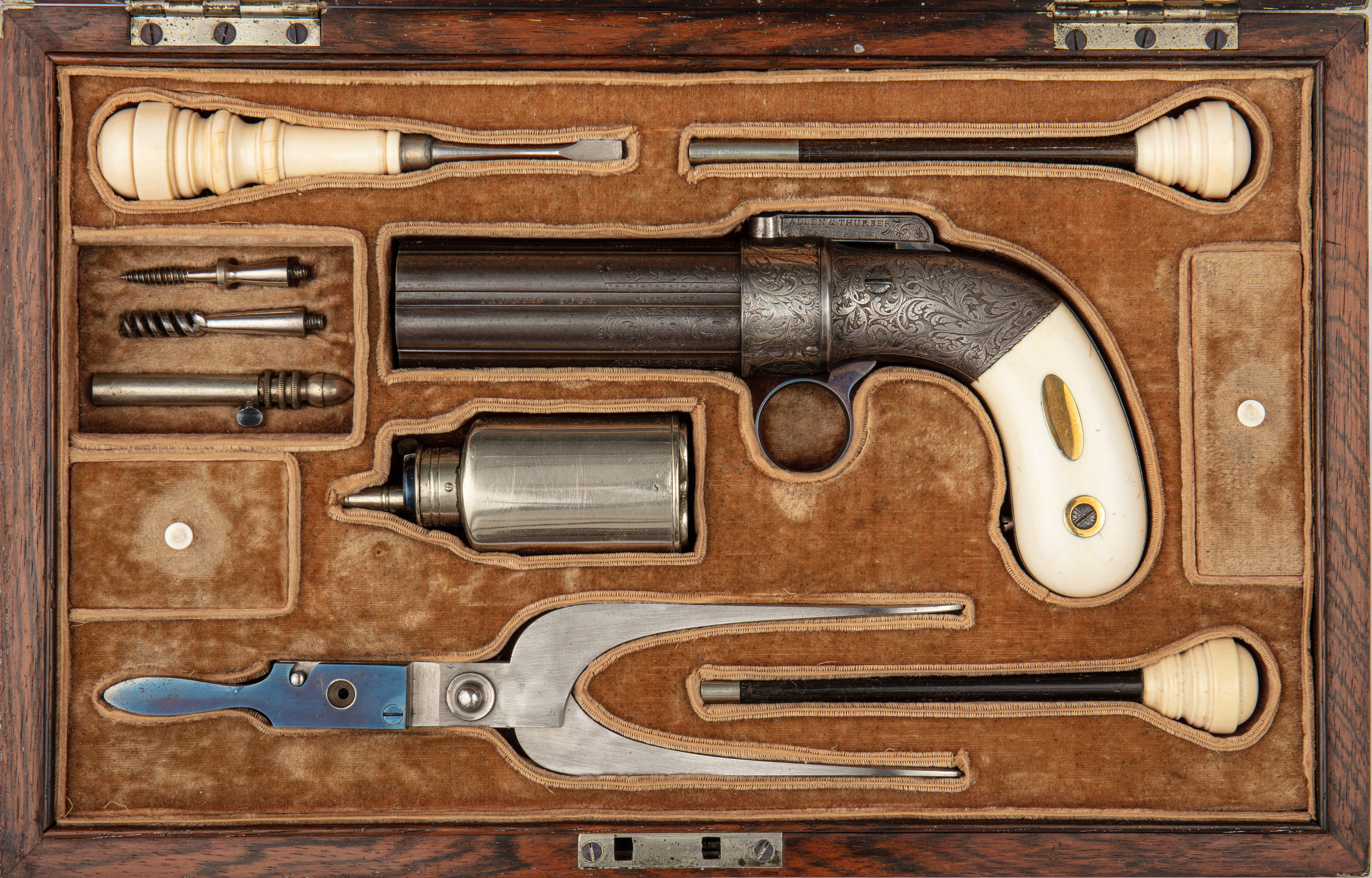
In the annals of American arms manufacturing, few objects capture the intersection of industrial ingenuity and Victorian aestheticism as vividly as the cased six-barreled revolving percussion pistol, colloquially known as the “pepperbox.” Produced primarily in Norwich, Connecticut—a crucible of 19th-century firearms innovation—this weapon transcends its utilitarian origins to become a compelling artifact of material culture. At Katherine Fashion Lab, we approach this piece not merely as a tool of defense, but as a sartorial object, a study in the architecture of repetition, and a testament to the era’s obsession with mechanical precision as a form of personal adornment. The pepperbox, with its clustered barrels and lavish cased presentation, offers a profound lesson in how function and fashion coalesce into a statement of status, power, and aesthetic mastery.
The Mechanical Silhouette: Repetition as Design Language
The pepperbox’s most arresting feature is its rotating six-barrel cluster, a design that eschews the single-shot elegance of contemporary derringers in favor of a brutalist, almost botanical, proliferation of cylinders. This is not a weapon of subtlety; it is a statement of preemptive volume. Each barrel, machined from steel with a precision that speaks to the early industrial prowess of Norwich, is a testament to the era’s fascination with seriality. The barrels are arranged in a tight hexagonal formation, their muzzles aligned with a geometric discipline that evokes the repeating patterns of a woven textile or the pleated folds of a Victorian gown. The visual rhythm created by this cluster—six identical apertures, each promising a discharge—instills a sense of controlled chaos. It is a design that says, “I am prepared for the unpredictable,” a quality that resonates deeply with the modern couturier’s embrace of functional multiplicity in accessories, from stacked bracelets to layered necklines.
The barrel cluster is not merely a mechanical solution; it is a deliberate aesthetic provocation. The steel, when polished, would have caught candlelight with a cold, steely shimmer, contrasting sharply with the warm, organic hues of the rosewood grip and the ivory accents. This interplay of hard and soft, industrial and natural, is a hallmark of the pepperbox’s design philosophy. The barrels are not hidden; they are celebrated, their cylindrical forms echoing the columns of a neoclassical portico or the tiered ruffles of a crinoline skirt. In this sense, the pepperbox is a wearable architecture, a miniature monument to the era’s faith in mechanical progress as a form of beauty.
Materials as Narrative: Gold, Silver, Ivory, and Velvet
The pepperbox’s material palette is a masterclass in hierarchical ornamentation. The steel barrels, while functional, are elevated by gold and silver inlays that trace delicate scrollwork along the cylinder flutes and frame. These precious metals are not applied haphazardly; they form a visual narrative of wealth and refinement. The gold, often used for the trigger guard and hammer, catches the eye and directs attention to the mechanism of action—the very point where intention becomes discharge. The silver, more subtle, is etched into the barrel cluster, creating a filigree effect that softens the starkness of the steel. This is not mere decoration; it is a rhetoric of luxury, a way of saying that even the most violent of tools can be rendered exquisite through craftsmanship.
The ivory grip is perhaps the most tactile element of the design. Carved to fit the hand with anatomical precision, the ivory offers a smooth, almost milky counterpoint to the metal’s hardness. Its natural grain, when polished, takes on a subtle translucency that suggests both fragility and endurance. In the context of the American 19th century, ivory was a material of exoticism and status, imported from distant shores and worked by skilled artisans. Its inclusion here is a deliberate luxury signifier, a nod to the owner’s global reach and discerning taste. The grip’s ergonomic curve, often featuring a slight palm swell, mirrors the contours of a tailored glove, reinforcing the idea that the pistol is an extension of the body—a prosthetic of power.
The rosewood case is the final, and perhaps most revealing, element. Rosewood, with its deep, reddish-brown hues and dense grain, was a favored material for Victorian cabinetmakers. The case is lined with crimson velvet, a fabric that evokes both the opulence of a theater curtain and the bloodiness of the weapon’s purpose. The velvet is not merely a protective lining; it is a stage upon which the pistol rests, a dramatic backdrop that heightens the object’s theatricality. The case itself is fitted with compartments for a powder flask, bullet mold, and cleaning tools, transforming the pepperbox from a solitary tool into a complete ensemble. In fashion terms, this is the ultimate accessory set—a coordinated collection that speaks to the owner’s preparedness and taste.
Context and Legacy: The Pepperbox as a Cultural Artifact
To fully appreciate the pepperbox, one must understand its socio-historical context. Norwich, Connecticut, in the mid-19th century, was a hub of arms manufacturing, fueled by the demands of westward expansion, urban self-defense, and the looming specter of civil conflict. The pepperbox was not a military weapon; it was a civilian statement, carried by gentlemen, gamblers, and travelers as a badge of autonomy. Its six barrels offered a rapid succession of shots, a technological advantage that was as much about psychological deterrence as practical defense. The cased presentation, with its velvet lining and fitted tools, elevated the pistol to the status of a gentleman’s objet d’art, akin to a fine watch or a bespoke cane.
From a modern couture perspective, the pepperbox embodies a philosophy of adornment that challenges our contemporary notions of fashion and function. It is a wearable technology, a precursor to the smartwatch or the designer handgun holster, in that it merges utility with aesthetic identity. The repetition of barrels can be read as a rhythmic motif, a visual beat that echoes the patterns of a lace shawl or the pleats of a Fortuny gown. The precious metal inlays are a form of embroidery on steel, a testament to the human desire to beautify even the most utilitarian objects. The rosewood case, with its velvet bed, is a traveling wardrobe for the weapon, a reminder that presentation is as important as possession.
Conclusion: The Pepperbox as a Masterclass in Design Synergy
The cased six-barreled revolving percussion pistol from Norwich, Connecticut, is far more than a historical curiosity. It is a synthesis of mechanical innovation and ornamental excess, a object that demands to be read through the lens of couture. Its design language—repetition, contrast, material hierarchy, and theatrical presentation—offers enduring lessons for the modern fashion lab. The pepperbox teaches us that form can follow fear, that luxury can coexist with lethality, and that the most powerful statements are often made through the careful orchestration of multiple elements. At Katherine Fashion Lab, we see in this pistol a blueprint for the wearable artifact, a reminder that the line between tool and adornment is always, and beautifully, blurred.