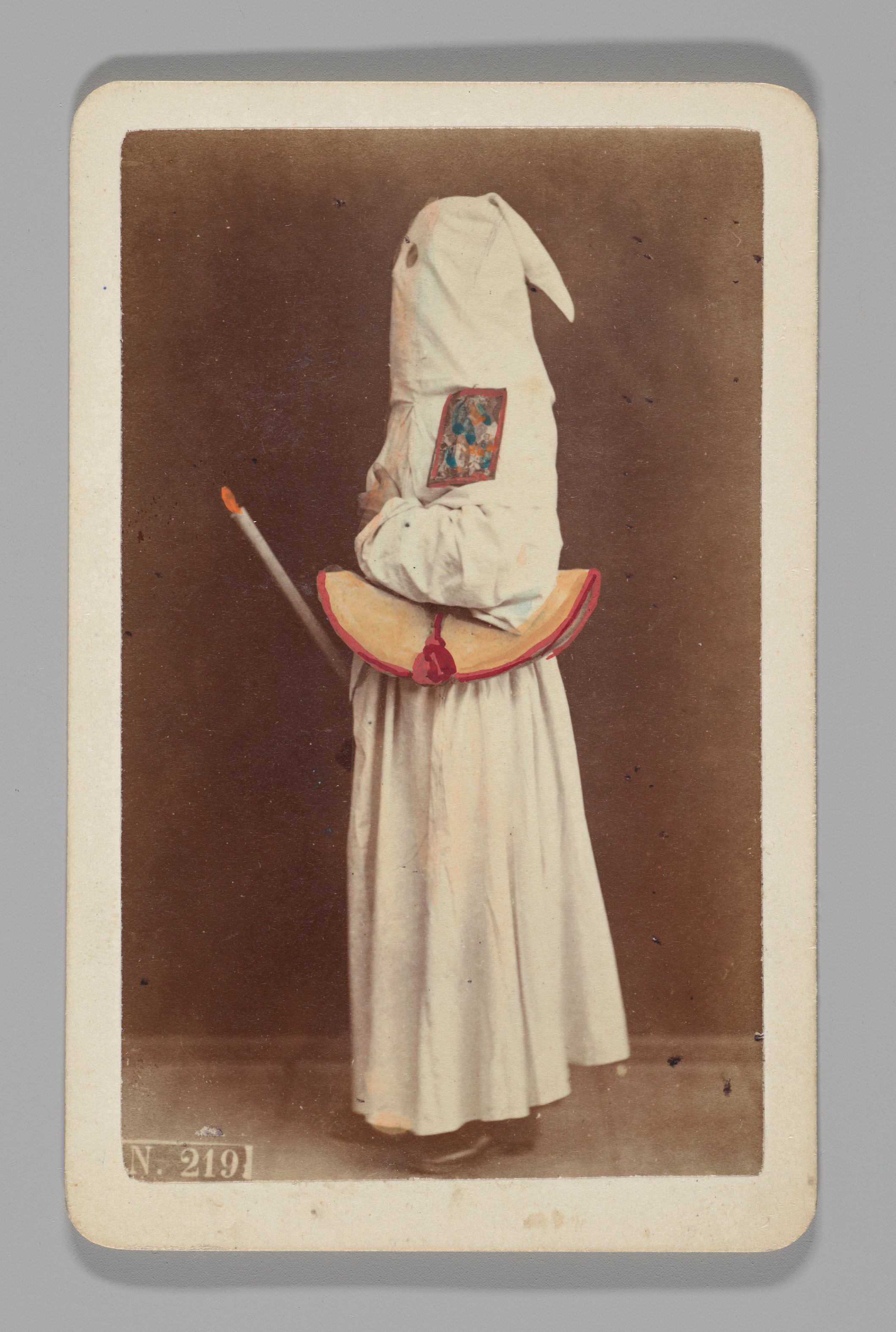
The Veil and the Void: Deconstructing the Studio Portrait of an Unidentified Subject
In the annals of fashion history, the studio portrait often serves as a definitive record of sartorial identity. Yet, the subject of our analysis—a vintage albumen silver print with applied color, depicting a person in a white robe and face-covering hood, titled “Studio Portrait: Person Wearing White Robe and Face Covering Hood, Naples”—defies such easy categorization. This is not a document of a specific garment’s trend or a celebrity’s style. Rather, it is a profound meditation on the interplay between concealment and revelation, a study in the architecture of anonymity that speaks to the deepest currents of global heritage and the enduring power of textile as a vessel for cultural and spiritual meaning.
The Materiality of Memory: Albumen and Applied Color
Before engaging with the subject’s attire, we must first consider the medium itself. The albumen silver print, a photographic process dominant from the 1850s to the 1890s, is a material artifact of its time. Its sepia-toned, ethereal quality imbues the image with a sense of historical distance, yet the application of hand-tinted color—likely watercolor or aniline dye—introduces a jarringly intimate, almost tactile dimension. The applied color is not merely decorative; it is a deliberate act of interpretation. The white of the robe is not a photographic white; it is a painterly white, layered with subtle blues and creams to suggest volume and texture. This hybrid technique—part mechanical reproduction, part artisanal embellishment—mirrors the subject’s own hybridity: a figure caught between the specific and the universal, the documented and the imagined.
The print’s provenance from Naples, a city historically at the crossroads of European, Mediterranean, and North African trade routes, further enriches its narrative. Naples was a bustling port where religious iconography, folk traditions, and nascent fashion photography converged. This image, likely created in a commercial studio catering to a diverse clientele, is a testament to the global flows of visual culture in the late 19th century. The subject’s attire, while not explicitly labeled, resonates with a multitude of traditions: the burnous of North Africa, the cappa magna of Catholic processions, and the habitus of monastic orders. The robe’s voluminous folds, captured in the soft focus of the albumen process, become a landscape of drapery, a topography of cloth that transcends any single cultural origin.
The Architecture of Anonymity: Deconstructing the Hood and Robe
The most arresting element of the composition is the face-covering hood. It is not a simple veil; it is a structured cowl that extends forward, creating a void where the face should be. This is not a garment of modesty in the conventional sense, but one of erasure. The hood transforms the wearer into a blank canvas, a cipher upon which the viewer projects meaning. In a fashion context, this is a radical act. The face is typically the locus of identity, expression, and beauty. By obscuring it, the garment forces us to read the body through the syntax of the robe—its folds, its weight, its relationship to the ground.
From a couture analysis perspective, the robe’s construction is deceptively simple. The fabric, likely a heavy linen or cotton blend, falls in vertical pleats that suggest both restraint and flow. The absence of visible seams or fastenings creates a seamless silhouette, a monolithic form that emphasizes the vertical axis of the human figure. The applied color, with its delicate highlights on the shoulders and the crest of the hood, mimics the play of natural light on a three-dimensional form, giving the robe a sculptural presence. This is not a garment designed for movement in the modern sense; it is a garment designed for stillness, for the static contemplation of a studio portrait. Yet, within that stillness, there is a profound tension. The folds of the robe, particularly around the arms and torso, suggest a body beneath—a body that is both present and withheld.
Global Heritage and the Language of Concealment
The subject’s attire cannot be divorced from the broader context of global heritage. The white robe and hood evoke a spectrum of cultural and spiritual practices: the thawb of the Arabian Peninsula, the djellaba of the Maghreb, the alb of Christian liturgy, and even the shroud of funerary rites. In each tradition, white symbolizes purity, transcendence, and a detachment from the material world. Yet, in this portrait, the whiteness is not purely symbolic; it is also a strategic absence. The lack of ornamentation—no embroidery, no jewelry, no insignia—strips the garment of any overt signifier of rank or ethnicity. This is a deliberate aesthetic choice that elevates the subject from the particular to the archetypal.
This archetypal quality is what makes the image so compelling for contemporary fashion discourse. In an era obsessed with personal branding and visual identity, the subject’s refusal to be identified is a form of resistance. The hood, in particular, prefigures the work of avant-garde designers like Rei Kawakubo and Rick Owens, who have used hoods and veils to question the primacy of the face in fashion. Kawakubo’s “Lumps and Bumps” collection (1997) and Owens’s draped, monumental forms both owe a debt to this kind of anonymous, sculptural dressing. The Naples portrait is not a historical curiosity; it is a precursor to a modernist sensibility that values the body as architecture over the body as a canvas for expression.
The Standalone Study: A Portrait of the Void
The designation of this work as a “standalone study” is crucial. Unlike a series or a narrative sequence, this single image exists in isolation, demanding that we engage with it on its own terms. There is no context of a procession, a ritual, or a social event. The subject stands against a plain backdrop, likely a painted studio flat, with no props or companions. This isolation amplifies the garment’s power. The robe becomes the entire world of the image, a universe of fabric that both contains and exceeds the human form.
From a curatorial standpoint, the applied color adds a layer of temporal irony. The hand-tinting was likely done to make the photograph more appealing to a client who desired a semblance of realism or perhaps to evoke the quality of a painted miniature. Yet, the result is the opposite of realism. The color, applied with a brush, is uneven, almost ghostly. The white of the robe does not match the white of the paper; it floats on the surface of the image. This disjunction between the photographic and the painterly creates a dialogic tension that mirrors the tension between the seen and the unseen in the subject’s attire. The viewer is left not with a definitive reading, but with a series of questions: Who is this person? What are they hiding? What are they revealing?
Conclusion: The Eternal Return of the Hooded Figure
In the end, the “Studio Portrait: Person Wearing White Robe and Face Covering Hood, Naples” is a masterclass in the power of negative space. The garment does not adorn the body; it replaces the body as the primary subject of the image. The hood, the void, the applied color—all work together to create a portrait of absence that is paradoxically full of meaning. For Katherine Fashion Lab, this piece is not merely a historical artifact; it is a touchstone for understanding how fashion can function as a language of both belonging and withdrawal. It reminds us that the most profound statements in couture are often those that remain unsaid, that the greatest luxury is the freedom to be unseen, and that the most enduring garment is the one that cloaks the soul in mystery. In a world saturated with visual noise, this anonymous figure, wrapped in white and lost to history, speaks with a clarity that transcends time.