Deconstructing the Line: A Couture Analysis of 'Strip'
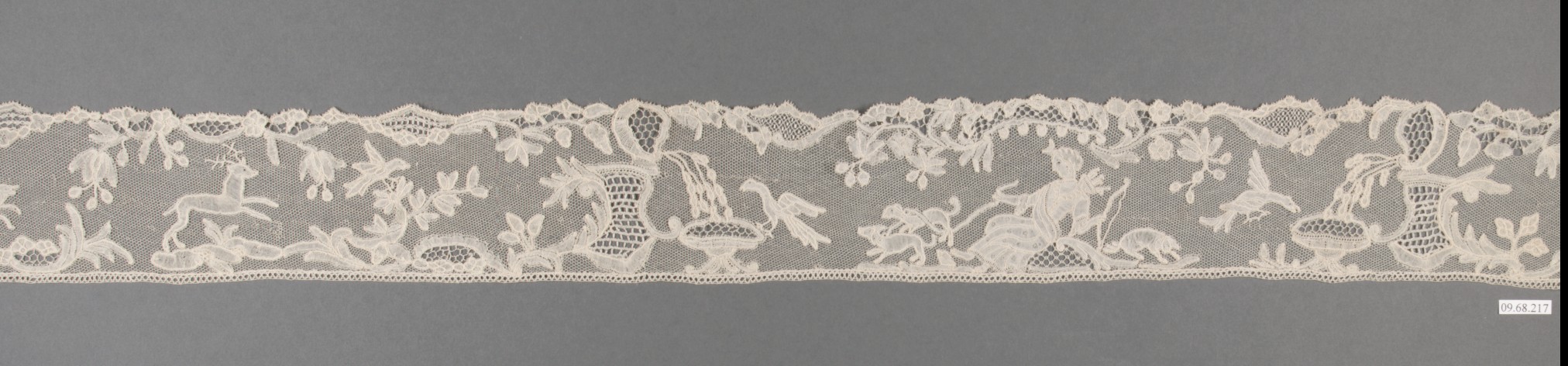
In the rarefied atmosphere of haute couture, where the ethos is often one of accumulation—of embellishment, narrative, and technical bravura—the decision to subtract is perhaps the most radical gesture of all. Katherine Fashion Lab's standalone study, 'Strip', is a masterclass in this philosophy. It transcends the simplistic notion of minimalism to engage in a profound dialogue with material heritage, architectural form, and the very essence of the line. Originating from a deep dive into Global Heritage, specifically the intricate worlds of bobbin lace and point d’Angleterre, 'Strip' does not merely use these textiles but interrogates their foundational principles, arriving at a garment that is both a deconstruction and a reverence.
Material as Genesis: The Heritage of the Thread
The conceptual genesis of 'Strip' lies in a forensic appreciation of its named materials. Bobbin lace, with its origins tracing across Europe from Italy to Flanders, is a testament to communal craftsmanship, built thread by thread upon a pillow. Its structure is inherently linear, a mapping of connections and voids. Point d’Angleterre, despite its name, is a Flemish lace of unparalleled delicacy, renowned in the 17th century for its fine floral motifs and intricate grounds. Traditionally, these laces are valued for their ornamental completeness, applied as precious accents to signify status and refinement.
Katherine Fashion Lab’s pivotal intervention is to reject the appliqué mindset. Instead, the atelier asks: What is the core architectural truth of this craft? The answer is the line—the single, continuous, or strategically knotted thread that defines space. 'Strip' extracts this fundamental principle. The garment is conceived not as a canvas for lace, but as lace itself, scaled to the proportions of the human form. The intricate, small-scale motifs of traditional point d’Angleterre are analytically expanded, their curves and junctions abstracted into the sweeping lines of a bodice’s seam or the geometric void of a sleeve. The material is no longer decoration; it is structure.
Architectural Form: The Body as Pillow
This transposition of scale and function leads to the study's most striking achievement: its architectural silhouette. The garment, likely a columnar gown or a tailored separates set, is constructed from panels that mimic the modular nature of lace strips. Seams are not hidden but celebrated as the leading threads of the design, tracing a deliberate, minimalist topography over the body. The negative space—the jours or holes in traditional lace—becomes assertive, strategic cut-outs that reveal the skin beneath. These are not provocations but calibrated studies in contrast, emphasizing the solidity of the form beside the emptiness, much like the linen thread and air of the original craft.
The construction demands a couture-level inversion of technique. Where lace is typically fragile and supported, here it must be engineered to hold shape and endure tension. This necessitates innovative understructures, perhaps a sheer, fused backing or a revolutionary method of thread coating, that provide integrity without sacrificing the ethereal, linear aesthetic. The body becomes the pillow upon which this giant lace is crafted, its contours dictating the flow and tension of the design's "threads." The fit is thus absolute, a second skin built from a web of lines, resulting in a powerful juxtaposition of strength and fragility.
The Conceptual "Strip": Reduction as Enlightenment
The title 'Strip' operates on multiple, interconnected levels. Literally, it references the strips of lace traditionally produced. Formally, it describes the design's reduction to essential lines, stripping away color, superfluous ornament, and often, opaque fabric. Philosophically, it signifies an act of revelation—stripping heritage materials back to their core truth to reveal a modern, potent application. This is not heritage as pastiche but heritage as algorithm, a code of construction extracted and rewritten.
In the context of global heritage, this approach is both respectful and revolutionary. It avoids cultural appropriation by not replicating specific cultural motifs but by engaging with a universal, cross-cultural principle of textile construction: the interlocking of threads. Bobbin lace finds echoes in traditions worldwide, from Latin American ñandutí to Middle Eastern lacework. 'Strip' taps into this global lineage of the line, positioning itself not as a representative of one culture, but as a student of a shared human ingenuity.
Conclusion: A Standalone Study in Couture Logic
As a standalone study, 'Strip' succeeds in its primary objective: to pursue a single idea with exhaustive focus and intellectual rigor. It demonstrates that couture's future is not solely in the invention of new materials, but often in the radical re-contextualization of the old. By dissecting bobbin lace and point d’Angleterre with the precision of a scholar and the vision of an architect, Katherine Fashion Lab has created a garment that is a manifesto. It argues for clarity over clutter, for structural honesty over applied fantasy, and for a deep, analytical engagement with heritage as a living, mutable resource.
The final form is a serene yet powerful statement. It is quiet couture, where the whisper of history in the technique speaks louder than any shout of transient fashion. 'Strip' confirms that the most advanced frontier in design often lies in looking back, not to copy, but to comprehend—and then, to reduce, refine, and rebuild. In doing so, it redefines luxury not as opulence, but as the supreme clarity of an idea, perfectly executed.