Heritage Analysis: The Burial of Saint Zenobius
Subject Matter and Cultural Provenance
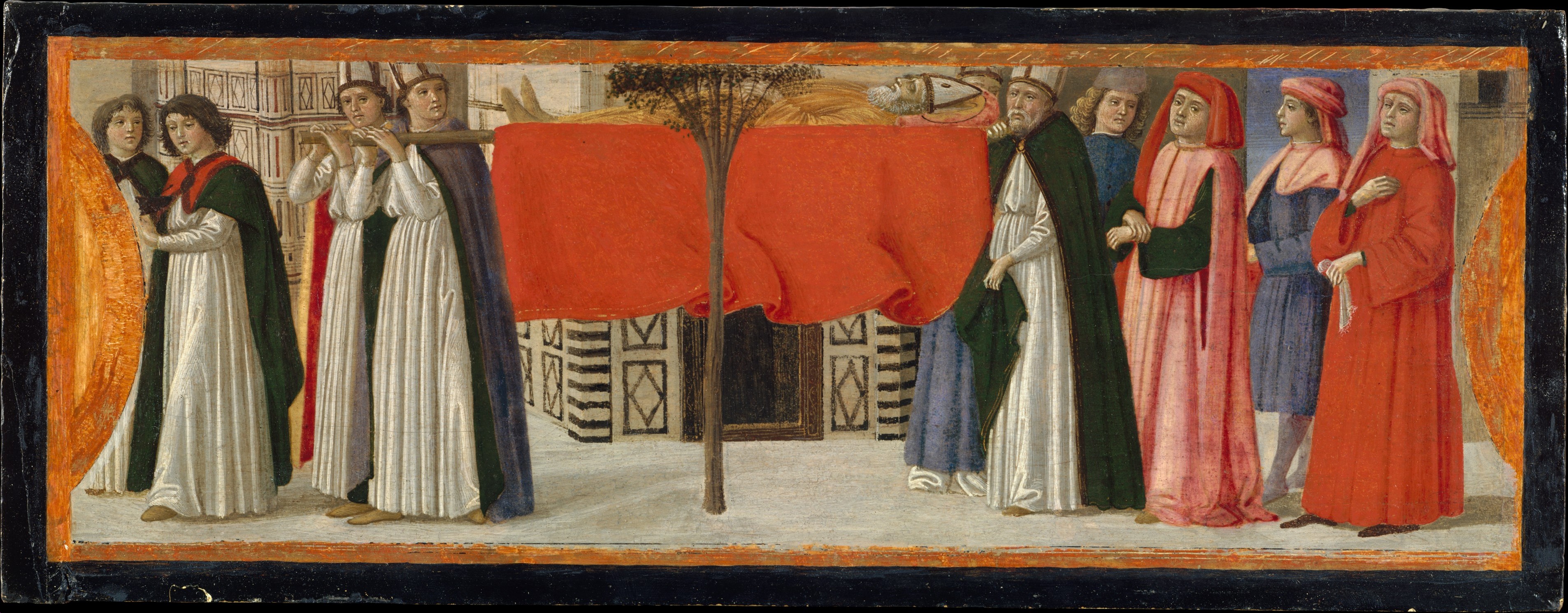
The Burial of Saint Zenobius, rendered in tempera and gold on wood, originates from the early Renaissance period of Florentine civilization, specifically attributed to the workshop of Domenico Ghirlandaio circa 1480–1490. This panel, part of a larger altarpiece cycle, depicts the funeral rites of Saint Zenobius, the first bishop of Florence, a figure whose spiritual authority and civic legacy shaped the city’s identity. The medium—tempera and gold leaf—reflects the technical mastery and symbolic priorities of a civilization where art served as a vessel for divine narrative and temporal power. For Katherine Fashion Lab, this artifact offers a strategic lens through which to examine how adornment, ritual, and material wealth converge to communicate status and transcendence.
Symbolic Power: The Gold Ground as Divine Authority
The Metallurgical Language of Prestige
The extensive use of gold leaf in The Burial of Saint Zenobius is not merely decorative but a deliberate assertion of spiritual and political supremacy. In Renaissance Florence, gold signified the uncreated light of God, elevating the earthly scene to a celestial plane. The saint’s burial cloth, depicted with gilded threads, mirrors the opulence of ecclesiastical vestments worn by bishops during high liturgy. This symbolic power is rooted in the belief that material splendor could mediate between the mortal and the divine—a principle that resonates with contemporary luxury strategy.
Strategic Implication for 2026
Katherine Fashion Lab can transpose this gold-ground logic into a 2026 haute couture collection by employing precious metal finishes—such as 24-karat gold embroidery or gilded accessories—that signal exclusivity and timelessness. The symbolic power of gold in Renaissance art suggests that luxury brands must not only use precious materials but also imbue them with narrative weight. A capsule collection inspired by Saint Zenobius could feature gold-threaded veils or metallic brocade jackets, positioning the wearer as a custodian of heritage rather than a mere consumer of fashion.
Historical Adornment: Vestments and Civic Identity
The Ecclesiastical Wardrobe as Status Marker
The painting meticulously records the historical adornment of Renaissance clerics: the mitre, the cope, and the dalmatic, each embroidered with symbolic motifs such as crosses, lilies, and geometric patterns. These vestments were not arbitrary; they encoded the bishop’s role as mediator between heaven and earth. The use of tempera allows for fine, precise detailing of these textiles, revealing the weave, drape, and interplay of light. For instance, the pallium—a woolen band worn by the pope and granted to Zenobius—is rendered with a subtle sheen, emphasizing its liturgical importance.
Strategic Implication for 2026
Historical adornment in this context offers a blueprint for Katherine Fashion Lab’s 2026 ready-to-wear line. The ecclesiastical silhouette—structured shoulders, long lines, and layered textiles—can be reimagined as power dressing for modern executives. Consider a double-breasted coat with gold-button closures inspired by the cope’s clasp, or a silk scarf printed with the geometric motifs from the bishop’s dalmatic. This approach merges historical authenticity with contemporary utility, appealing to clients who seek garments that tell a story of authority and refinement. The key is to avoid literal reproduction; instead, the brand should distill the essence of these vestments into minimalist, wearable forms.
Spiritual Meaning: Ritual, Transcendence, and Materiality
The Sacred Economy of Funerary Rites
The burial of Saint Zenobius is depicted as a public spectacle, with mourners, clergy, and city officials gathered around the bier. The spiritual meaning here is twofold: the saint’s death is not an end but a transition to eternal glory, and the material world—gold, silk, incense—is a conduit for this transcendence. The painting’s composition guides the viewer’s eye upward, from the draped corpse to the gold backdrop, symbolizing the soul’s ascent. This interplay between the material and the immaterial is central to understanding how luxury can serve as a vehicle for spiritual or emotional resonance.
Strategic Implication for 2026
For Katherine Fashion Lab, spiritual meaning can be operationalized through brand storytelling and experiential retail. A 2026 campaign might center on the concept of “ritual dressing”—garments designed for moments of significance, such as milestone birthdays, weddings, or personal achievements. The brand could host private viewing events in historic chapels or museums, where clients engage with the painting’s symbolism while previewing a collection. Additionally, the use of sustainable, ethically sourced materials (e.g., organic silk, recycled gold) can align with contemporary spiritual values of stewardship and mindfulness. This strategy positions the brand not as a purveyor of ephemeral trends but as a curator of meaningful, heirloom-quality pieces.
2026 High-End Luxury Strategy: From Artifact to Asset
Positioning Katherine Fashion Lab as Heritage Custodians
The analysis of The Burial of Saint Zenobius reveals a clear strategic directive for 2026: luxury must transcend the visual to become a multisensory, narrative-driven experience. The painting’s tempera and gold medium, with its luminous, enduring quality, suggests that high-end brands should prioritize craftsmanship over volume. Katherine Fashion Lab can adopt a “museum-grade” approach to production, where each garment is treated as a collectible artifact. This includes limited edition runs, numbered certificates of authenticity, and partnerships with art historians or conservators.
Strategic Pillars for 2026
- Material Integrity: Source gold, silk, and pigments from heritage suppliers, mirroring the Renaissance commitment to quality. For example, use Florentine gold leaf techniques in accessory hardware.
- Narrative Architecture: Develop a campaign titled “The Gilded Path,” referencing the saint’s journey from mortality to immortality. Use digital storytelling—short films, augmented reality—to immerse clients in the painting’s world.
- Exclusivity through Ritual: Launch a “Zenobius Collection” with a private preview in Florence’s Uffizi Gallery, where the painting is housed. Clients receive a leather-bound catalog with scholarly essays on the artifact’s symbolism.
- Price Point Strategy: Position the collection at a 40–60% premium over standard luxury lines, justified by the art-historical research and limited availability. This aligns with the painting’s own status as a singular, irreplaceable object.
Competitive Differentiation
In a saturated luxury market, Katherine Fashion Lab can leverage this heritage analysis to distinguish itself from brands that rely solely on logo-driven marketing. By anchoring the 2026 strategy in a specific, culturally significant artifact, the brand creates an intellectual and emotional moat. Competitors may replicate gold embroidery or ecclesiastical silhouettes, but they cannot replicate the authenticity of a direct lineage to Renaissance Florence. This is not fashion as consumption; it is fashion as cultural stewardship.
Conclusion: The Enduring Power of Adornment
The Burial of Saint Zenobius is more than a religious painting; it is a strategic document for how luxury brands can harness symbolic power, historical adornment, and spiritual meaning. For Katherine Fashion Lab, the 2026 strategy should not merely reference the past but reanimate its principles for a contemporary audience. By treating each garment as a sacred object, each collection as a ritual, and each client as a custodian of heritage, the brand can achieve a level of prestige that transcends market cycles. The gold ground of the painting reminds us that true luxury is not about what is seen, but what is believed.