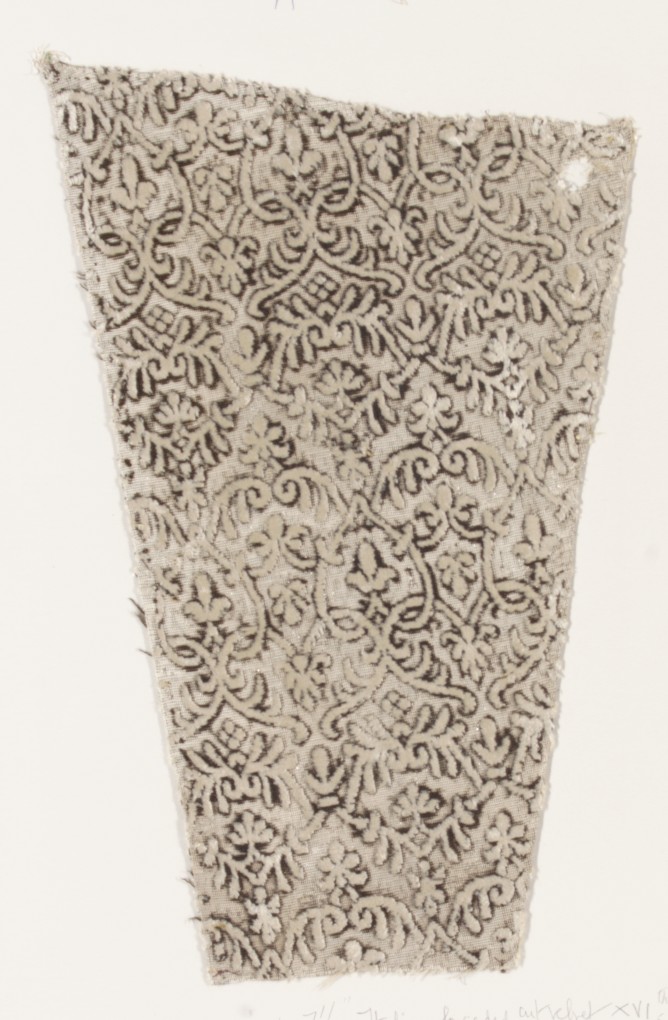
Deconstructing the Whole: A Couture Analysis of 'Fragment'
In the rarefied atmosphere of haute couture, where the narrative of a complete, flawless garment often reigns supreme, Katherine Fashion Lab presents a radical proposition: the 'Fragment' as a complete aesthetic and philosophical statement. This standalone study, rooted in a global heritage yet fiercely contemporary, is not a deconstruction in the traditional sense. It is, rather, a conscious elevation of the partial, the interrupted, and the evocative. By employing the luxurious dichotomy of silk and metal thread, the Lab does not merely create a garment component; it crafts a tactile thesis on memory, cultural cross-pollination, and the beauty inherent in impermanence and selective preservation.
The Philosophy of the Partial: Context as King
The very premise of 'Fragment' challenges the couture canon. Couture has historically been the domain of the definitive—the fully realized, meticulously finished object that signifies mastery and totality. Katherine Fashion Lab subverts this by asking: what if the most powerful story is told through absence? What if the most luxurious object is the one that demands intellectual and emotional completion by the viewer? This standalone study operates like an archaeological find: a piece of a larger, unknown whole that sparks the imagination. Its context is not a seasonal trend but the vast, interconnected tapestry of human adornment across centuries and continents. It references a sleeve from a Han dynasty robe, the frayed edge of a Renaissance brocade, the interrupted pattern of a shattered Byzantine mosaic, all while refusing to be any one of them. It exists in the liminal space between histories, a deliberate rupture that speaks to our fragmented, digitally-augmented modern consciousness, where cultural references are absorbed and recombined in nonlinear, piecemeal fashion.
Material Dialectic: Silk and Metal Thread as Narrative Agents
The material selection is the cornerstone of this narrative. Silk, with its deep heritage spanning from ancient China to the Silk Road and into European ateliers, represents organic continuity, fluidity, and the softness of human history. It is the base canvas of memory—supple, vulnerable, and capable of magnificent drape and decay. In contrast, metal thread—whether fine gilt silver or modern alloy—introduces a element of the indestructible, the regal, and the sharply defined. It is the hard line of history, the imposed structure, the surviving artifact.
The genius of 'Fragment' lies in their interaction. The metal thread is not merely embroidered upon the silk; it is often engaged in a physical dialogue that borders on conflict. It may stitch a precise, geometric pattern that suddenly unravels where the silk has been purposely torn. It might trace the ghost of a floral motif before vanishing, leaving only the punctured silk behind. In sections, the metal could be worked to create a rigid, architectural form that cages a flow of silk, or conversely, the silk might be gathered and folded to obscure part of a metallic inscription. This push-and-pull creates a palpable tension. The silk suggests what was; the metal thread asserts what remains. Together, they do not create a harmonious whole but a compelling record of intervention, erosion, and selective emphasis.
Global Heritage as a Fragmented Palette
The 'Global Heritage' origin is not a pastiche. It is a methodological approach to sourcing form and technique. A color gradient might shift from the mineral reds of Cochineal, used in both pre-Columbian Americas and European tapestries, to the indigos of Japanese Edo and West African adire, meeting in a blurred, intermediate hue that belongs to neither. A stitch could reference the sashiko of Japan (functional reinforcement) alongside the zardozi of India (opulent decoration), questioning the hierarchy between repair and adornment. The silhouette of the fragment itself—perhaps a curved, asymmetrical shape—evokes a piece of a kimono's obi, a Celtic torc, or a segment of a crinoline cage, without committing to a single referent.
This is heritage without nostalgia. It is heritage as a field of raw, often contradictory data, where the Lab acts as editor, isolating fragments and forcing them into a new conversation. The result avoids the trap of cultural costume, instead presenting a hybrid artifact that feels both ancient and unnervingly future-forward, a relic from a culture that has always been global.
Couture as Standalone Study: The Value of the Incomplete
Presenting 'Fragment' as a standalone study is its most profound conceptual stroke. It is not a sketch for a future gown or a swatch for a collection. It is the final, framed object. This decision shifts the value proposition of couture from wearability and spectacle to contemplation and intellectual provocation. It asks the patron to invest not in a functional garment but in a piece of applied philosophy, a wearable art object that prioritizes idea over utility.
The craftsmanship, paradoxically, is at its most exquisite precisely where it mimics decay or rupture. A raw edge is not merely cut; its threads are individually manipulated to achieve a specific, expressive quality of unraveling. A "torn" section reveals a complex under-layer of contrasting weave, proving that the destruction is a meticulously built illusion. This hyper-controlled suggestion of entropy is the ultimate luxury—mastery so complete it can convincingly simulate its own absence.
In conclusion, Katherine Fashion Lab's 'Fragment' is a masterful couture manifesto. Through the strategic dialectic of silk and metal, and a fearless embrace of the partial, it redefines luxury as the luxury of implication. It suggests that in our fragmented age, true sophistication lies not in presenting a seamless whole, but in curating the most eloquent of pieces, trusting that the most discerning minds will comprehend the grandeur of the unseen, unspoken whole. It is a testament to the power of what is left unsaid, and what is left beautifully, intentionally, unfinished.