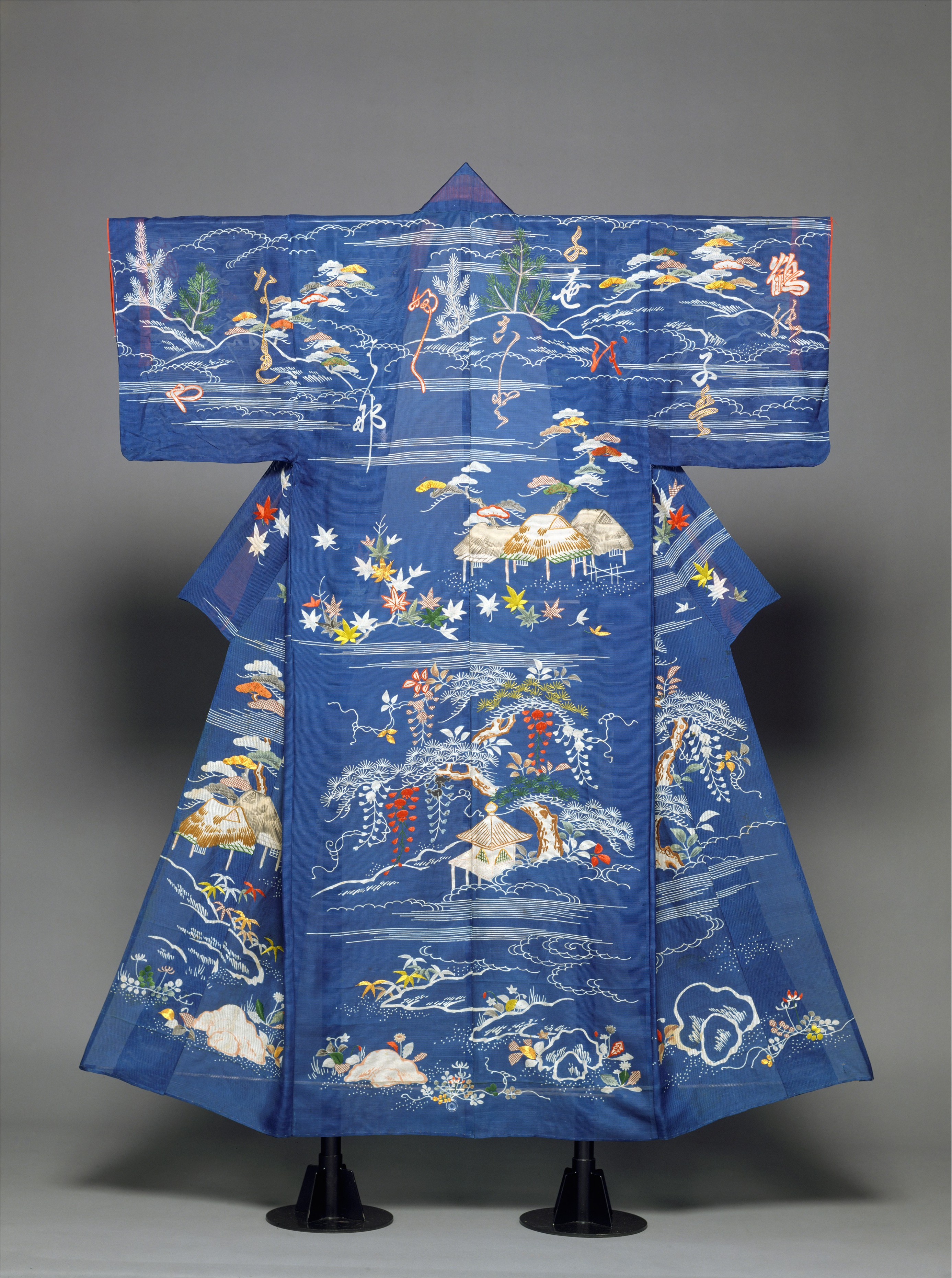
Deconstructing the Ephemeral: A Couture Analysis of the Unlined Summer Kimono (Hito-e) with Landscape and Poem
Introduction: The Art of Transience in Silk
In the rarefied sphere of haute couture, where fabric becomes narrative and construction is a philosophy, the unlined summer kimono, or *hito-e*, stands as a masterclass in controlled ephemerality. This particular example, a standalone study from the Katherine Fashion Lab collection, transcends mere garment status to embody a sophisticated dialogue between material, technique, and cultural memory. Crafted from embroidered and resist-dyed silk gauze (*ro*), this kimono is not a relic of a bygone era but a living artifact that speaks directly to contemporary luxury’s obsession with lightness, transparency, and the poetry of surface. For the discerning fashion analyst, this piece offers a profound lesson in how extreme restraint—in construction, color, and composition—can yield maximal aesthetic and intellectual impact.
The *hito-e* is defined by its lack of a lining, a deliberate choice that elevates the transparency of the *ro* weave from a structural necessity to a conceptual feature. In the humid summers of Japan, this unlined form was a response to climate, but in the context of Katherine Fashion Lab’s curation, it becomes a statement on vulnerability and the beauty of the unfinished. The garment’s silhouette—long, straight, and fluid—is deceptively simple. Yet, every centimeter of the silk gauze is a canvas for a meticulously orchestrated interplay of resist-dyeing (*shibori* or *yūzen*) and embroidery, creating a landscape that is both literal and metaphorical.
Materiality and Technique: The Language of *Ro* Silk
At the heart of this couture analysis is the substrate itself: *ro*, a type of silk gauze characterized by its alternating plain weave and open, leno-like bands. This structure is not merely decorative; it is a feat of textile engineering. The open weave allows for maximum breathability, while the denser areas provide a ground for intricate decoration. In the context of haute couture, *ro* demands a level of precision that modern mass production cannot replicate. The warp and weft threads, often twisted for strength and luster, must be handled with near-surgical care to avoid distortion.
The resist-dyeing process on such a delicate ground is a high-risk, high-reward endeavor. The artisan applies a resist paste—typically a rice-based mixture—to the silk, blocking the dye from penetrating certain areas. This allows for the creation of crisp, fluid boundaries between color fields. In this kimono, the resist technique is used to suggest a misty, atmospheric landscape. The gradations of indigo, pale celadon, and ochre are not painted but coaxed from the fabric through multiple dye baths. The result is a soft, almost watercolor-like diffusion of color that mimics the hazy air of a summer dawn.
Superimposed on this dyed landscape is a layer of embroidery. The threads—silk floss, gold-wrapped, and occasionally flat metallic—are worked in a combination of satin stitch, couching, and French knots. The embroidered elements are not merely decorative; they are narrative. A cluster of pine needles, a wisp of a cloud, the calligraphic strokes of a poem—each stitch is a deliberate mark that adds texture and depth. The embroidery does not compete with the dyed background; rather, it punctuates it, creating a tactile rhythm that invites the viewer to look closer. This layering of resist-dye and embroidery is a hallmark of Japanese textile artistry, where technique is never an end in itself but a means to evoke an emotional response.
Iconography and Narrative: Landscape as Couture Text
The landscape depicted on this *hito-e* is not a literal topography but an idealized, poetic vision. It draws on the tradition of *meisho-e* (famous place pictures), yet here the location is deliberately ambiguous. The scene suggests a riverbank at twilight, with reeds bending in an unseen breeze and distant mountains dissolving into mist. This ambiguity is a strategic choice. By refusing to anchor the landscape in a specific geography, the kimono becomes a universal meditation on transience—a core tenet of Japanese aesthetics (*mono no aware*).
The inclusion of a poem, likely a *waka* or *haiku*, integrates text into the visual field. The calligraphy is not merely an inscription; it is an integral part of the composition. The brushstrokes, rendered in embroidered thread, mimic the flow of ink on paper. The poem’s content—typically evoking themes of fleeting beauty, such as cherry blossoms falling or a distant cuckoo’s call—amplifies the garment’s narrative of impermanence. In couture terms, this is a radical act: the wearer becomes a living page, a mobile canvas for a literary and visual experience. The poem is not hidden on a label or inside a pocket; it is displayed across the back and shoulders, demanding to be read as much as seen.
This integration of text and image recalls the tradition of *shikishi* (poem cards) and *kakemono* (hanging scrolls), where calligraphy and painting coexist in a single field. By translating this format onto a wearable object, the kimono blurs the boundaries between art and garment, between the gallery and the wardrobe. For the contemporary luxury consumer, this offers a new paradigm: clothing that functions as a portable art collection, a statement of intellectual and aesthetic refinement.
Silhouette and Construction: The Architecture of Unlined Luxury
From a construction standpoint, the *hito-e* is a study in reduction. There are no darts, no zippers, no complex seaming. The garment is composed of straight panels of silk, cut with a precision that allows the fabric to fall naturally from the shoulders. The sleeves, long and sweeping (*furisode*-inspired in their amplitude), are attached with a slight drop at the shoulder, creating a gentle, almost ethereal drape. The unlined nature of the piece means that the interior construction is fully exposed. The seams, finished with a hand-rolled edge, are visible. The *okumi* (front overlap panels) are attached with a meticulous running stitch that is both functional and decorative.
This transparency of construction is a deliberate couture gesture. In Western haute couture, the interior of a garment is often a secret world of intricate finishing. Here, the inside is the outside. The lack of a lining means that the wearer’s body becomes part of the design. The silhouette is not rigidly defined; it shifts with movement, with the wearer’s breath. This is a garment that demands a certain poise, a consciousness of the body within the fabric. It is not for passive dressing; it is an active collaboration between cloth and person.
The weight of the *ro* silk is critical. It must be substantial enough to hold its shape, yet airy enough to float. The balance is achieved through the choice of thread count and the careful application of the resist paste, which stiffens the fabric slightly. The embroidery, while adding texture, also adds weight. The artisan must calculate the distribution of these elements to ensure that the garment hangs gracefully, without sagging or pulling. This is a feat of engineering as much as artistry.
Context and Legacy: Standalone Study as Couture Paradigm
This *hito-e* is presented as a standalone study, divorced from the full kimono ensemble of obi, undergarments, and footwear. This curatorial choice is significant. It allows the viewer to focus entirely on the kimono itself—its material, its technique, its narrative. In a contemporary fashion landscape obsessed with styling and context, this piece demands to be judged on its own merits. It is a reminder that true couture is not dependent on accessories or a runway presentation. It is the garment itself that must speak.
The relevance of this *hito-e* to Katherine Fashion Lab’s broader mission is profound. It embodies the lab’s commitment to investigating the intersection of artisanal tradition and modern luxury. The kimono is not a costume; it is a template for thinking about how clothing can be both functional and transcendent. The techniques employed—resist-dye, embroidery, the use of *ro* silk—are not obsolete. They are living practices that can be adapted to contemporary silhouettes and materials. The lesson for today’s designers is clear: true innovation often lies not in novelty but in a deep, respectful re-engagement with the past.
In conclusion, this unlined summer kimono is a triumph of couture logic. It uses the most ephemeral of materials—gauze, dye, thread—to create something that feels eternal. It is a garment that does not shout but whispers, that invites contemplation rather than applause. For the wearer, it offers a moment of stillness in a chaotic world. For the analyst, it provides a case study in how technique, narrative, and material can converge to produce a work of art that is also a piece of clothing. In the Katherine Fashion Lab, this *hito-e* is not just a study; it is a benchmark.