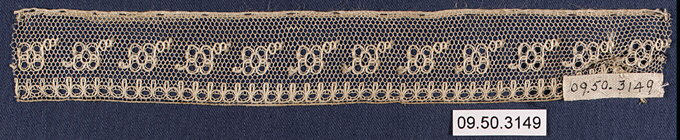
The Art of the Strip: Deconstructing Machine-Made Lace in Global Heritage Couture
In the rarefied world of haute couture, where craftsmanship is often synonymous with hand-stitched artistry, Katherine Fashion Lab presents a provocative thesis: the industrial precision of machine-made lace, when isolated and celebrated as a "strip," can transcend its mechanical origins to become a powerful vessel for global heritage. This standalone study, titled simply "Strip," challenges the traditional hierarchy of textile production, positing that the repetitive, geometric patterns of machine lace—often dismissed as a lesser cousin to hand-made Alençon or Chantilly—possess a unique narrative potential. By stripping away context, scale, and embellishment, the Lab forces a confrontation with the material itself, revealing how a single, continuous strip of lace can encode centuries of cultural migration, trade, and adaptation.
The Paradox of Machine-Made Lace: Heritage Through Repetition
Machine-made lace, particularly the Nottingham and Leavers varieties that emerged during the Industrial Revolution, has long been a paradox. On one hand, it democratized adornment, making lace available to the middle classes. On the other, its very reproducibility was seen as a threat to the artisanal soul of lacemaking. Katherine Fashion Lab’s "Strip" reclaims this medium by focusing on its most fundamental unit: the continuous, unbroken strip. Unlike a full garment or a yard of fabric, a strip is a liminal object—neither raw material nor finished product. It exists in a state of potential, a line of thread that can be looped, draped, or suspended. The Lab’s analysis reveals that this very ambiguity is its strength. The strip becomes a metaphor for the threads of global heritage themselves: interconnected, repeating, yet capable of infinite variation.
The machine-made lace used in this study draws from patterns that are deeply rooted in global heritage motifs. The geometric repeats echo the intricate suzani embroideries of Central Asia, where floral and medallion patterns symbolize fertility and protection. Simultaneously, the scalloped edges recall the filet lace of the Mediterranean, a net-like technique that traveled from Egypt to Italy and Spain. The Lab’s choice to render these motifs in machine-made lace—rather than hand-crafted—is a deliberate commentary on how heritage is preserved and transformed. The machine does not erase history; it archives it, repeating the pattern with a mechanical fidelity that a hand cannot match. Yet, this repetition introduces a new layer of meaning: the strip becomes a record of industrial globalization, where a 19th-century Nottingham machine can produce a pattern that originated in a 16th-century Ottoman court.
Materiality and Momentum: The Strip as a Sculptural Element
In the standalone study, the strip is not merely a decorative component; it is the protagonist. Katherine Fashion Lab employs the lace strip in three distinct modes: linear tension, cascading drape, and geometric suspension. Each mode exploits the unique structural properties of machine-made lace, which, unlike its hand-made counterpart, has a consistent tension and rigidity. The synthetic or cotton-blend threads, often reinforced with a nylon core, allow the strip to hold its shape without the need for additional boning or stabilizers. This material integrity enables the strip to function as a sculptural element, defying the expectation that lace must be soft, yielding, and feminine.
Consider the first mode: linear tension. Here, a single strip of machine-made lace, measuring two inches in width and four feet in length, is stretched taut between two points. The pattern—a repeating floral arabesque—is magnified by the tension, each loop and bridge of thread visible as a distinct architectural element. The strip becomes a line of force, a vector that traces the path of a global trade route. The Lab draws a parallel to the Silk Road, where luxury textiles were stretched across continents, their patterns evolving with each exchange. The tension in the strip is not just physical; it is historical, a taut connection between East and West, past and present.
The second mode, cascading drape, softens this tension. The strip is allowed to fall in a series of loops, creating a rhythm of shadow and light. The machine-made lace, with its uniform openwork, becomes a sieve for light, casting patterns on the surface below. This mode invokes the mashrabiya screens of Islamic architecture, where geometric latticework filters sunlight while maintaining privacy. The strip, in this context, is not a garment but an environmental intervention, a portable piece of heritage that modulates space. The Lab emphasizes that this draping technique is a direct reference to the sari and sarong, garments where a single strip of fabric is manipulated to create multiple silhouettes. The machine-made lace, with its inherent stiffness, challenges the wearer to adapt, to find new ways of wrapping and tying that honor the material’s industrial origins while embracing its global ancestry.
Cultural Coding: The Strip as a Palimpsest
Perhaps the most compelling aspect of "Strip" is its exploration of cultural coding. A strip of machine-made lace is not a blank canvas; it is a palimpsest, bearing traces of the hands that designed the pattern, the machines that produced it, and the cultures that adopted it. Katherine Fashion Lab has selected lace patterns that are explicitly hybrid. One strip features a Paisley motif, a design that originated in Persia, was adopted by the Mughal Empire, and later became a hallmark of Scottish textile production. Another strip uses a Boteh pattern, a teardrop shape that symbolizes a flame or a cypress tree, found in Iranian and Indian textiles. By isolating these patterns in a machine-made context, the Lab highlights how heritage is not static but migratory. The strip becomes a passport, a document of cultural exchange that transcends national borders.
The standalone study also addresses the issue of authenticity. In the fashion industry, machine-made lace is often viewed as a compromise, a way to achieve the look of handcraft without the cost. The Lab rejects this hierarchy, arguing that the machine-made strip has its own authenticity—one rooted in the industrial era’s democratization of beauty. The repetition of the pattern, far from being monotonous, is a form of meditation. Each identical loop and flower head is a testament to the precision of the machine, a precision that allows for the mass production of heritage. The Lab’s analysis suggests that in a world of fast fashion, the machine-made strip can be a slow object, one that requires the viewer to look closely, to appreciate the infinitesimal variations in thread tension and dye saturation that occur even in the most controlled industrial processes.
Conclusion: The Strip as a Future Archive
Katherine Fashion Lab’s "Strip" is more than a couture analysis; it is a manifesto for a new mode of heritage preservation. By focusing on the machine-made lace strip, the Lab demonstrates that globalization does not homogenize culture but creates new layers of meaning. The strip is a record of movement, a document of how patterns travel and transform. It is also a challenge to the fashion industry to reconsider its materials. Machine-made lace, often relegated to the realm of "trim" or "appliqué," is elevated to the status of primary structural element. The strip is not a supplement; it is the subject.
In this standalone study, the strip becomes a future archive. It encodes the history of the machine, the hand, and the cultures that intersect in its threads. For the discerning couture client, wearing a garment constructed from these strips is an act of intellectual engagement. It is a declaration that heritage is not a relic to be preserved in a museum but a living, breathing material that can be stretched, draped, and suspended in new configurations. Katherine Fashion Lab’s "Strip" invites us to see the lace not as a decoration but as a document, a strip of history that we can wear, touch, and transform. The machine-made lace, in all its repetitive glory, is finally given its due: a testament to the global, industrial, and deeply human desire to adorn ourselves with meaning.