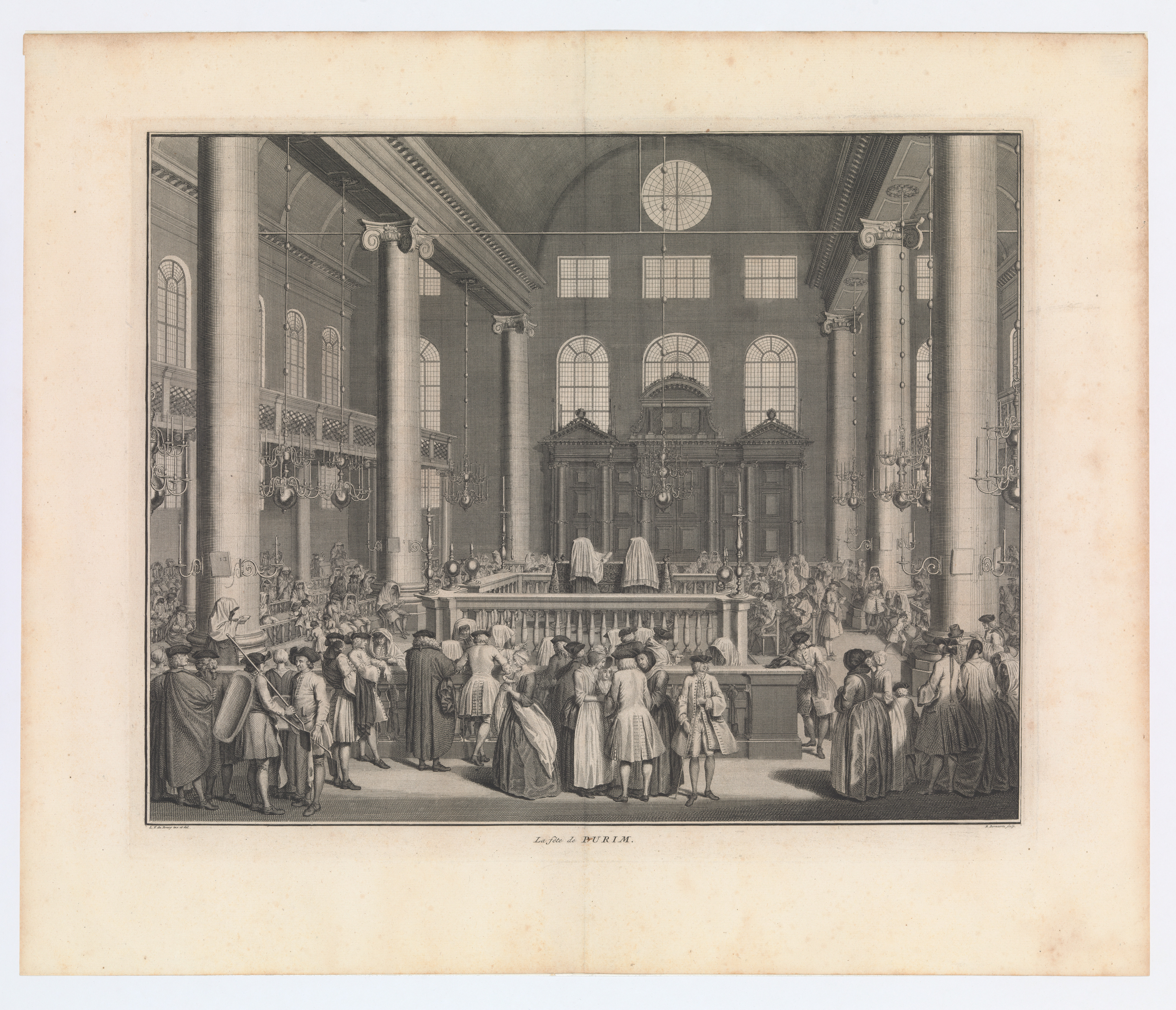
Festival of Light, Theater of Identity: A Couture Analysis of Purim at the Portuguese Synagogue
The Festival of Purim, commemorating the deliverance of the Jewish people in ancient Persia, is a unique paradox: a sacred occasion expressed through carnivalesque revelry, masquerade, and theatricality. When viewed through the lens of couture analysis, Purim transcends its religious narrative to become a profound case study in the performance of identity, community, and resilience. Placing this vibrant, global heritage festival within the specific architectural grandeur of the Portuguese Synagogue in Amsterdam—a site symbolizing hard-won religious freedom—creates a rich tapestry for examining fashion as a complex social text. This standalone study, rendered in the precise lines of etching and engraving, invites us to dissect the interplay between solemn space and celebratory adornment, between prescribed tradition and liberating disguise.
The Architectural Frame: Sobriety as a Canvas for Spectacle
The Portuguese Synagogue (the Esnoga), completed in 1675, is a monument of austere elegance. Its vast, unadorned interior, illuminated by the soft, natural light of countless candles reflected in massive brass chandeliers, is defined by clean lines, dark wood, and a sense of serene majesty. This architecture communicates dignity, permanence, and a sober reverence. It is, in essence, the ultimate classic foundation garment—structured, imposing, and setting a strict tonal code. Into this reserved environment bursts the riotous, chromatic energy of Purim. The couture analysis here begins with this stark contrast: the fixed, permanent "garment" of the space itself versus the temporary, transformative costumes of its occupants. The synagogue’s interior does not change for Purim; rather, it becomes a neutral runway, its solemnity heightening the visual impact of the festival's sartorial rebellion. The etched lines capturing the synagogue’s precise geometry would, in our mental fashion plate, be cross-hatched with the fluid, unpredictable patterns of satin, silk, and velvet.
The Purim Masquerade: Couture as Subversion and Catharsis
Purim’s central sartorial mandate—the wearing of costumes (lechavot)—is a masterclass in fashion theory. It engages with themes of concealment, revelation, and the instability of identity. In the context of the Portuguese Jewish community of Amsterdam, survivors of the Inquisition who practiced their faith in secret for generations, the act of public masquerade carries deep historical resonance. Where once concealment was a matter of life and death (the conversos hiding their true faith), on Purim, concealment becomes a public, joyous game.
From a couture perspective, we can categorize the costumes into distinct narrative silos. First, the direct representation: elaborate recreations of Persian royalty (King Ahasuerus, Queen Esther, Mordecai), crafted from rich brocades, faux furs, and gilded accessories. These are haute historical fiction, requiring meticulous research and craftsmanship to achieve verisimilitude. Second, the abstract or allegorical: costumes representing concepts from the Purim story itself—a giant hamantaschen pastry, a noose for the villain Haman, a scroll (Megillah)—which function as wearable, three-dimensional puns. Third, and most analytically compelling, is the modern or pop-cultural disguise: the superhero, the celebrity, the contemporary political figure. This layer introduces anachronistic dialogue, placing ancient themes of power and deliverance into immediate conversation with the present.
Each costume choice is a strategic communication. To don the robes of Queen Esther is to temporarily embody hidden courage and strategic diplomacy. To dress as Haman is to safely "try on" and mock the archetype of the oppressor, neutering his power through ridicule. To appear as a completely unrelated modern figure is to exercise a different kind of freedom—the freedom to step entirely outside one's own narrative. The engraved line, capable of capturing both the finest detail of a lace ruff and the sweeping gesture of a cape, is the perfect medium to trace this complex interplay of texture, symbol, and silhouette.
Materiality and Social Fabric: Beyond the Disguise
While the costume is the headline, the full couture analysis of Purim must account for the underlying social garments. The synagogue setting ensures that, for parts of the service, traditional attire remains visible beneath or alongside costumes. The tallit (prayer shawl) may be worn over a pirate’s outfit; a queen’s crown may sit atop a modest headscarf. This creates a powerful sartorial palimpsest, where layers of identity—religious, festive, personal—are literally stacked upon one another.
Furthermore, Purim involves the commandment of mishloach manot, the giving of gift baskets of food and drink. The presentation of these baskets is itself a minor couture event, with elaborate packaging, thematic tying, and decorative aesthetics becoming an extension of the giver’s festive persona. The rustle of fine paper and ribbon, the gleam of arranged fruits and pastries—these are the accessories to the day’s social performance. The etching medium, with its capacity for intricate detail, would meticulously render the weave of a basket, the fold of a ribbon, and the pattern on a porcelain plate, recognizing them as integral components of the visual and tactile experience.
Conclusion: The Eternal Seam of Tradition and Transformation
The Festival of Purim within the Portuguese Synagogue presents a timeless couture dialectic. It is the negotiation between the structured heritage of the space and community and the liberated improvisation of the individual in costume. The solemn, engraved lines of the synagogue’s architecture provide the stable ground upon which the vibrant, sometimes chaotic, embroidery of the celebration is laid. This is fashion at its most intellectually robust: not merely about aesthetics, but about memory, psychology, and social cohesion.
For the Katherine Fashion Lab, this analysis underscores that true couture is never merely worn; it is performed within a context that gives it meaning. The Purim masquerade, in its specific historical and architectural setting, reveals clothing as a tool for navigating complex identities—honoring a past of hidden faith by publicly playing with concealment, and using the temporary inversion of norms to ultimately reinforce communal bonds. It is a living testament to the idea that the most powerful garments are those that allow us to tell our stories, protect our spirits, and, for one glittering, noisy, joyful day, rewrite the rules of the world we inhabit.