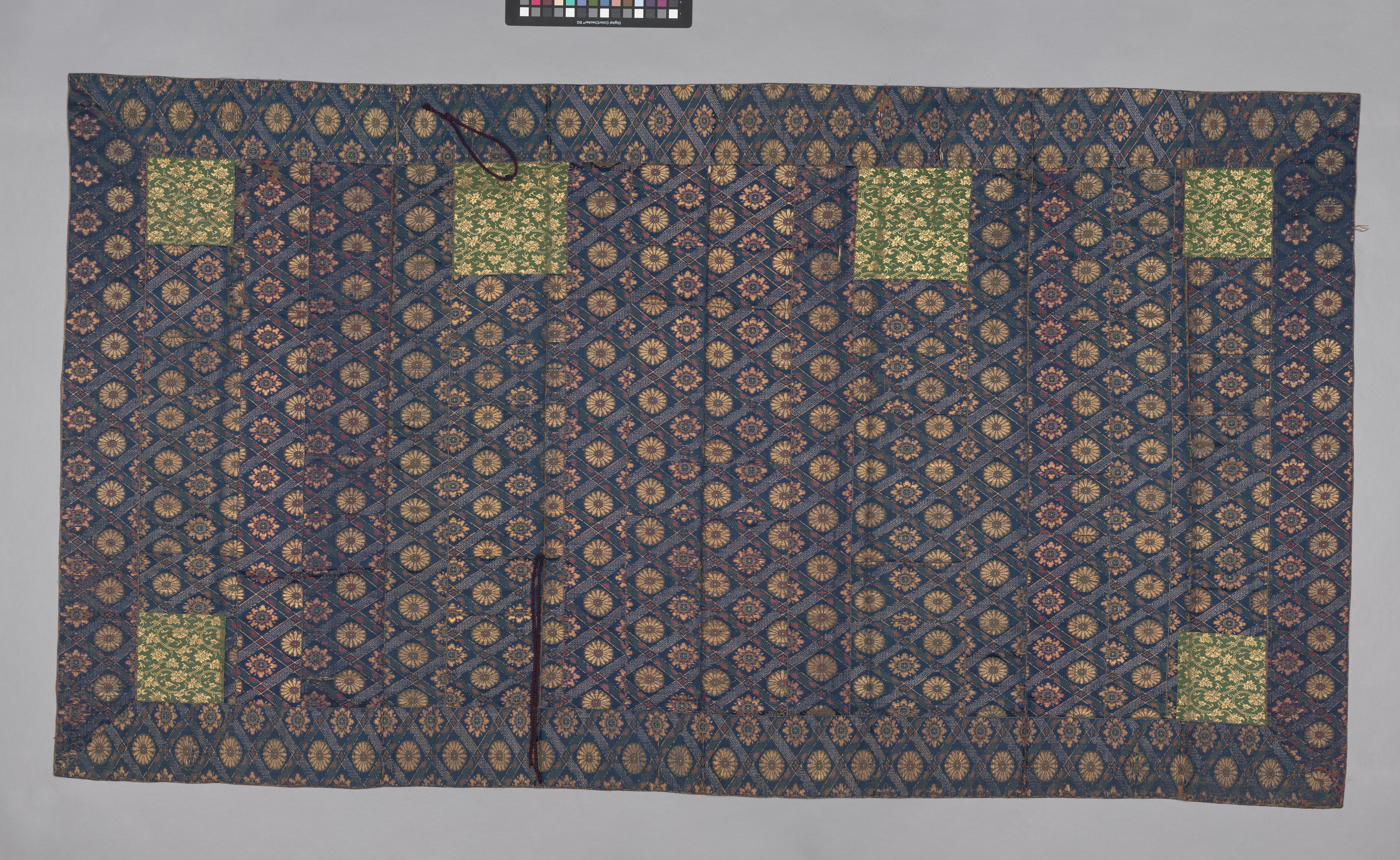
The Shichijō Priest’s Robe: An Exegesis of Sacred Silhouette and Profane Craft
Within the hallowed archives of Katherine Fashion Lab, the Shichijō Priest’s Robe emerges not merely as a garment of religious function, but as a profound study in the intersection of ritualistic form and material opulence. This standalone analysis dissects the robe’s architectural integrity, its textile narrative, and its silent dialogue between the divine and the temporal. Crafted from a foundation of silk and articulated with metallic thread, this piece transcends its liturgical origins to become a masterclass in couture restraint and symbolic resonance.
I. The Silhouette of Transcendence: Architectural Draping and Hieratic Form
The robe’s silhouette is a study in controlled volume. Unlike Western ecclesiastical vestments that often emphasize horizontal breadth or exaggerated shoulders, the Shichijō robe adheres to a vertical, columnar logic that elongates the wearer’s form, suggesting a bridging of earthly and celestial planes. The silk base, with its inherent fluidity, is manipulated into deep, cascading folds that fall in a near-mathematical precision. The cut is deceptively simple: a T-shape that allows for generous fabric to pool at the feet, yet the construction is anything but rudimentary.
Critical to the robe’s aesthetic is the metallic thread embroidery that traces the garment’s seams and hems. This is not a mere embellishment; it is a structural articulation. The metallic lines function as a sartorial skeleton, defining the robe’s fall and creating a visual counterpoint to the silk’s softness. The thread, likely a blend of gold or silver-wrapped silk, catches ambient light, creating a halo effect around the priest’s movements. This interplay of light and shadow transforms the robe into a kinetic sculpture, where every gesture—a blessing, a bow, a procession—is underscored by a shimmering calligraphy of thread.
The overall form is one of hieratic stillness. The robe does not conform to the body but rather envelops it, creating a second skin of sacred geometry. The sleeves, voluminous and falling to the knee, are left unsewn at the sides, allowing for a dramatic reveal of the inner lining—a subtle subversion of the garment’s monolithic exterior. This design choice speaks to a couture sensibility: the juxtaposition of concealment and revelation, the hidden detail that rewards a discerning eye.
II. The Textile Lexicon: Silk as Spirit, Metallic Thread as Divinity
At the material level, the Shichijō robe engages in a dialogue of contrasts. The silk—likely a high-twist habutae or a charmeuse—offers a matte, almost liquid finish that absorbs light rather than reflecting it. This quality imbues the robe with a sense of humility and depth, a visual metaphor for the priest’s inner contemplation. The silk’s weight is critical: too heavy, and the folds become static; too light, and the garment loses its ceremonial gravity. The fabric chosen achieves a perfect equilibrium, draping with a luminous austerity that is both serene and commanding.
In stark contrast, the metallic thread is a material of assertive brilliance. It is not merely decorative but is employed with the precision of a calligrapher’s brush. The embroidery patterns—often inspired by Japanese motifs such as chrysanthemums, clouds, or stylized dragons—are worked in a flat, satin stitch that creates a raised, almost sculptural surface. This technique, known as kinran (gold brocade), requires an artisan’s hand to maintain the thread’s tension and prevent kinking. The metallic thread’s reflective properties serve a liturgical purpose: in the dim light of a temple, these threads would catch candlelight, symbolizing the divine presence that illuminates the mortal world.
This material dichotomy—the humble silk and the opulent metallic thread—mirrors the dual nature of the priestly role: the human vessel and the divine message. The robe does not shy away from luxury; rather, it sacralizes opulence, transforming it into a vehicle for spiritual expression. In a couture context, this is a radical act. The garment rejects the notion that simplicity equals sanctity, instead proposing that meticulous craftsmanship and precious materials can be conduits for the ineffable.
III. The Grammar of Embroidery: Symbolic Cartography and Artisanal Mastery
The embroidery on the Shichijō robe is not random ornamentation but a symbolic cartography. Each motif is chosen with theological and aesthetic precision. The metallic thread traces patterns that often include the hōsōge (imaginary flower) or the shishi (mythical lion), both of which carry protective and purifying connotations. These motifs are arranged along the robe’s vertical axis, guiding the eye upward—a visual ascension that mirrors the priest’s role as an intermediary between earth and heaven.
The execution of this embroidery is a feat of artisanal mastery. The metallic thread, notoriously difficult to work with due to its stiffness and tendency to fray, is manipulated into tight, uniform stitches. The artisan must account for the thread’s lack of elasticity, planning each curve and angle to prevent breakage. The result is a surface that is both rigid and fluid—a paradox that speaks to the robe’s dual nature as a garment of both constraint and grace. The embroidery’s density varies: at the collar and cuffs, it is almost solid, forming a protective barrier; on the body, it is more sparse, allowing the silk to breathe. This variation creates a rhythm, a visual heartbeat that animates the garment.
From a couture perspective, this embroidery is a declaration of intent. It elevates the robe from a functional vestment to a piece of wearable art. The time investment—often months for a single garment—is a testament to the value placed on ritual and beauty. In an era of fast fashion, the Shichijō robe stands as a defiant monument to slow, intentional craftsmanship.
IV. The Body and the Void: The Wearer as Vessel
Central to this analysis is the understanding that the Shichijō robe is not designed for the body in a conventional sense. It does not seek to accentuate curves or create a flattering silhouette. Instead, it erases the individual body, replacing it with a universal form. The robe’s generous proportions and lack of waist definition allow it to drape identically on any wearer, emphasizing the role over the person. This is a profound couture statement: the garment as a leveler, a tool for transcending the self.
The void created within the robe—the space between the silk and the skin—is as important as the fabric itself. This negative space allows for movement and breath, but also for a symbolic emptiness that the wearer fills with intention. The metallic thread’s shimmer becomes a guide for the gaze, drawing attention not to the body but to the ritual actions of the hands and the face. The robe, in essence, becomes a stage for the sacred drama.
V. Conclusion: The Shichijō Robe as a Paradigm of Sacred Couture
In the context of Katherine Fashion Lab’s ongoing exploration of global garment traditions, the Shichijō Priest’s Robe emerges as a paradigm of sacred couture. It is a garment that refuses to be reduced to mere fashion or mere religion. Its silk whispers of humility, its metallic thread shouts of transcendence, and its silhouette speaks of a quiet, unyielding authority. This is a piece that demands to be studied not as an artifact of a bygone era, but as a living text—a sartorial scripture that continues to inform our understanding of beauty, ritual, and the human desire to clothe the spirit.
The robe’s legacy for contemporary design lies in its unapologetic commitment to material integrity and symbolic depth. It challenges us to see couture not as a superficial pursuit, but as a practice of meaning-making, where every stitch is a prayer and every fold a meditation. In the Shichijō robe, we find a garment that is both ancient and timeless, a testament to the enduring power of silk, thread, and the hands that bind them together.