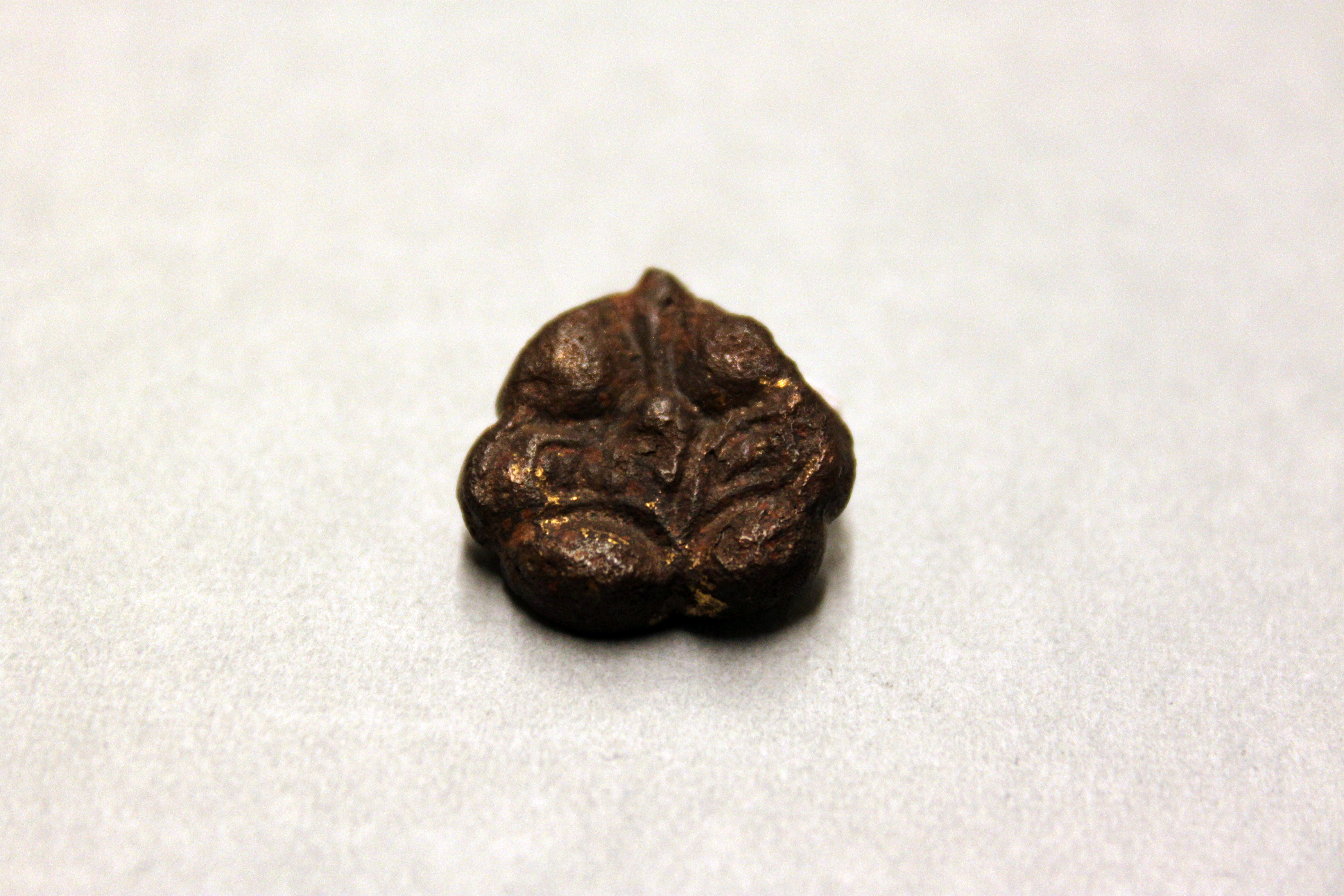
The Art of the Belt: A Couture Analysis of Bronze and Gilded Heritage
In the lexicon of haute couture, accessories are often relegated to the role of mere embellishment—afterthoughts that complete an ensemble but rarely define it. Yet, at Katherine Fashion Lab, we recognize that the most profound statements of sartorial identity are frequently forged at the intersection of structure and symbolism. The subject of this analysis—a standalone study of a belt fitting crafted from cast bronze with remnants of gilding—challenges the conventional hierarchy of fashion components. This object, drawn from a global heritage context, is not merely a functional strap but a microcosm of artisanal mastery, cultural transmission, and the enduring dialogue between material and form. Through a rigorous couture lens, we dissect how this belt fitting transcends its utilitarian origins to become a singular artifact of design philosophy.
Materiality and Craft: The Bronze Casting Process
The choice of bronze as the primary material is a deliberate declaration of permanence and prestige. Unlike leather, textile, or synthetic polymers, bronze demands an intimate relationship with fire, patience, and precision. The casting process—likely achieved through the lost-wax technique, a method revered across civilizations from ancient China to Renaissance Europe—imbues the fitting with an almost architectural integrity. Each pour of molten metal into the mold captures the artisan’s initial gesture, freezing a moment of fluidity into solid form. The resulting surface carries the subtle irregularities of hand-finishing: microscopic pits, slight asymmetries, and a tactile warmth that machine production cannot replicate. For the couture house, such imperfections are not flaws but signatures—testaments to the human hand that shaped the object.
The remains of gilding on this piece elevate its material narrative further. Gold leaf or gold amalgam, applied over the bronze substrate, once rendered the belt fitting a beacon of light and status. Over time, wear and environmental exposure have eroded much of this surface, leaving only faint traces—a ghost of opulence. This erosion is not a degradation but a patina of history. In couture analysis, we interpret such aging as a form of narrative layering: the gilding speaks to the original intention of display and hierarchy, while the exposed bronze beneath reveals the object’s journey through time. The interplay between the two materials creates a visual tension—a dialogue between the ephemeral and the enduring, the precious and the foundational.
Structural Anatomy: Form and Function in Harmony
From a structural standpoint, the belt fitting demonstrates an exquisite balance between support and ornament. The cast bronze base provides rigidity, ensuring that the belt retains its shape when cinched around the waist, hip, or torso. This is not a passive accessory; it actively participates in the sculpting of the silhouette. The fitting’s dimensions—likely a buckle, clasp, or ornamental plaque—are calibrated to distribute tension evenly, preventing stress fractures in the metal while allowing for repeated fastening and unfastening. The gilding remnants, though primarily decorative, also served a protective function, reducing oxidation and wear on the bronze beneath.
The design vocabulary of the fitting, though unadorned by explicit motifs, reveals a profound understanding of ergonomics and proportion. The curvature of the buckle or clasp follows the natural arc of the human body, suggesting that the artisan studied anatomy as much as metallurgy. Edges are softened, not sharp, to avoid snagging delicate fabrics. The clasp mechanism—whether a hook, pin, or toggle—operates with a satisfying click, a tactile feedback that confirms security without requiring visual confirmation. Such details are the hallmarks of couture-level engineering: invisible to the casual observer, yet essential to the wearer’s experience.
Global Heritage: The Belt as Cultural Signifier
To analyze this belt fitting solely through a Western couture framework would be to ignore its global heritage origins. Belts have served as markers of identity across cultures for millennia. In ancient Mesopotamia, bronze belts signified military rank; in Han Dynasty China, jade-adorned belts denoted imperial favor; in West African kingdoms, gold and bronze fittings were emblems of lineage and spiritual protection. This particular fitting, with its cast bronze and gilding, echoes these traditions while remaining deliberately ambiguous in its provenance. It is a composite of global influences—a nomadic motif here, a classical proportion there—synthesized into a form that resists easy categorization.
This ambiguity is a strength. In contemporary couture, where cultural appropriation is a persistent concern, the belt fitting’s ability to reference multiple heritages without claiming any single one allows it to function as a universal artifact. It honors the craftsmanship of the past while offering a blank slate for the wearer’s own narrative. The gilding, once a symbol of royalty in one culture, might now signify resilience in another. The bronze, once a material of warfare, becomes a medium for creative expression. This fluidity is the essence of global heritage in fashion: not a fixed tradition, but a living dialogue that adapts to new contexts.
Couture Context: The Standalone Study
The decision to present this belt fitting as a standalone study is a curatorial choice that redefines its role within the fashion ecosystem. Removed from the garment it once secured, the fitting becomes an independent object of contemplation. It is no longer subordinate to a dress or coat; it commands its own space, demanding attention as a complete work of art. This isolation allows us to appreciate its sculptural qualities—the play of light on its curved surfaces, the weight of its metal in the hand, the history etched into its patina.
In the context of Katherine Fashion Lab, such standalone studies serve as pedagogical tools. They deconstruct the hierarchy of fashion, elevating the accessory to the same critical status as the gown. They also challenge the fast-fashion paradigm of disposability. A bronze belt fitting, with its centuries-spanning lineage, is the antithesis of a seasonal trend. It is an investment in permanence, a reminder that true couture values endurance over novelty. For the discerning collector or designer, this object offers a masterclass in material integrity, cultural literacy, and the art of restraint.
Conclusion: A Legacy Cast in Metal
This belt fitting, forged from bronze and gilded with gold, is far more than a functional clasp. It is a repository of global heritage, a testament to the skill of ancient metallurgists, and a source of inspiration for contemporary couture. Its remains of gilding whisper of lost opulence, while its sturdy bronze core speaks of resilience. In analyzing it, we uncover not just the history of a single object, but the principles that underpin all great design: respect for material, understanding of the human form, and a willingness to let time add its own patina of meaning. At Katherine Fashion Lab, we do not merely study such artifacts—we learn from them, allowing them to shape the future of fashion with the weight of their past.