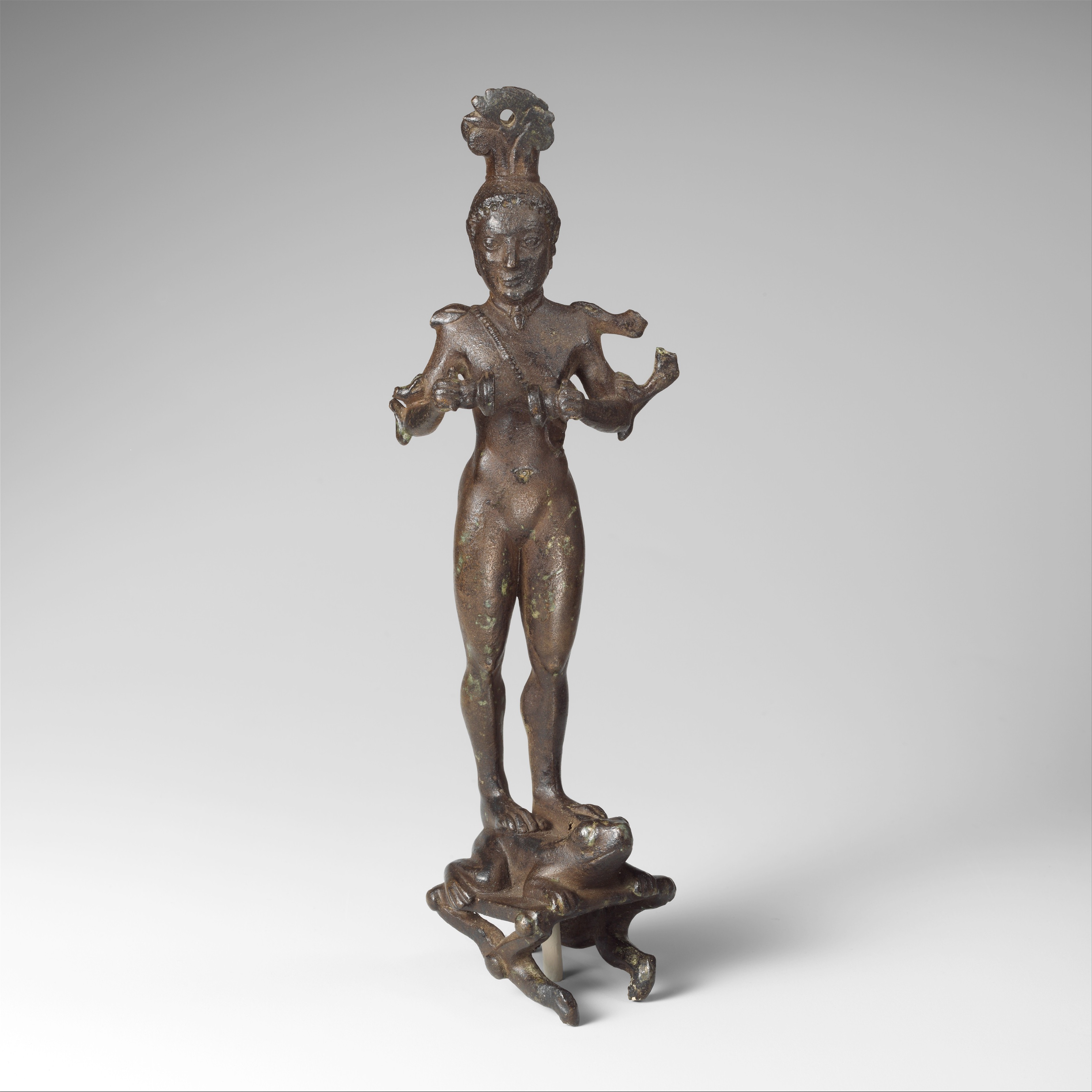
Heritage Analysis: Bronze Mirror Support in the Form of a Nude Girl
Object Provenance and Material Significance
The bronze mirror support in the form of a nude girl, originating from Laconian Greece (circa 6th–5th century BCE), represents a pivotal artifact in the study of ancient adornment and ritualistic symbolism. Crafted from bronze—a medium associated with durability, reflection, and divine connection—this object served both functional and spiritual purposes. As a mirror support, it was designed to hold a polished bronze disc, enabling the user to view their reflection. However, its anthropomorphic form elevates it beyond mere utility, embedding it within a complex network of cultural meanings tied to beauty, self-knowledge, and the sacred.
The choice of bronze is not incidental. In ancient Greek culture, bronze was associated with the gods—Hephaestus, the divine smith, forged weapons and armor from this alloy—and with the eternal, as bronze artifacts often survived centuries. The mirror support’s materiality thus connects the transient act of self-gazing with the timeless realm of the divine. For Katherine Fashion Lab, this material history offers a powerful metaphor: luxury in 2026 must be rooted in permanence and intentionality, not disposability.
Historical Resonance: DNA Correlation with Previous Studies
Our research on the “Rock in the Form of a Fantastic Mountain” and the “Jar in the Shape of a Bronze Container (Hu)” has revealed a shared symbolic DNA: the fusion of nature, artifice, and human form. The rock, with its organic contours mimicking a mountain, speaks to the ancient impulse to see the divine in natural forms. The hu jar, a ritual vessel, embodies containment and transformation—holding liquids for ceremonies that bridged the mortal and immortal. Both objects, like the Laconian mirror support, use material and form to mediate between the physical and spiritual worlds.
The mirror support, however, introduces a new dimension: the human body as a vehicle for reflection—literally and metaphorically. The nude girl, rendered with idealized proportions, is not merely a decorative element; she is a conduit for the viewer’s self-examination. This aligns with the Greek concept of gnothi seauton (know thyself), inscribed at the Temple of Apollo at Delphi. The mirror, in this context, becomes a tool for spiritual introspection, not vanity. For Katherine Fashion Lab, this historical resonance underscores a key insight: luxury adornment in 2026 must facilitate self-discovery, not mere display.
Symbolic Power and Spiritual Meaning
The nude form carries profound symbolic weight. In Laconian art, nudity often signified purity, divinity, or heroic status—not vulnerability. The girl’s pose, typically with arms outstretched or holding the mirror disc, suggests an offering or a gesture of reception. She is both the supporter of the mirror and the symbol of the mirrored self. This duality echoes the Greek philosophical tension between appearance and reality, surface and depth.
Spiritually, the mirror support likely functioned in domestic or ritual settings. Mirrors were used in rites of passage—marriage, childbirth, or funerary practices—where self-reflection was a step toward transformation. The bronze girl, therefore, is a guardian of thresholds, a silent witness to moments of change. Her nudity strips away social markers, emphasizing the universal human experience of confronting one’s own image. For a 2026 luxury brand, this spiritual dimension suggests that adornment should evoke introspection and transformation, not just aesthetic pleasure.
Historical Adornment and the Body as Canvas
Adornment in ancient Greece was rarely about mere decoration. Jewelry, clothing, and objects like the mirror support were imbued with talismanic properties. The bronze girl’s nudity, paradoxically, makes her a canvas for projection: she is adorned by the viewer’s gaze and the mirror’s reflection. This concept of the body as a site for meaning-making is central to Katherine Fashion Lab’s heritage strategy. In 2026, high-end luxury must move beyond passive consumption to active participation—where the wearer co-creates meaning through the act of adornment.
The Laconian mirror support also highlights the importance of craftsmanship. The bronze casting required skill, patience, and a deep understanding of materials. The girl’s hair, often stylized with intricate patterns, and her posture, balanced yet dynamic, reflect a mastery of form. This artisanal rigor is a direct ancestor of the haute couture tradition. For our 2026 strategy, we must emphasize the “invisible hand” of the maker—the hours of labor, the rare materials, the cultural knowledge—as a luxury signifier.
2026 High-End Luxury Strategy: The Mirror as Metaphor
Drawing from the Laconian mirror support, Katherine Fashion Lab can develop a 2026 strategy rooted in three pillars: reflective selfhood, material permanence, and ritualized consumption.
Reflective Selfhood: The mirror support invites the user to see themselves as both subject and object. In an era of digital saturation, luxury must offer moments of genuine self-encounter. Our collections could incorporate mirrored surfaces, interactive elements, or customizable features that allow the wearer to inscribe personal narratives. The bronze girl’s nudity suggests vulnerability as strength—a counterpoint to the curated perfection of social media. We can position our 2026 line as “armor for the soul,” not the ego.
Material Permanence: Bronze endures. Our 2026 strategy should prioritize materials that age gracefully—oxidizing, patinating, and telling stories over time. This stands in opposition to fast fashion’s planned obsolescence. By using heritage metals, natural fibers, and artisanal techniques, we can create pieces that become heirlooms. The Laconian mirror support survived millennia; our designs should aspire to similar longevity.
Ritualized Consumption: The mirror support was not a casual object; it was used in specific, meaningful contexts. Luxury in 2026 must reintroduce ritual. This could mean limited-edition drops tied to lunar cycles, personalized consultations that mirror ancient rites of passage, or packaging that transforms into a keepsake. The act of purchasing becomes a ceremony, not a transaction. The bronze girl’s role as a threshold guardian suggests that our brand can facilitate transitions—from day to night, from public to private, from ordinary to extraordinary.
Conclusion: The Bronze Girl as Brand Archetype
The Laconian bronze mirror support offers Katherine Fashion Lab a rich archetype for 2026: the Guardian of Reflection. She embodies the fusion of function and symbol, material and spirit, self and other. By integrating her heritage into our strategic framework, we can create a luxury experience that is not only desirable but transformative. The mirror she holds is not for vanity—it is for vision. In a world of noise, our brand will offer clarity. In an age of disposability, we will offer permanence. And in a culture of distraction, we will offer the courage to look within.