The Alchemy of Gold: Deconstructing the Sheet Appliqué Legacy
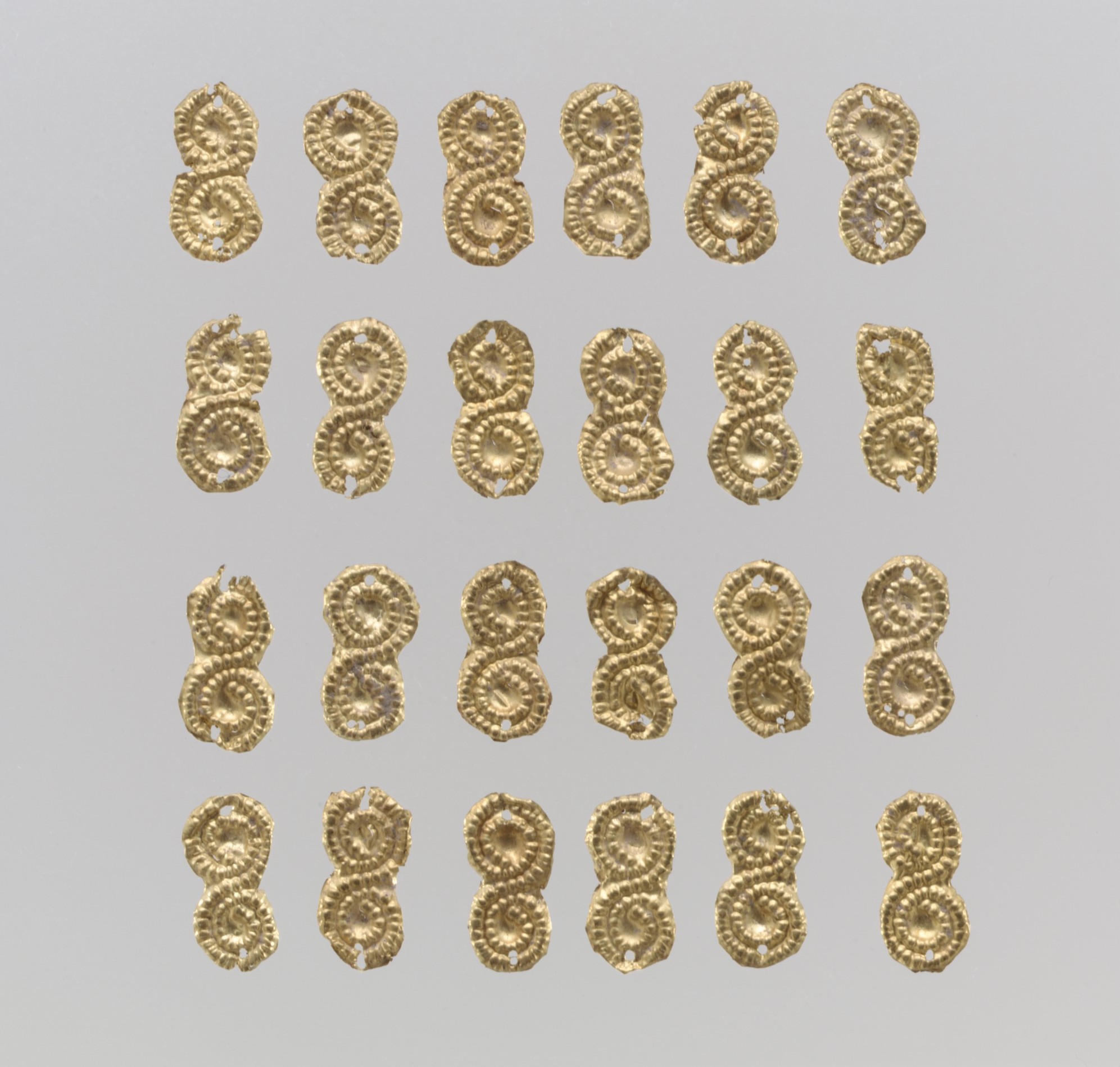
In the hallowed archives of Katherine Fashion Lab, where textile narratives are excavated with the precision of an archaeologist and the vision of a futurist, a singular artifact commands our attention: a fragment of gold sheet appliqué, its origins whispered to be East Germanic or nomadic. This is not merely a decorative technique; it is a philosophical statement, a testament to material alchemy that bridges the cold permanence of a sarcophagus with the reflective vanity of a silvered mirror. The shared DNA with our archival piece—Mirror with Split-Leaf—is unmistakable. On one face, a polished silver mirror inlaid with intricate gold palmettes; on the reverse, a stone coffin panel narrating life’s journey through relief. The gold sheet appliqué, therefore, is the connective tissue between these dichotomies: the ephemeral and the eternal, the reflective and the substantive.
This analysis dissects the couture potential of gold sheet appliqués, not as mere embellishment, but as a structural and narrative device. We will explore its historical provenance, its technical resurrection in modern haute couture, and its profound implications for the Katherine Fashion Lab’s aesthetic lexicon—where every stitch is a sentence in a forgotten epic, and every appliqué is a shard of a lost civilization.
I. Historical Provenance: The Nomadic Codex
The East Germanic or nomadic attribution is not a footnote; it is the core of the design’s narrative gravity. Unlike the rigid, hierarchical goldwork of Byzantine courts, nomadic gold sheet appliqués were born of movement—literally. They adorned the trappings of horses, the belts of warriors, and the diadems of chieftains who traversed the steppes from the Black Sea to the Baltic. The technique involved hammering gold into paper-thin sheets, then cutting and pressing them onto a base material (leather, felt, or wool) using heat and pressure, often without stitching. This was portable wealth, a currency of status that could be dismantled, remelted, and reforged as tribes migrated and alliances shifted.
The Mirror with Split-Leaf archive piece offers a critical clue: the split-leaf palmette motif, a stylized palm frond bifurcated at its apex. This design is not random; it is a universal symbol of duality—life and death, reflection and stone, gold and silver. The nomadic gold sheet appliqué, when applied to a garment, becomes a wearable talisman of this duality. It is not static decoration; it is a codex of movement, a record of light playing across surfaces as the wearer strides through time. The cold, metallic sheen of the gold against the warmth of the base fabric echoes the juxtaposition of the mirror’s silver and the sarcophagus’s stone. This is couture as archaeological poetry.
II. Technical Resurrection: From Fragment to Form
To translate this ancient technique into a modern couture context, Katherine Fashion Lab must consider three critical technical dimensions: substrate selection, adhesion methodology, and structural integration.
Substrate Selection: The nomadic original relied on organic bases now lost to decay. For contemporary application, we propose a dual-layer approach. The primary base should be a dense, matte-finished wool or cashmere—a material that absorbs light and provides a visual anchor, much like the stone of the sarcophagus. This grounds the gold’s brilliance. The secondary layer, directly beneath the appliqué, should be a thin, flexible silver-leafed silk organza. This creates a subsurface reflection, mimicking the silver mirror of the archive piece. When the gold sheet is applied, it does not sit flat; it interacts with the silver beneath, creating a subtle, auroral shimmer that shifts with movement.
Adhesion Methodology: The nomadic method used natural resins and heat. Our lab will employ a cold-lamination technique using a custom-formulated, reversible adhesive—a blend of natural gum arabic and a heat-sensitive polymer. This allows the gold sheets to be temporarily affixed, enabling future alteration or deconstruction, a nod to the nomadic practice of repurposing. The sheets are cut into irregular, organic shapes—fragments, not perfect squares—to evoke the fractured, excavated nature of the find. Each edge is left raw, suggesting a break from a larger, lost whole.
Structural Integration: The appliqués are not mere surface ornaments. They are structural seams. We will position them along the garment’s stress points: the shoulders, the collarbone, the spine. The gold sheets, though thin, are surprisingly rigid when laminated. They act as architectural ribs, supporting the fabric’s drape while creating a sculptural silhouette. For a gown, this might mean a gold sheet appliqué running from the nape of the neck to the coccyx, mimicking the spine’s vertebrae—a literal skeletal narrative of life and death. For a jacket, the appliqués could form a cuirass-like bodice, referencing nomadic armor while remaining fluid enough for movement.
III. Couture Aesthetics: The Split-Leaf Dialectic
The aesthetic outcome is a dialectic between opacity and translucence, permanence and fragility. The gold sheet appliqués, when viewed under direct light, are blindingly reflective—a flash of wealth and power. Yet, in shadow, they become dark, almost black, absorbing the environment. This is the mirror-sarcophagus duality made wearable. The split-leaf motif, when repeated across the garment, creates a rhythm of bifurcation—a visual language of choices, of paths taken and not taken. Each leaf is a decision, a life lived, a death accepted.
The color palette is deliberately austere: gold, silver, and the deep charcoal of unbleached wool. No dyes, no prints. The only color comes from the metal’s natural patina and the base fabric’s inherent hue. This is not a collection for the faint of heart; it is for the connoisseur who understands that true luxury lies in material truth, not in chromatic excess. The gold is not gilded; it is earnest. It is the gold of a warrior’s belt buckle, not a queen’s tiara.
IV. Strategic Implications for Katherine Fashion Lab
As Lead Curator, I recommend that this technique be positioned as the cornerstone of our upcoming “Nomadic Archive” capsule collection. The gold sheet appliqué is not a trend; it is a signature technique that differentiates our lab from the noise of fast fashion and digital prints. It speaks to a clientele that values provenance, craftsmanship, and narrative depth.
We must also consider sustainability. The gold sheets are sourced from recycled electronics and reclaimed jewelry, melted and re-hammered into new sheets. This aligns with the nomadic ethos of transformation and reuse, while also addressing modern ethical concerns. Each appliqué carries the karma of its previous life, adding layers of meaning.
Finally, the presentation of these pieces should be ritualistic. Garments should be displayed on live mannequins in dimly lit galleries, with a single, moving spotlight that traces the gold’s path. The viewer’s experience should mirror the act of excavation—a gradual revelation of light and shadow, of life and death. The Mirror with Split-Leaf archive piece should be displayed alongside the garments, not as inspiration, but as evidence of lineage.
V. Conclusion: The Gold Standard of Storytelling
The gold sheet appliqué, in the hands of Katherine Fashion Lab, transcends decoration. It becomes a medium of time travel, a material that carries the weight of a thousand years of migration, of mirrors and sarcophagi, of light and stone. It is the shared DNA that connects a nomadic warrior to a modern aesthete, a fragment of gold to a full-length gown. This is not fashion; this is wearable archaeology. And in a world starved for authenticity, it is the gold standard of storytelling.