Deconstructing the Whole: A Couture Analysis of 'Fragment'
In the rarefied air of haute couture, where the narrative is as meticulously constructed as the garment itself, Katherine Fashion Lab presents 'Fragment'—a standalone study that is both a profound philosophical inquiry and a masterclass in material resurrection. Eschewing the traditional seasonal collection format, this work operates as a focused thesis, interrogating the very nature of heritage, continuity, and identity in a globalized world. By employing macramé—a craft with diffuse, global origins—as its primary lexicon, the Lab does not merely create a garment; it engineers a tangible dialectic between rupture and connection, isolation and network.
The Conceptual Core: Heritage as a Non-Linear Tapestry
The subject, 'Fragment,' immediately posits a state of being that is partial, detached from a presumed whole. In the context of 'Global Heritage,' this becomes a powerful metaphor for contemporary cultural identity. We no longer inherit a single, unbroken thread of tradition but rather a collage of influences, a patchwork of histories accessed through digital and physical diaspora. Katherine Fashion Lab astutely recognizes that modern heritage is inherently fragmentary. This collection is not about reconstructing a lost unity—a futile, perhaps even undesirable, endeavor—but about examining the fragment itself as a complete, valid, and potent entity. The garment becomes a site where these global fragments are suspended, allowing their individual beauty and history to resonate while hinting at the ghost of a larger, perhaps imaginary, tapestry.
This conceptual framework challenges the often monolithic presentation of heritage in fashion. Instead of appropriating a specific cultural dress in its entirety, the Lab engages with a de-territorialized technique: macramé. This choice is critical. The craft’s presence in Arabic, Chinese, and European maritime histories, among others, makes it a true citizen of the world. It is a shared language of knots, a common code that belongs everywhere and nowhere specifically. Thus, the 'Fragment' study leverages macramé not as an ethnic signifier but as a structural metaphor for the interconnected yet distinct nodes of human creativity.
Material Intelligence: The Macramé Metier Re-engineered
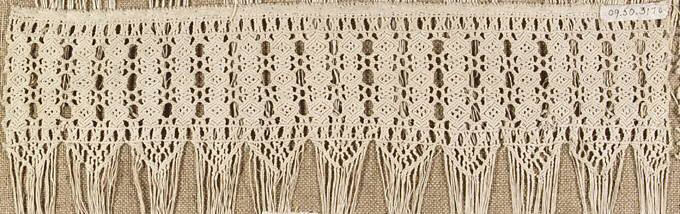
The selection of macramé is far from nostalgic craft revivalism; it is a strategic, intelligent material choice that directly serves the core concept. Traditionally associated with functional or decorative objects, the Lab elevates it to the pinnacle of couture, subjecting it to an unprecedented level of technical scrutiny and innovation. The macramé in 'Fragment' is not the coarse jute of bohemian wall hangings. Here, it is rendered in a spectrum of materials—from lustrous, fine silk cord that mimics the drape of liquid metal to gossamer-weight linen threads that dissolve into air. This transmutation of the humble into the luxurious is a couture imperative, but it goes deeper: the material's hand-knotted essence is irreducibly human, a direct tether to artisanal legacy.
Each knot in the composition is a decision point, a nexus. The density of these knots creates areas of opacity and structure, forming what can be described as the "fragments" themselves—solidified panels of intricate history. Between them, the Lab engineers deliberate negative spaces and unraveled termini, where threads are left purposefully untethered, echoing the idea of rupture, of stories interrupted or journeys begun. The construction likely involves a hybrid framework, where macramé elements are anchored to a minimal, almost architectural, under-structure, allowing the knotted fragments to appear as if suspended in space. This technique creates a mesmerizing play of shadow and substance, where the void is as articulate as the material.
Form, Silhouette, and the Standalone Statement
As a standalone study, the silhouette of 'Fragment' is necessarily sculptural and declarative. It moves beyond the functional requirements of wearability to prioritize pure expression. One can envision a form that is perhaps asymmetrical, with a cascade of macramé fragments flowing from a single shoulder, or a structured bodice that appears to be disintegrating into intricate knotted trails at the hem. The silhouette itself becomes a map of connectivity and disconnection.
The context of a standalone study liberates the Lab from commercial considerations, allowing for a purer exploration of form. It is a garment meant for contemplation, like a moving sculpture. The wearer becomes both curator and canvas, animating the fragments and giving spatial dimension to the spaces between. The interplay of light through the thousands of meticulously placed knots would create a dynamic, ever-changing pattern on the body beneath, suggesting that identity itself is not static but a play of light and shadow, of revealed and concealed histories.
Conclusion: The Integral Fragment
Katherine Fashion Lab's 'Fragment' ultimately proposes a radical redefinition. It argues that in our globalized age, we are all composites, and there is integrity to be found in the fragmentary state. The masterpiece does not seek to hide its seams or conceal its disparate origins; it celebrates them, making the method of connection—the knot—the hero of the narrative. This couture analysis reveals a work of exceptional conceptual maturity and technical audacity. By fusing the deeply human, tactile language of a global craft with a sharp, contemporary philosophy, the Lab has crafted a testament to the idea that our fragmented heritage is not a source of lack, but a rich, complex, and beautiful new whole. The standalone study stands precisely as it intends: as a complete and eloquent fragment, inviting endless interpretation and proving that from countless individual knots, a formidable and cohesive strength can emerge.