The Shawl as a Global Artefact: A Couture Analysis of Wool Craft and Heritage
In the lexicon of fashion, few accessories possess the narrative depth and technical complexity of the shawl. At Katherine Fashion Lab, we approach this garment not merely as a piece of fabric, but as a movable archive of global heritage, a testament to human ingenuity in textile engineering, and a canvas for cross-cultural dialogue. This standalone study examines the shawl through a couture lens, focusing on its material essence—wool—and its journey from functional necessity to high-fashion statement. The analysis deconstructs the shawl’s structural grammar, its historical provenance across civilizations, and the contemporary reimagination that positions it as a cornerstone of sustainable luxury.
Material Mastery: The Wool Substrate as a Couture Foundation
Wool, as a fiber, is a paradox of softness and resilience. From the highlands of Tibet to the valleys of Kashmir, the selection of wool determines the shawl’s drape, thermal regulation, and tactile language. In couture terms, the wool shawl demands an intimate understanding of fiber micron count, twist, and weave density. For instance, the pashmina—derived from the Capra hircus goat native to the Himalayan region—requires a micron count of 12–15 for true luxury, yielding a gossamer weight that defies its insulating properties. This is not a casual textile; it is an engineered material that responds to body heat and movement, creating a second skin that is both protective and expressive.
Katherine Fashion Lab’s analysis emphasizes the inherent sustainability of wool as a biodegradable, renewable resource. Unlike synthetic alternatives, wool’s natural crimp and moisture-wicking properties allow for minimal intervention in the finishing process. The shawl’s construction—whether handwoven on a traditional pit loom or crafted via a digital Jacquard—becomes a dialogue between ancient technique and modern precision. The wool’s ability to hold complex dyes, from natural indigo to mineral-based pigments, further elevates it as a medium for narrative design, where color becomes a signifier of regional identity and artisan lineage.
Global Heritage: The Shawl as a Cartography of Civilization
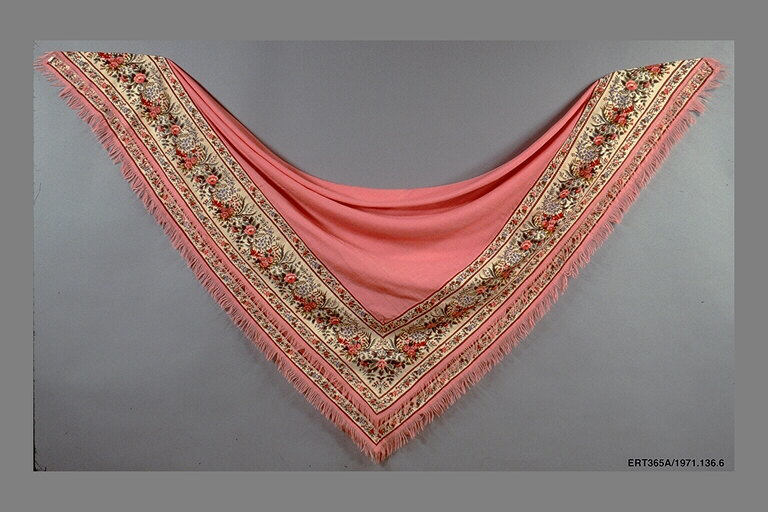
The shawl’s provenance is a map of human migration and exchange. In the Kashmiri tradition, the shawl was a symbol of royal patronage, its intricate buta (paisley) motifs woven by master artisans whose families guarded the technique for generations. These shawls traveled the Silk Road, influencing Persian, Ottoman, and eventually European textile cultures. The French châle of the 19th century, often woven in Lyon from fine merino wool, was a direct descendant of this heritage, adapted for the bourgeoisie as a marker of sophistication and global awareness.
Simultaneously, the Andean lliclla—a woolen shawl worn by Indigenous women of the Quechua and Aymara communities—embodies a different narrative. Here, the wool is often from alpaca or llama, spun and dyed with local plants and cochineal. The geometric patterns are not decorative; they are a form of textile code, encoding community identity, marital status, and cosmological beliefs. The shawl becomes a wearable text, a living archive of pre-Columbian knowledge. In this context, the shawl is not an accessory but a primary garment, a shield against the high-altitude cold and a banner of cultural resilience.
From the Middle Eastern abaya to the Scottish plaid, each iteration of the wool shawl carries the fingerprints of its origin. The Orenburg shawl from Russia, known for its cobweb-like fineness, is knitted from the soft down of Orenburg goats, a technique so delicate that a shawl can pass through a wedding ring. This is not mere craft; it is a form of mathematical precision, where stitch counts and tension ratios create a fabric that is both airy and warm. The global heritage of the shawl, therefore, is not a linear progression but a polyphonic conversation, where each tradition informs and enriches the others.
Couture Construction: The Shawl’s Structural Vocabulary
In the atelier, the shawl is deconstructed into its core components: the field, the border, and the fringe. Each element carries functional and aesthetic weight. The field—the main body—must be woven with a consistent tension to ensure even drape. The border, often a denser weave or a contrasting pattern, serves as a visual frame, directing the eye and providing structural integrity to prevent fraying. The fringe, whether hand-knotted or woven as a continuation of the warp, is not an afterthought; it is a kinetic element that adds movement and a tactile finish.
Katherine Fashion Lab’s approach to the shawl involves a modular design philosophy. By treating the shawl as a geometric plane rather than a fixed shape, we explore asymmetry, layering, and multifunctionality. A single wool shawl can be draped as a cape, folded into a stole, or knotted as a sculptural neckpiece. This versatility is the hallmark of couture: a garment that transcends a single occasion and becomes a tool for personal expression. The weight and hand of the wool—whether a crisp worsted or a soft flannel—dictate the possibilities. A heavy tweed shawl, for example, demands a more structured silhouette, while a cashmere-wool blend invites fluid, Grecian-style draping.
Contemporary Reimagination: The Shawl in Sustainable Luxury
In the current fashion landscape, the wool shawl emerges as a counterpoint to fast fashion’s disposability. Its timeless silhouette and durable material align with the principles of slow fashion and circular design. At Katherine Fashion Lab, we advocate for the shawl as a heritage investment piece—one that can be passed down through generations, its value accruing with age and wear. The reimagination involves not only the material but also the narrative. We collaborate with artisan cooperatives in Kashmir, Peru, and Scotland to source wool that is ethically harvested and hand-processed, ensuring that the shawl’s provenance is transparent and equitable.
Technological innovation also plays a role. Digital weaving allows for the reproduction of historical patterns with exacting fidelity, while 3D knitting enables zero-waste construction, where the shawl is shaped directly on the machine without cutting. This fusion of heritage and technology redefines the shawl as a hybrid artefact—one that honors the past while embracing the future. The color palette, too, shifts from traditional earth tones to include modern, muted pastels and deep jewel tones, allowing the shawl to integrate into a contemporary wardrobe without losing its cultural resonance.
Conclusion: The Shawl as a Universal Language
This standalone analysis reaffirms the shawl’s position as a couture essential—a garment that embodies the intersection of global heritage, material mastery, and sustainable innovation. The wool shawl is not a relic of the past but a living, evolving form that speaks to our need for connection, warmth, and identity. For Katherine Fashion Lab, it represents a commitment to honoring the artisan’s hand while pushing the boundaries of design. Whether draped over a silk gown or paired with a tailored suit, the shawl remains a quiet declaration of elegance—one that carries the weight of centuries and the promise of tomorrow.