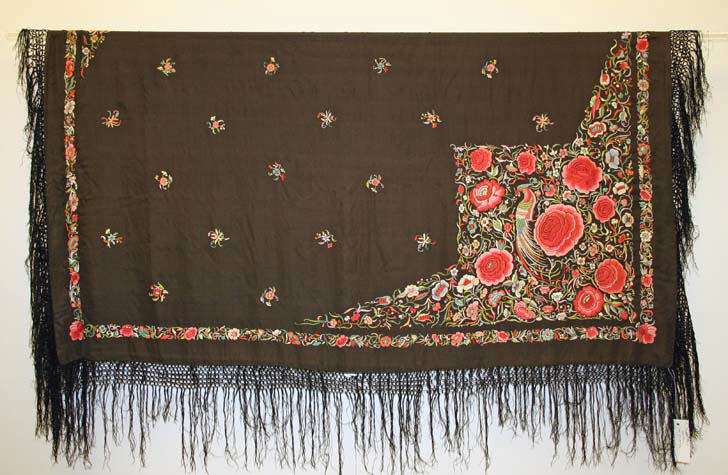
The Art of the Philippine Silk Shawl: A Couture Analysis
Introduction: The Shawl as a Canvas of Cultural and Material Mastery
In the lexicon of fashion, few accessories possess the transformative power of the shawl. It is neither a garment in the traditional sense nor a mere afterthought; rather, it is a fluid, architectural statement that bridges the intimate and the public. At Katherine Fashion Lab, we approach the shawl not as a commodity but as a standalone study in couture—a discipline where material, origin, and technique converge to create a narrative of exceptional artistry. This analysis focuses on a singular artifact: a Philippine silk shawl. Within its folds lies a synthesis of indigenous heritage and global luxury, a testament to the Philippines’ often-overlooked contribution to high fashion. Here, the shawl transcends its functional role to become a medium of cultural expression, a study in drape, and a celebration of silk’s unparalleled luminosity.
Materiality: The Unrivaled Character of Philippine Silk
The foundation of any couture piece is its material, and Philippine silk—locally known as seda—offers a distinctive profile that distinguishes it from its Chinese, Italian, or Indian counterparts. The silk used in this shawl is sourced from the Bombyx mori silkworm, cultivated in regions such as Negros Occidental and Batangas, where sericulture has been revived as a sustainable craft. What sets Philippine silk apart is its fiber’s inherent irregularity. Unlike the machine-perfect uniformity of mass-produced silks, Philippine silk retains a subtle, organic texture—a slight slub that catches light in unpredictable ways. This imperfection is not a flaw but a signature of artisanal production, lending the fabric a tactile depth that feels both luxurious and alive.
The shawl’s weight is deliberately calibrated: a 12-momme crepe de chine weave that offers a delicate balance between fluidity and structure. When held, the fabric cascades with a liquid-like gravity, yet it possesses enough body to hold a sculpted fold. The hand-feel is cool and smooth, with a faint rasp that speaks to the natural sericin content—a protein that many commercial silks strip away. This nuanced materiality makes the shawl a study in sensory sophistication, demanding that the wearer engage with its texture as much as its visual impact.
Weave and Construction: The Handloom Legacy
The shawl’s construction is rooted in the Philippine tradition of handloom weaving, a practice that predates colonial influence and remains central to the country’s textile identity. Unlike mechanized looms that impose rigid, uniform tension, the handloom process allows for a dynamic interplay between warp and weft. Each pass of the shuttle is guided by a weaver’s intuition, resulting in a fabric with subtle variations in density and drape. For this shawl, the weave is a plain weave with a slight warp-faced emphasis, creating a surface that is matte on one side and subtly lustrous on the other—a duality that can be exploited for dramatic effect in styling.
The edges are finished with a meticulous hand-rolled hem, a technique that requires hours of patient craftsmanship. Each roll is no wider than 2 millimeters, secured with invisible silk thread. This detail is not merely decorative; it prevents fraying while preserving the shawl’s weightlessness. Similarly, the fringe—if present—is hand-twisted from the same warp threads, creating a terminal that echoes the shawl’s overall rhythm without visual interruption. These construction choices elevate the piece from a simple rectangle of fabric to a couture object, where every stitch is a deliberate decision.
Color and Dye: The Palette of the Archipelago
Color in a Philippine silk shawl is never arbitrary; it is a language drawn from the archipelago’s natural environment. This particular shawl employs a palette of indigo and abaca beige, achieved through natural dyeing processes. The indigo, sourced from the Indigofera tinctoria plant, is applied in multiple dips to achieve a depth that synthetic dyes cannot replicate. The result is a blue that shifts from deep navy to a luminous cerulean under sunlight, with subtle gradations that reveal the dyer’s hand. The beige comes from a sappanwood and turmeric bath, yielding a warm, earthy tone that complements the indigo without competing for dominance.
The dyeing process is a study in patience and precision. Each shawl is immersed in the dye vat for controlled periods, then exposed to air to oxidize—a cycle repeated until the desired saturation is achieved. This method produces colors that are not uniform but possess a living quality, as if the fabric itself were breathing. In couture terms, this chromatic complexity allows the shawl to interact with different lighting conditions, offering a new visual experience with every wear. It is a deliberate departure from the flat, consistent hues of mass-market scarves, asserting the shawl’s status as an art piece.
Cultural Provenance: The Shawl as a Carrier of Identity
To analyze this shawl solely through its material and construction is to miss its deeper resonance. In Philippine culture, the shawl—often referred to as a panyo or alampay—carries significant social and ceremonial weight. Historically, it was worn by women as a sign of modesty and status, draped over the shoulders or used to carry infants. In the context of this couture analysis, the shawl becomes a vessel for reimagined heritage. The design motifs, though abstract, draw from indigenous B’laan and T’boli patterns—geometric forms that represent the cosmos, fertility, and protection. These are not literal reproductions but reinterpretations, woven into the silk’s surface through a subtle ikat-like resist technique.
This cultural provenance is not a marketing gimmick; it is a foundational layer of the shawl’s identity. For Katherine Fashion Lab, the Philippine origin is a counterpoint to the homogenizing forces of global fashion. It asserts that luxury need not be divorced from locality, and that the most profound couture emerges when a designer respects the roots of their material. The shawl, therefore, is a silent ambassador of Filipino craftsmanship, challenging the wearer to consider the hands and histories that brought it into being.
Drape and Wearability: The Couture Experience
A shawl’s true test lies in its performance on the body. This Philippine silk shawl exhibits a drape that is both graceful and architectural. When worn asymmetrically over one shoulder, the fabric’s weight creates a diagonal line that elongates the silhouette, while the natural slubs catch light to produce a subtle shimmer. If folded into a narrow stole, the shawl gains structure, allowing it to be pinned into a sculptural collar or a cascading back panel. The versatility is not accidental; it is the result of precise weight distribution and fiber elasticity.
The temperature-regulating properties of silk further enhance its wearability. In tropical climates, the shawl breathes, wicking moisture away from the skin; in cooler environments, it provides a lightweight layer of insulation. This adaptability makes it a year-round investment piece, aligning with the principles of sustainable couture. The shawl does not merely accessorize an outfit; it transforms the wearer’s relationship with their environment, offering a tactile dialogue between fabric, body, and space.
Conclusion: The Shawl as a Standalone Masterpiece
In isolating the Philippine silk shawl for standalone study, we uncover a universe of meaning within a single accessory. It is a testament to the power of material—silk as a living fiber that reflects light and touch. It is a celebration of technique—handloom weaving and natural dyeing that resist industrial efficiency. And it is a cultural artifact, woven with the stories of an archipelago’s resilience and creativity. For Katherine Fashion Lab, this shawl is not merely a product but a philosophy: that true couture lies in the details, in the provenance, and in the quiet mastery of the handmade. It invites the wearer to participate in a narrative that is both personal and global, ephemeral and eternal. In the end, the shawl is not just an object to be worn—it is a lesson in how to see, feel, and honor the art of fashion at its most refined.