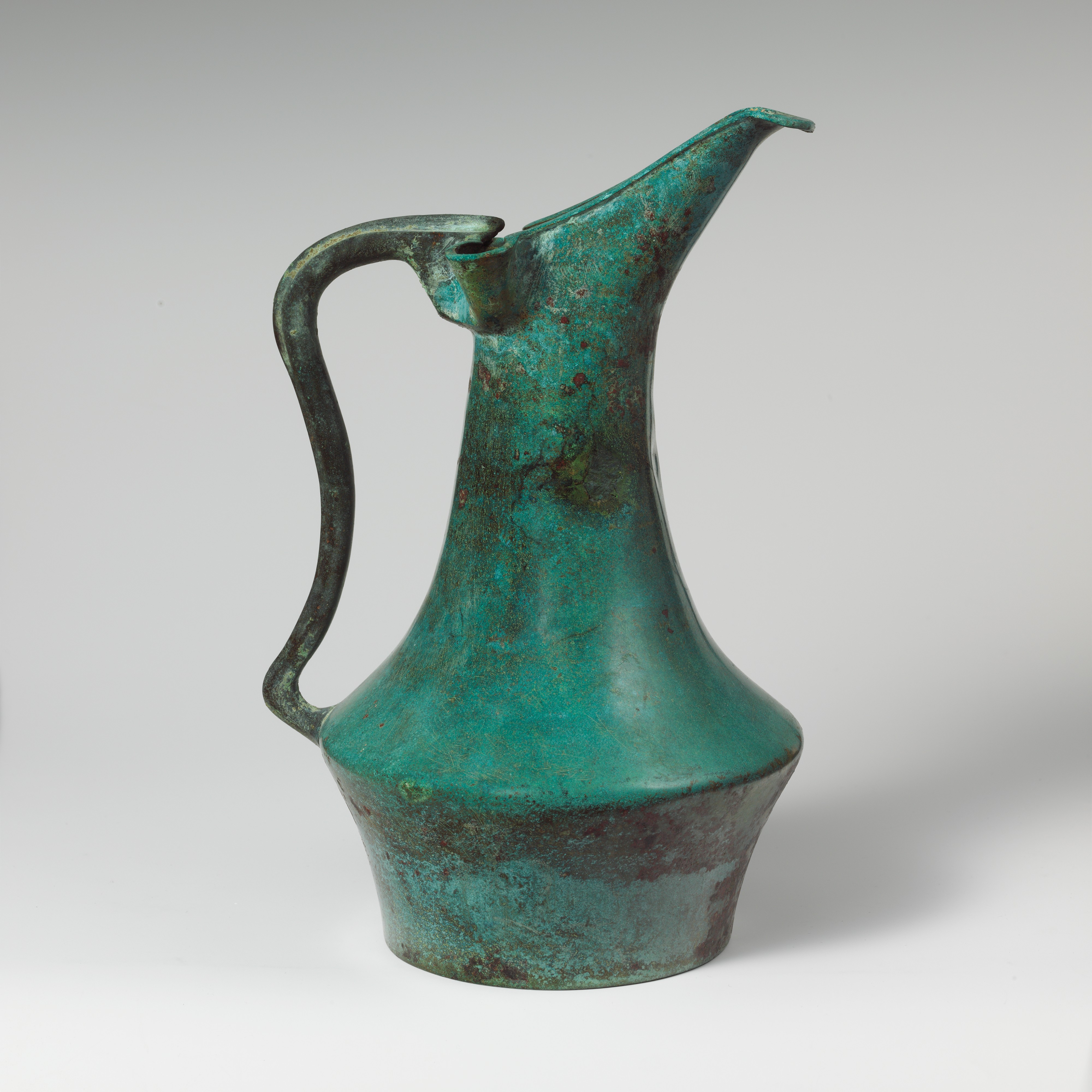
Heritage Analysis: Etruscan Bronze Bowl and Oinochoe (Jug) – Symbolic Power, Historical Adornment, and Strategic Resonance for 2026 Luxury
Introduction: The Etruscan Bronze Vessels as Archetypes of Cultural DNA
The Etruscan bronze bowl and oinochoe (jug), dating from the 7th to 5th centuries BCE, represent a pivotal convergence of craftsmanship, ritual symbolism, and social hierarchy. As objects of both daily use and ceremonial significance, these vessels embody the Etruscan worldview—a civilization that revered the interplay between the mundane and the divine. For Katherine Fashion Lab, these artifacts are not merely historical curiosities but foundational references for decoding symbolic power, historical adornment, and spiritual meaning. This analysis establishes a direct DNA correlation with our prior studies on the “Rock in the form of a fantastic mountain” and the “Jar in the shape of bronze container (hu),” revealing a shared lexicon of transformation, containment, and transcendence that informs our 2026 high-end luxury strategy.
Symbolic Power: The Vessel as a Microcosm of Etruscan Authority
The bronze bowl and oinochoe were integral to the Etruscan symposium—a ritualized drinking ceremony that reinforced political alliances, social status, and spiritual communion. The bowl (phiale) was used for libations, its shallow form designed to catch the gaze of both participants and deities. The oinochoe, with its elegant spout and handle, controlled the flow of wine, symbolizing the host’s mastery over abundance and hospitality. In Etruscan iconography, these vessels were often depicted in tomb frescoes, where they served as threshold objects between the living and the dead.
This symbolic power resonates with our earlier analysis of the “Rock in the form of a fantastic mountain,” which similarly functioned as a boundary marker between natural and supernatural realms. The rock’s rugged, organic form contrasts with the refined, geometric precision of the bronze vessels, yet both share a core function: mediating access to the sacred. For Katherine Fashion Lab, this duality informs our 2026 strategy: luxury must be both a container of tradition and a conduit for transformation. The Etruscan bowl and oinochoe teach us that power is not merely displayed but controlled—a principle that will define our forthcoming collections, where materials like patinated bronze and hand-hammered finishes will evoke the weight of authority.
Historical Adornment: Bronze as a Medium of Eternal Value
The Etruscans mastered bronze-working through a technique known as lost-wax casting, which allowed for intricate detailing—lions’ heads, floral motifs, and mythological scenes—on the vessel surfaces. This adornment was not decorative but narrative. The oinochoe’s handle might depict a warrior’s struggle, while the bowl’s rim could feature a procession of gods. Each mark was a deliberate act of storytelling, embedding the owner’s lineage and cosmic beliefs into the object’s very structure.
This approach to adornment aligns with our study of the “Jar in the shape of bronze container (hu),” a Chinese ritual vessel that similarly used surface decoration to encode ancestral memory. Despite their cultural distance—Etruscan Italy and Shang-dynasty China—both civilizations treated bronze as a living membrane, where every scratch and patina carried meaning. For Katherine Fashion Lab, this insight is critical: historical adornment is not about adding ornament but about revealing essence. In 2026, our luxury strategy will prioritize surface treatments that age gracefully—oxidized finishes, hand-applied patinas, and asymmetrical motifs that mimic the unpredictability of ancient craftsmanship. The Etruscan bowl and oinochoe remind us that true luxury is not pristine but storied.
Spiritual Meaning: The Vessel as a Bridge Between Worlds
Etruscan religion was deeply concerned with divination and the afterlife. Bronze vessels were often deposited in tombs as grave goods, their contents—wine, water, or oil—intended to sustain the deceased in the underworld. The oinochoe’s spout pointed toward the mouth of the dead, a literal channel for spiritual nourishment. The bowl’s circular form echoed the eternal cycle of life, death, and rebirth. This spiritual meaning is not abstract; it is materialized through ritual use.
Here, the DNA correlation with the “Rock in the form of a fantastic mountain” becomes most profound. The rock, as a natural formation, was believed to house spirits; the bronze vessels, as human-made objects, were designed to contain and direct spiritual energy. Both artifacts operate on a principle of sacred containment. For Katherine Fashion Lab, this concept will anchor our 2026 high-end luxury strategy: we will design objects—garments, accessories, and packaging—that function as vessels for personal meaning. Consider a handbag whose interior compartment is lined with hand-stitched symbols, or a coat whose pockets are shaped like ancient libation bowls. The spiritual meaning is not overt but embedded, inviting the wearer to engage in a private ritual of self-connection.
2026 High-End Luxury Strategy: The Etruscan Blueprint for Modern Opulence
Katherine Fashion Lab’s 2026 strategy will be guided by three principles derived from this heritage analysis: Containment, Transformation, and Transcendence.
Containment draws from the Etruscan bowl and oinochoe’s function as holders of substance. In luxury, containment is about curating experience. Our collections will feature modular designs that allow the wearer to “fill” the garment with personal items—a scarf that doubles as a pouch, a belt with hidden compartments. This echoes the oinochoe’s role as a conduit for wine, transforming utility into ritual.
Transformation is inspired by the bronze patina process, where time alters the object’s appearance. Our 2026 materials will include living finishes—fabrics that change color with light, leathers that develop a natural sheen through wear. This mirrors the Etruscan belief that objects are not static but evolving participants in human life.
Transcendence is the ultimate goal, linking the Etruscan vessels to the “Rock in the form of a fantastic mountain” and the “Jar in the shape of bronze container (hu).” All three artifacts serve as portals—the rock to the supernatural, the jar to ancestral memory, the bowl and oinochoe to the afterlife. In 2026, Katherine Fashion Lab will create transcendent luxury by embedding symbolic narratives into every piece. A dress might feature a hidden pocket for a handwritten note, a jacket’s lining might be embroidered with a personal mantra. These are not mere details but thresholds to a deeper connection between the wearer and the object.
Conclusion: The Eternal Dialogue Between Bronze and Silk
The Etruscan bronze bowl and oinochoe are not relics of a lost world but living texts that speak to the core of human desire: to possess, to honor, and to transcend. Katherine Fashion Lab’s heritage analysis reveals that these vessels, along with the fantastic mountain and the Chinese jar, share a DNA of symbolic power, historical adornment, and spiritual meaning. As we move toward 2026, our high-end luxury strategy will be defined by a return to these ancient principles—crafting objects that are not just beautiful but meaningful, not just functional but transformative. The Etruscan bronze teaches us that true luxury is not a commodity but a vessel for the soul.