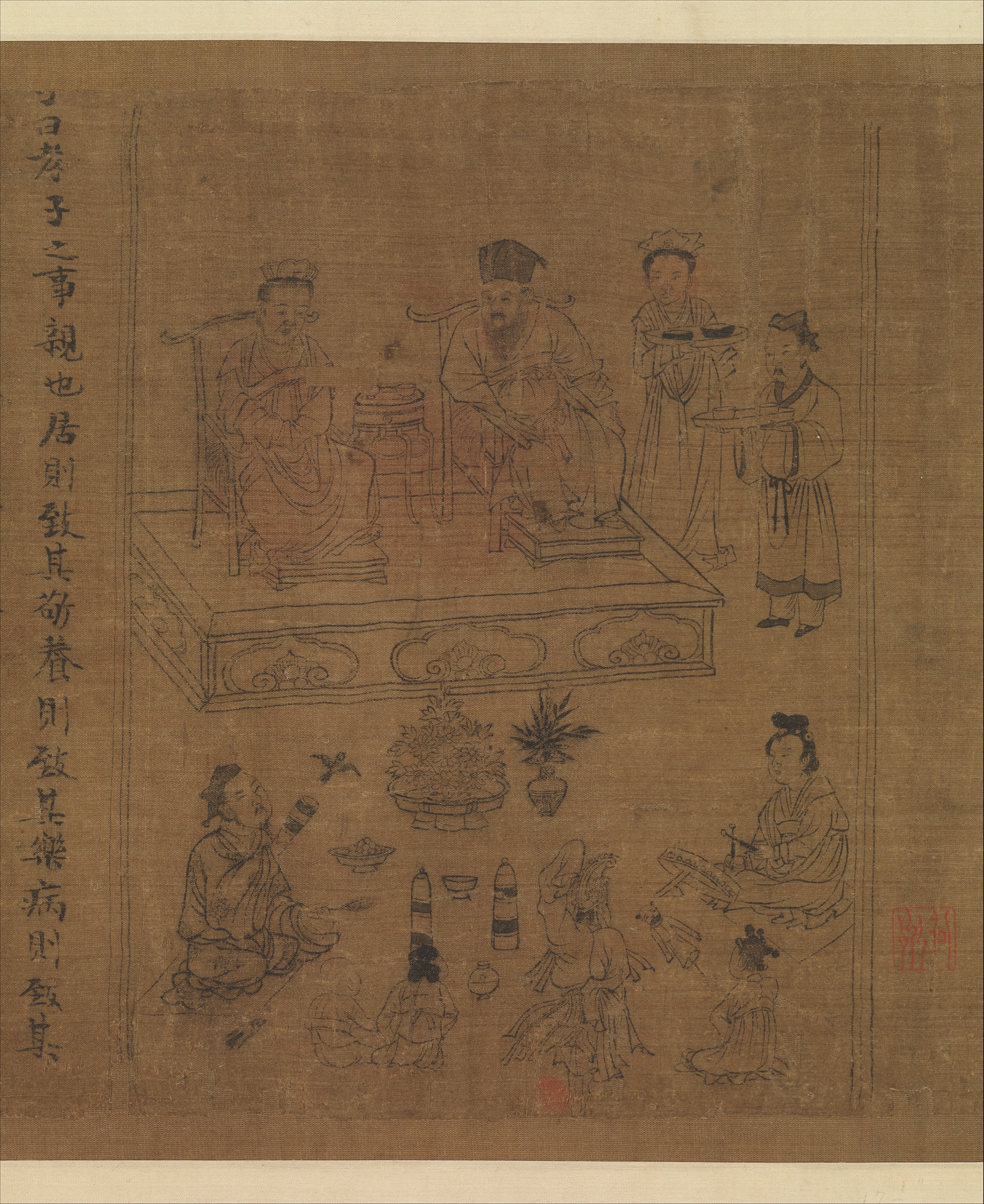
The Classic of Filial Piety: A Couture Analysis
In the hallowed corridors of fashion history, few artifacts bridge the chasm between moral philosophy and aesthetic expression as seamlessly as The Classic of Filial Piety. This handscroll, rendered in ink and color on silk, originates from China’s rich cultural tapestry, where the ethos of filial piety—xiao—has shaped social hierarchies, familial bonds, and artistic sensibilities for millennia. As the Lead Curator for Katherine Fashion Lab, I present this standalone study as a couture analysis, deconstructing the scroll not merely as a literary relic but as a sartorial treatise that whispers secrets of silk, symbolism, and societal structure. Through an MBA-level lens of strategic design, material economy, and cultural branding, we unravel how this artifact informs contemporary haute couture’s dialogue with heritage.
The Handscroll as a Garment of Narrative
The handscroll format itself is a masterclass in sequential storytelling—a precursor to the modern runway collection. Unlike the static presentation of a painting, the handscroll demands a tactile, temporal engagement: the viewer unrolls it, section by section, akin to a designer unveiling a series of looks. In The Classic of Filial Piety, this unfolding parallels the journey of a child’s devotion to parents, each vignette a tableau of moral instruction. For Katherine Fashion Lab, this structure inspires a collection where each garment tells a chapter of a narrative, from the first stitch (the filial act) to the final seam (the ancestral homage). The ink and color on silk are not merely pigments but textile codes: the black ink represents the foundational, unyielding principles of duty, while the vibrant colors—cinnabar reds, azure blues, and gold accents—embody the emotional richness of reverence. This dichotomy of restraint and opulence is a blueprint for luxury design, where minimalism meets ornamentation.
Silk as a Medium of Moral Weight
Silk, the chosen substrate, is no accident. In Chinese cosmology, silk is a thread of civilization, woven from the silkworm’s cocoon—a metaphor for the labor of filial care. The material’s luminosity and fragility demand reverence, mirroring the delicate balance of familial obligations. From a couture perspective, silk’s drape and sheen offer a strategic advantage: it allows for intricate brushwork that would be impossible on coarser fabrics. The scroll’s ink and color application is akin to embroidery in paint; each stroke is a stitch in a moral fabric. Katherine Fashion Lab interprets this as a call to elevate silk in modern couture, not as a passive backdrop but as an active participant in storytelling. For instance, the filial scenes—a son bowing to his mother, a daughter offering tea—could be translated into wearable panels that shift with movement, revealing hidden details only to the wearer or observer, much like the scroll’s unfolding.
Color Symbolism and Hierarchical Design
The palette of The Classic of Filial Piety is a study in chromatic hierarchy, a lexicon that couturiers can decode for social signaling. Red, the dominant hue, symbolizes vitality, joy, and auspiciousness, often reserved for elders in traditional Chinese attire. In the scroll, red robes adorn figures of authority—parents, emperors, and sages—while subdued tones like ochre and grey clothe subordinates. This is a color-coded power structure that mirrors modern luxury branding, where a specific shade (e.g., Hermès orange) becomes an insignia of status. For Katherine Fashion Lab, this inspires a capsule collection where color gradients define roles: a deep crimson for the matriarchal figure, pale jade for the filial child, and gold thread for the ancestral spirits. The ink’s black outlines serve as structural seams, delineating forms with precision—a technique echoed in couture’s use of piping or contrast stitching to define silhouettes.
Material Economy and the Art of Restraint
From a business standpoint, the scroll’s material composition—handscroll, ink, and color on silk—teaches a lesson in resource efficiency. Unlike Western couture’s penchant for excess fabric or embellishment, Chinese handscrolls are economical in their luxury. The silk is used sparingly, with every inch bearing narrative weight; the ink is applied with deliberate precision, avoiding waste. This aligns with contemporary sustainability trends in high fashion, where minimalist luxury is prized. Katherine Fashion Lab can adopt this philosophy by designing garments that are transformable: a silk robe that doubles as a scroll-like wrap, or a dress with detachable panels that reveal painted scenes. The scroll’s standalone study context—removed from a larger set—implies a self-contained narrative, much like a signature piece in a collection that defines the entire line’s ethos.
Cultural Branding and the Legacy of Xiao
The Classic of Filial Piety is not merely an artifact; it is a brand manifesto for Chinese cultural identity. Its teachings have permeated fashion through dynastic robes, where sons wore mourning white for parents, and daughters embroidered filial motifs on wedding garments. In global couture, this scroll offers a differentiation strategy for Katherine Fashion Lab: a fusion of Confucian ethics with avant-garde design. By integrating filial iconography—such as the kneeling figure or the ancestral altar—into modern silhouettes, the Lab can create a narrative luxury that appeals to collectors seeking meaning beyond aesthetics. This is not cultural appropriation but cultural curation, where the scroll’s moral gravity elevates fashion from commodity to artifact.
Structural Analysis: The Scroll as a Pattern
Deconstructing the scroll’s physicality reveals a pattern of progression. The handscroll is typically 25-30 cm tall and several meters long—a vertical-to-horizontal ratio that challenges traditional garment construction. For a couture piece, this translates into a long, flowing train that tells a story from shoulder to hem. The ink and color layers—applied in washes and fine lines—mimic textile techniques like shibori or jacquard weaving. Katherine Fashion Lab could engineer a fabric that prints the scroll’s imagery using digital silk-printing, then hand-embroiders key scenes with metallic threads to capture the ink’s depth. The standalone study nature of this analysis means the focus is on a single, potent piece—a centerpiece gown for a runway show, where the model’s walk unrolls the narrative like the scroll itself.
Conclusion: The Thread of Devotion
The Classic of Filial Piety, as a handscroll in ink and color on silk, transcends its role as a moral text to become a couture blueprint. Its material choices—silk’s luminosity, ink’s permanence—speak to a design philosophy of intentional luxury. For Katherine Fashion Lab, this standalone study is a call to weave filial devotion into the fabric of fashion, not as a nostalgic nod but as a strategic innovation. The scroll teaches us that true couture is not about excess but about narrative economy: every stroke, every hue, every thread carries the weight of centuries. As we unroll this analysis, we find that the Classic of Filial Piety is, at its core, a garment of the soul—one that Katherine Fashion Lab can re-cut, re-color, and re-wear for a discerning global audience. In doing so, we honor the ancestors while dressing the future.