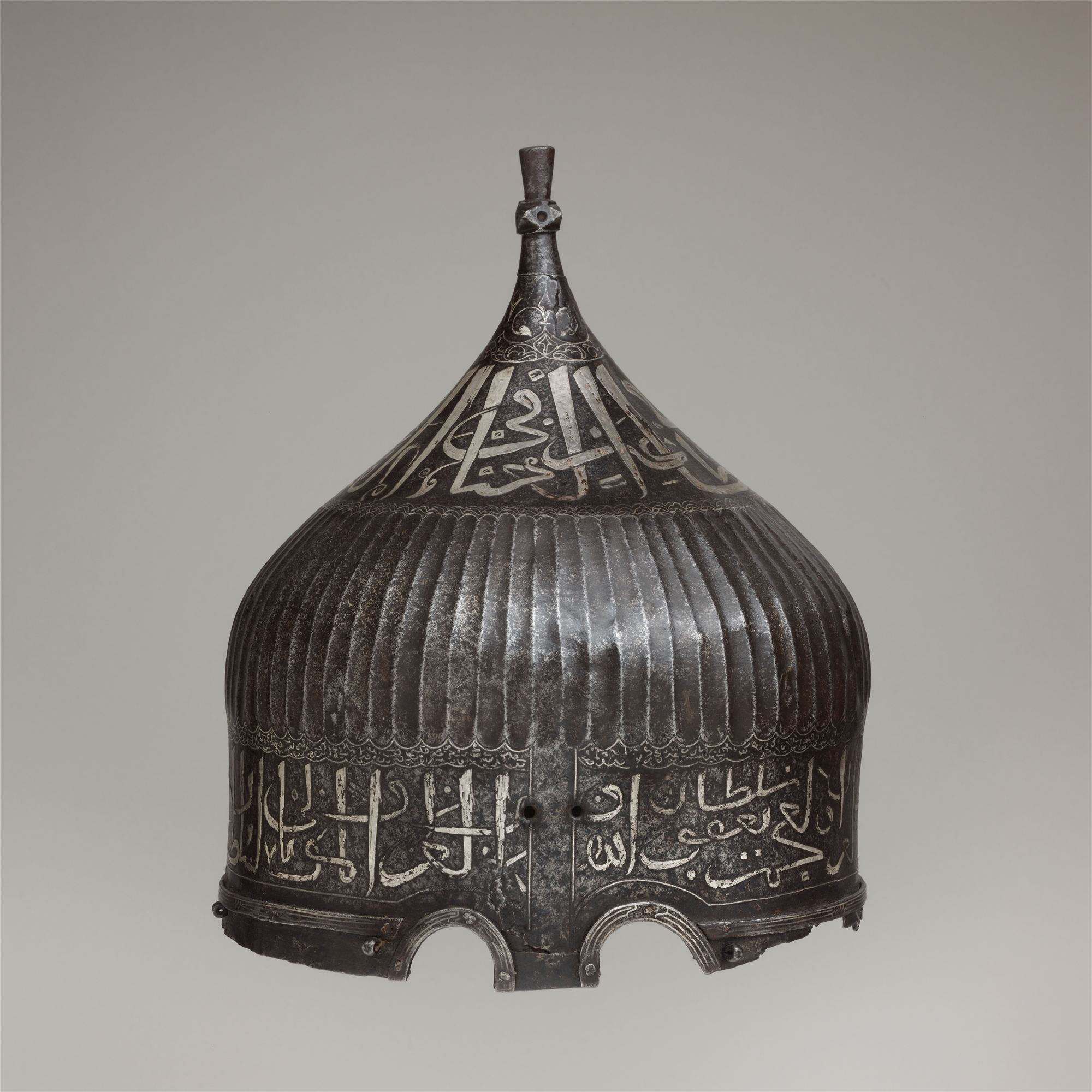
Executive Summary: The Turban Helmet as a Proto-Luxury Artefact
This strategic standalone research paper, prepared for Katherine Fashion Lab, deconstructs the Turban Helmet—a singular artefact from the Ottoman and Safavid spheres (circa 15th-17th centuries)—as a foundational case study in heritage luxury. Crafted from steel, iron, and silver, this object transcends its primary martial function to embody a complete system of symbolic power, sacred adornment, and sovereign identity. Our analysis positions it not as a relic, but as a direct conceptual precursor to contemporary high-end fashion, where material, craftsmanship, and narrative converge to confer status and spiritual armor. The insights herein are engineered to inform a disruptive 2026 luxury strategy, moving beyond superficial appropriation to a profound integration of archetype and meaning.
Historical & Material Deconstruction: The Armor of Sovereignty
The Turban Helmet, or "çiçak" in Ottoman Turkish, emerged from a cultural milieu where the empires of the Ottomans and Safavids were not only political and military rivals but also competing centers of artistic and spiritual excellence. Its physical composition is a deliberate hierarchy of materials speaking a language of power. The foundational structure of steel or iron provided the essential, life-preserving utility—the "couture" base. Upon this, silver was applied in intricate overlay (koftgari) or inlay, depicting verses from the Quran, floral arabesques, and benedictory inscriptions. This material triad—base metal, precious metal, sacred text—created a tangible cosmology: the resilience of iron, the celestial light of silver, and the divine word of God, all forged into one.
Craftsmanship as Spiritual Discipline
The creation of such a helmet was an act of devotion. Master armorers (zırger) and calligraphers collaborated, transforming a battlefield implement into a liturgical object. The repetitive hammering, etching, and inlaying were meditative processes, with the artisan’s skill seen as a reflection of divine creativity. The result was an object that was never "mass-produced"; each was a unique testament to the patron's piety and the artisan's granted talent. For Katherine Fashion Lab, this underscores a core luxury principle: value is engineered through narrative-rich, collaborative, and spiritually-informed craftsmanship, where the process is as sacrosanct as the product.
Semiotic Analysis: The Multilayered Symbolic Lexicon
The Turban Helmet’s power resides in its dense symbolic coding, operating on multiple simultaneous registers: political, spiritual, and social.
The Crown and the Creed
Its most potent symbol was its form: a high, conical helmet designed to accommodate a wrapped turban. This hybrid design fused Eastern Roman imperial crown aesthetics with the Islamic turban, the "crown of the faithful." It visually declared the wearer as both a temporal ruler and a spiritual champion. The inscribed prayers and Qur'anic verses—often Ayat al-Kursi (The Throne Verse) for protection—transformed the wearer’s head, the seat of intellect and soul, into a vessel of divine authority. The helmet was less about concealing the warrior and more about revealing the chosen sovereign, armoring him in faith as much as in steel.
Adornment as Apotropaic Armor
Historical adornment here served a profound apotropaic function—to ward off evil. The shimmering silver arabesques were not mere decoration; they represented the boundless, intertwining garden of Paradise, a spiritual reality made manifest to deflect harm. In a high-luxury context, this translates to the concept of functional adornment: every stitch, gem, and pattern must carry intentional meaning, offering the modern wearer not just beauty, but a talismanic sense of identity, protection, and purpose.
Strategic Integration: The 2026 Luxury Archetype
For Katherine Fashion Lab’s forward-looking strategy, the Turban Helmet provides a master blueprint for transcending seasonal trends and entering the realm of cultural archetypes. The goal for 2026 is not to replicate the object, but to re-embody its principles for a discerning, meaning-seeking clientele.
Pillar 1: Material Allegory & Hybridization
Move beyond conventional luxury materials. Develop a new "triad" for the 21st century: innovative technical textiles (the modern "steel"), ethically sourced precious metals or lab-grown gemstones (the "silver"), and integrated artisan intelligence—perhaps through embedded digital narratives or collaborations with master calligraphers and miniaturists (the "sacred text"). Create pieces that are hybrid by design: a coat that functions as a sanctuary, a glove that serves as a manifesto.
Pillar 2: Spiritual Armor for the Modern Ego
The contemporary luxury consumer seeks armor for the boardroom, the digital sphere, and the psyche. Collections must be conceived as "Spiritual Armor" for specific modern rites: the "Diplomacy Suit" with hidden motifs of unity; the "Resilience Cloak" engineered for psychological comfort. Adornment must be recast as intentional empowerment, with each collection built around a core narrative of protection, clarity, or authority, informed by cross-cultural philosophical codes.
Pillar 3: Sovereign Identity & Limited Legacy
Emulate the helmet’s uniqueness. Implement a "Sovereign Edition" model: ultra-limited, commissioned pieces where the client collaborates in the narrative. Utilize advanced manufacturing for custom-fit foundations, hand-applied artistry, and a documented "lineage" for each piece—a digital provenance ledger detailing its inspiration, artisans, and materials. This transforms the product into a peerless heirloom, mirroring the helmet’s journey from royal armory to museum vitrine.
Conclusion: From Imperial Armory to Future Atelier
The Turban Helmet stands as a testament to the immutable principles of true luxury: the synthesis of supreme utility and transcendent art, the encoding of power and piety in material form, and the creation of objects that define and defend the identity of the wearer. For Katherine Fashion Lab, this analysis provides a strategic compass. The 2026 initiative must look past superficial aesthetic references and engage in a deeper dialogue with heritage—not as a source of motif, but as a wellspring of meaning. By interpreting the helmet’s legacy of symbolic power, sacred craftsmanship, and holistic adornment, the Lab can craft a future-facing luxury language that offers the ultimate modern commodity: not just clothing, but consecrated identity. The objective is clear: to forge the turban helmets of the 21st century.