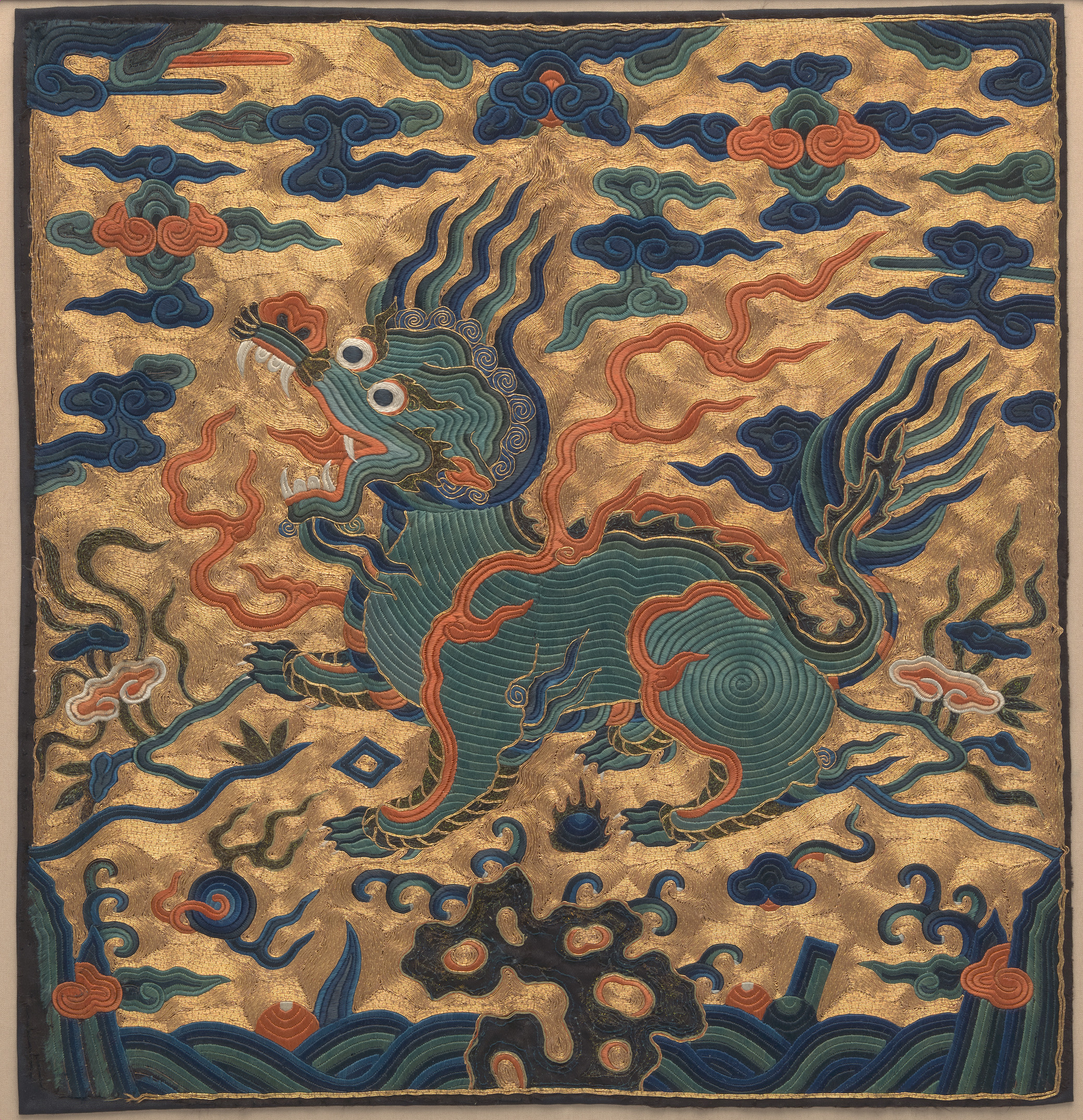
Apex of Opulence: Deconstructing the Rank Badge with Stylized Bear
In the vast lexicon of Chinese imperial regalia, few artifacts command the same intellectual reverence as the Rank Badge, or buzi. These embroidered squares, affixed to the surcoats of civil and military officials, served not merely as decoration but as a rigorous semiotic system of power, hierarchy, and cosmological order. At Katherine Fashion Lab, we have undertaken a standalone study of a singular, arresting specimen: a Rank Badge featuring a Stylized Bear, executed in silk, feather, and metallic thread embroidery on a luminous silk satin ground. This artifact, originating from China, transcends its historical function to become a masterclass in material storytelling, technical virtuosity, and the nuanced language of status.
Material Lexicon: Silk, Feather, and Metal
The badge’s foundation is a panel of silk satin, whose inherent sheen provides a dynamic, almost aqueous background. The choice of satin is deliberate; its smooth, reflective surface creates a stark contrast with the dense, textured embroidery, allowing the central motif to command visual primacy. The embroidery itself is a triumvirate of luxury materials. Silk floss, dyed in deep indigos, cinnabar reds, and muted golds, forms the primary structure of the bear and its surrounding cloudscape. Yet, it is the inclusion of feather that elevates this piece from exquisite craft to haute couture. Tiny, iridescent feathers—likely from a kingfisher or pheasant—are meticulously couched onto the satin, creating a micro-texture that shifts with light, evoking the bear’s fur with an almost tactile realism.
The metallic thread, predominantly gold-wrapped silk, is employed with surgical precision. It outlines the bear’s musculature, defines the swirling clouds, and articulates the auspicious motifs—bats, longevity symbols, and wave patterns—that frame the central figure. This thread is not merely decorative; it is a conductor of light and meaning, catching illumination to create a halo of power around the bear. The interplay between the matte silk, the shimmering feather, and the brilliant metallic thread creates a multi-sensory experience, a hallmark of the most sophisticated textile art.
Iconographic Analysis: The Stylized Bear as Emblem of Valor
Within the strict hierarchy of Ming and Qing dynasty rank badges, the bear (xiong) was designated for military officials of the fourth rank. Unlike the more common tiger or lion, the bear is a less frequently depicted but profoundly symbolic creature. In Chinese cosmology, the bear is associated with strength, courage, and the ability to repel malevolent spirits. Its depiction here is not naturalistic but stylized, a deliberate artistic choice that aligns with the badge’s function as a heraldic emblem rather than a zoological study.
The bear is rendered in a dynamic, almost heraldic posture: head turned, mouth slightly open in a silent roar, and one paw raised as if in command. Its body is a study in controlled tension, with exaggerated shoulders and a thick, powerful neck. The stylization is evident in the geometric patterning of its fur, which is rendered through alternating bands of feather and silk thread, creating a rhythmic, almost abstract texture. This is not a bear to be found in the wild; it is an archetype of martial virtue, a visual shorthand for the official’s duty to protect the imperial order.
Surrounding the bear is a meticulously composed microcosm. Swirling cloud forms (xiangyun), rendered in metallic thread, suggest the celestial realm from which imperial authority derives. Below the bear’s paws, stylized waves and mountains (shuiya) symbolize the stability of the empire. The inclusion of five bats (wu fu) fluttering above is a classic pun: the word for bat (fu) is a homophone for “blessing,” and five bats represent the five blessings—longevity, wealth, health, love of virtue, and a natural death. Every element is encoded with meaning, transforming the badge into a talismanic object that confers not only rank but cosmic protection.
Technical Virtuosity: Embroidery as Sculpture
The execution of this badge demands a forensic appreciation of embroidery techniques. The primary method employed is satin stitch, where long, parallel threads cover the ground entirely, creating a smooth, lustrous surface. However, the artisans have layered this with couching for the metallic threads, where the gold wire is laid on the surface and secured with tiny silk stitches. This technique allows the metal to remain unbroken, maximizing its reflective quality. The feather work is a variation of laid work, where quills are attached at one end and then stitched down, creating a dimensional, fur-like effect.
The precision is staggering. The smallest details—the bear’s claws, the individual petals of the peony blossoms, the scales of the stylized waves—are executed with a consistency that suggests a master artisan working over many months. The reverse side of the badge, often overlooked, reveals the chaos of controlled precision: a dense field of tiny, even stitches that speak to the discipline required. The silk satin ground shows no puckering, a testament to the use of a frame or tambour that kept the fabric taut during the painstaking process.
Cultural and Contextual Significance
This rank badge is not an isolated object but a node in a vast network of imperial ritual and identity. It was worn as part of a court surcoat (bufu) during official ceremonies, where the visual hierarchy of badges would have been immediately legible to all present. The choice of the bear for a fourth-rank military official is significant: it occupies a middle tier, suggesting a figure of substantial authority but not supreme command. The stylization, therefore, must be read as a negotiation between individual prestige and systemic order.
From a modern couture perspective, this badge anticipates many principles of high fashion construction. The use of mixed materials (silk, feather, metal) for textural contrast, the integration of narrative symbolism into garment design, and the elevation of embroidery to a primary structural element are all techniques that resonate in contemporary ateliers. One can draw a direct line from the meticulous handwork of this badge to the embroidered masterpieces of Schiaparelli, Dior, or Guo Pei. The bear becomes a proto-logo, a symbol of a house or a lineage, long before the modern concept of branding.
Conclusion: A Testament to Tangible Power
The Rank Badge with Stylized Bear is a triumph of applied artistry. It is a document of social hierarchy, a repository of cosmological symbolism, and a virtuosic display of textile technique. At Katherine Fashion Lab, we recognize this artifact as a foundational text for understanding how clothing can encode power, identity, and belief. The bear, rendered in silk and feather, is not merely an animal; it is a guardian of order, a symbol of valor, and an enduring testament to the human desire to weave meaning into every thread. In its standalone study, we find a blueprint for the intersection of craft, culture, and couture that remains profoundly relevant today.