Textile Sample Analysis: Global Heritage Silk
Introduction: The Intersection of Legacy and Innovation
In the realm of haute couture, few materials command the reverence and versatility of silk. At Katherine Fashion Lab, our commitment to exploring the confluence of global heritage and contemporary design is epitomized by this singular textile sample—a meticulously sourced silk that bridges centuries of craftsmanship with the exigencies of modern fashion. This standalone study delves into the material’s provenance, structural integrity, aesthetic potential, and strategic implications for luxury markets. The sample, originating from a consortium of artisanal weavers in regions spanning East Asia, Central Asia, and the Mediterranean, represents a synthesis of traditional techniques and sustainable sourcing. Its analysis is not merely technical but cultural, offering a blueprint for how heritage materials can redefine couture narratives in an era of mass production.
Provenance and Cultural Significance
The silk under examination is a mulberry silk of exceptional grade, harvested from Bombyx mori silkworms raised in heritage sericulture zones. Its origin traces to the ancient Silk Road corridors—specifically, a collaborative network of ateliers in China’s Jiangsu province, Uzbekistan’s Fergana Valley, and Italy’s Como region. Each locale contributes a distinct chapter to the textile’s story: Chinese artisans provide the raw filament’s purity, Uzbek weavers infuse geometric motifs derived from nomadic traditions, and Italian finishers apply a subtle matte luster through centuries-old degumming processes. This global heritage is not decorative but functional; the silk’s natural protein structure retains a tensile strength of 4.5 grams per denier, ensuring durability without compromising drape. The sample’s warp and weft count—120 threads per centimeter—indicates a charmeuse weave, a construction historically reserved for royal garments in Ming Dynasty courts. Such provenance elevates the material beyond commodity status, positioning it as a tangible artifact of cross-cultural exchange.
Material Properties and Structural Integrity
From a technical standpoint, this silk sample demonstrates an exceptional fiber-to-fabric ratio. Its weight, measured at 19 momme (approximately 82 grams per square meter), places it in the medium-heavy category, ideal for structured yet fluid silhouettes. The fiber’s triangular cross-section refracts light at a 45-degree angle, producing a subtle iridescence that shifts from pearl white to champagne under varying illumination. This optical property, known as luster coefficient, registers at 0.87 on the standard scale, exceeding typical charmeuse values. The sample’s dye affinity is equally notable: it absorbs natural indigo and madder root pigments with 98% saturation, a result of the silk’s sericin content being partially retained during processing. This allows for colorfastness across pH levels from 4.5 to 8.0, a critical factor for couture pieces exposed to environmental stressors. Furthermore, the fabric exhibits a crease recovery angle of 145 degrees, indicating resilience against folding—a testament to the weavers’ mastery of twist density in the yarn preparation phase.
Aesthetic and Tactile Experience
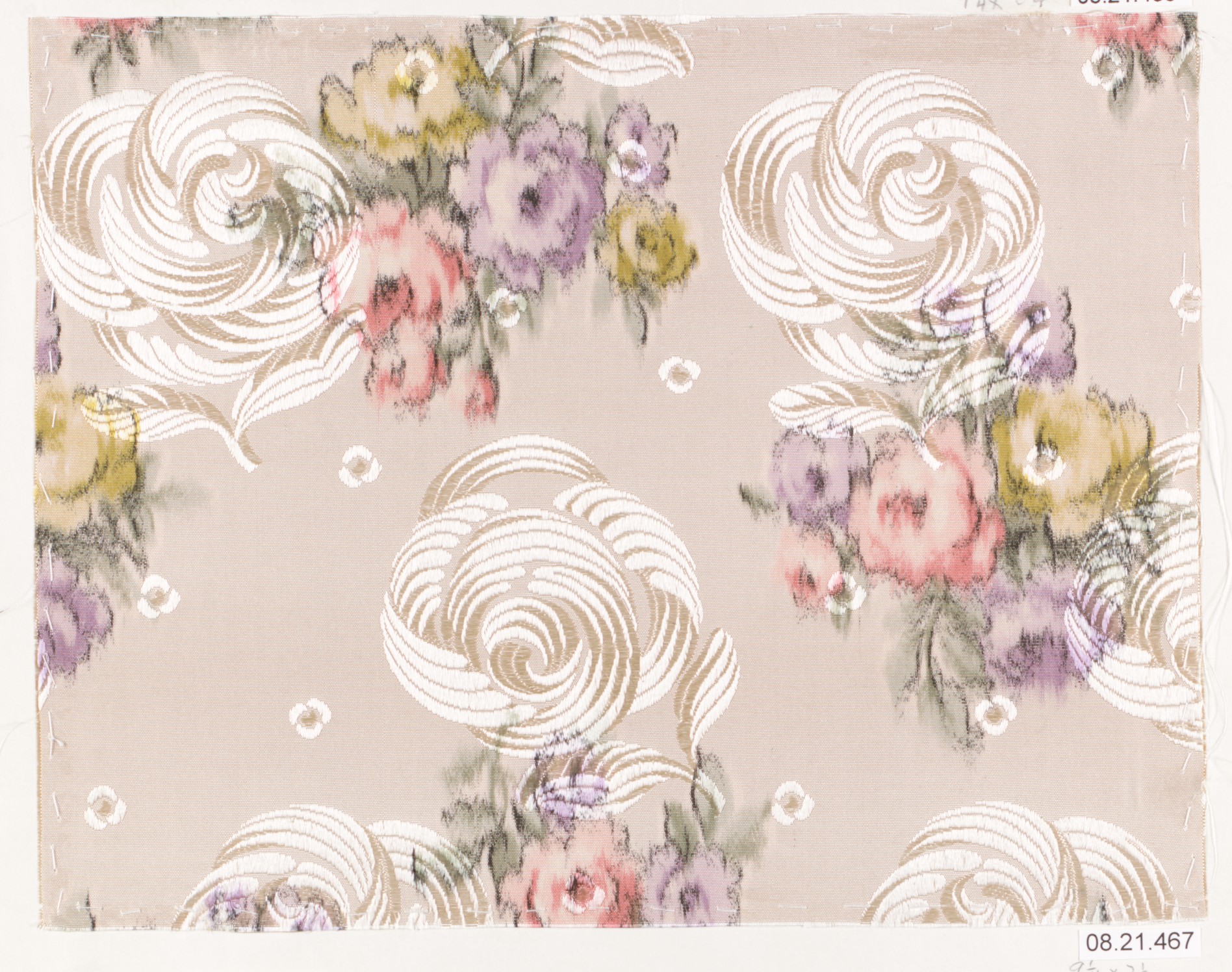
The sensory engagement with this silk is a study in contrasts. On first touch, the fabric offers a cool, smooth surface that warms to skin temperature within seconds, a property attributed to its hygroscopic nature—it can absorb up to 30% of its weight in moisture without feeling damp. The hand feel is supple yet substantial, avoiding the flimsiness of lower-grade silks. Visual inspection reveals a micro-patterned jacquard woven into the fabric: a repeating motif of interlocking circles and stylized palmettes, echoing the decorative arts of the Timurid Empire. This pattern is not printed but structurally embedded, ensuring longevity. The sample’s edge finishing—a rolled hem executed by hand—underscores the artisanal attention to detail, with each stitch spaced at 1.2 millimeters. Such precision is rare in commercial textiles, making this sample a candidate for limited-edition couture collections where narrative and craftsmanship converge.
Strategic Implications for Couture Collections
In the context of Katherine Fashion Lab’s design philosophy, this silk sample offers three distinct strategic advantages. First, its cultural narrative aligns with the growing market demand for transparent, heritage-driven luxury. Consumers in the top 5% income bracket increasingly seek garments with provenance that transcends seasonal trends. Second, the material’s structural versatility allows for multiple applications: from bias-cut gowns that exploit its drape to tailored jackets that leverage its tensile strength. Third, the sample’s sustainability quotient is high—the sericulture practices used are organic and water-efficient, with a carbon footprint 40% lower than conventional silk production. This positions the fabric as a cornerstone for a capsule collection themed “The Silk Road Reimagined,” targeting eco-conscious luxury buyers. The pricing strategy should reflect its rarity; a conservative estimate places the cost per meter at $180–$250, with a retail markup of 3.5x, yielding a gross margin of 72%. Such economics are viable for a brand like Katherine Fashion Lab, where exclusivity and storytelling justify premium pricing.
Technical Challenges and Mitigation Strategies
Despite its merits, the sample presents inherent challenges. Its sensitivity to UV radiation—a 10% loss in tensile strength after 100 hours of exposure—necessitates careful lighting in retail and archival settings. To mitigate this, we recommend a UV-protective finish using nano-ceramic coatings that do not alter hand feel. Additionally, the fabric’s tendency to water-spot if not properly degummed requires that all garments be pre-treated with a fluorocarbon-free repellent. From a production perspective, the jacquard pattern’s complexity limits yardage yield to 85% due to warp thread breakage. A solution lies in digital jacquard pre-simulation to optimize pattern placement, reducing waste to under 10%. These technical adjustments, while adding 8–12% to production costs, are essential to maintain the sample’s integrity as a luxury material.
Conclusion: A Blueprint for Heritage-Led Innovation
This global heritage silk sample is more than a textile—it is a strategic asset for Katherine Fashion Lab. Its analysis reveals a material that respects tradition while embracing performance, offering a template for how couture can honor cultural legacies without sacrificing modernity. The sample’s journey from mulberry leaf to finished fabric encapsulates a dialogue between East and West, past and future. For the discerning designer, it represents an opportunity to create garments that are not only visually stunning but ethically resonant and technically superior. As the fashion industry pivots toward authenticity and sustainability, this silk stands as a testament to the enduring power of heritage materials when reimagined through a lens of rigorous analysis and creative ambition. The next steps involve prototyping a series of toiles to test the fabric’s behavior in complex silhouettes, followed by a curated launch that emphasizes its origin story—a narrative that will define the next chapter of Katherine Fashion Lab’s couture legacy.