Deconstructing the Codex: A Couture Analysis of Japanese Woodblock Aesthetics
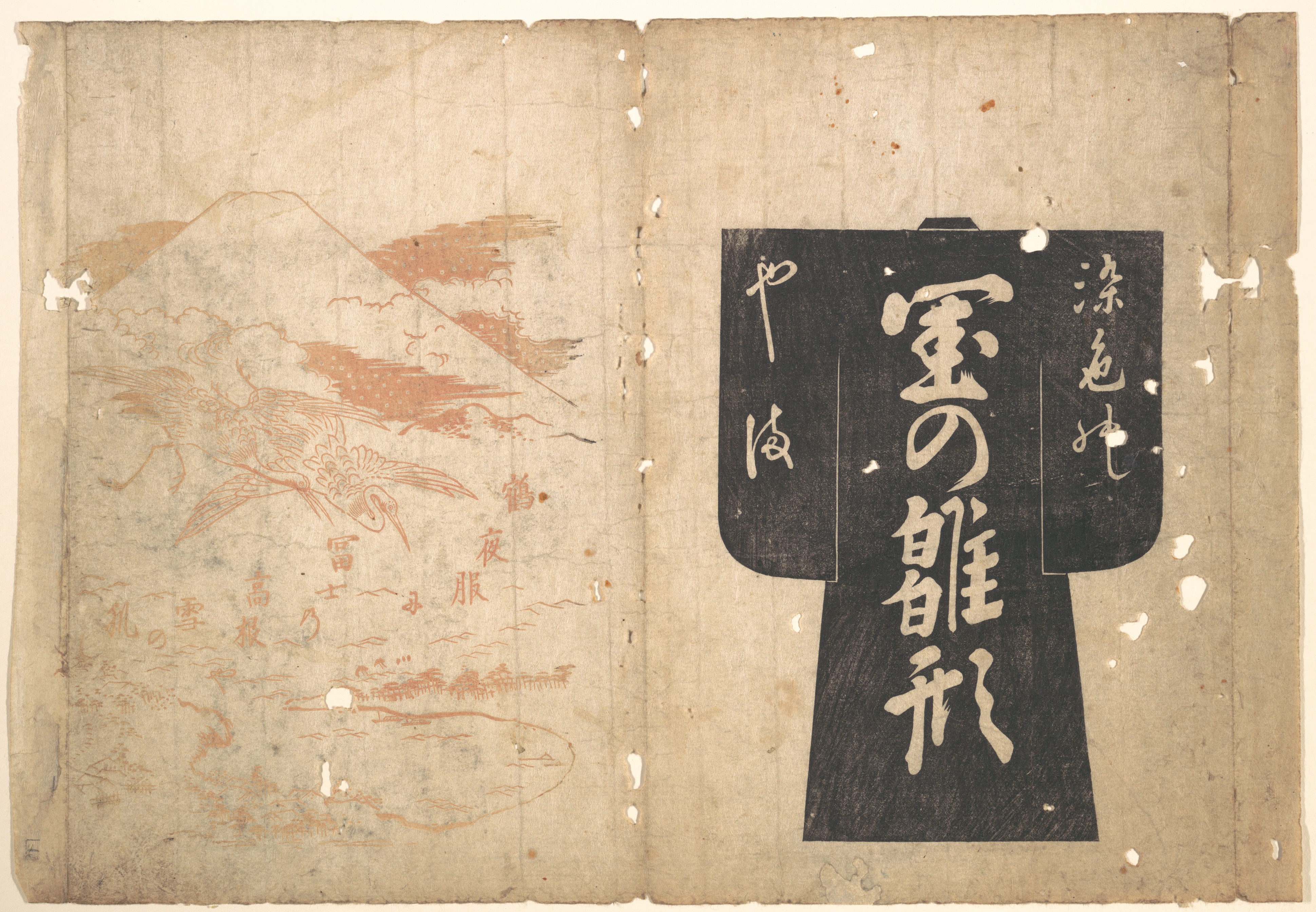
In the rarefied ateliers of haute couture, inspiration is seldom drawn from the literal. It is extracted, decoded, and re-engineered through the lens of profound technical and philosophical understanding. This analysis examines a singular artifact—a hand-colored woodblock print cover from a Japanese illustrated book—not as a mere historical object, but as a complete sartorial manifesto. It presents a rigorous framework of construction, material intelligence, and narrative depth that aligns precisely with the avant-garde ethos of Katherine Fashion Lab. This is not about reproducing kimono shapes; it is about internalizing the architectural principles, the strategic deployment of void, and the dialogue between artisan and medium that define this art form.
The Architecture of Restraint: Structural Philosophy
The woodblock print, by its very nature, is an exercise in disciplined construction. Each color, each line, exists due to a deliberate, pre-meditated incision into a wooden block. This process mirrors the foundational ethos of couture: the creation of a complex, multi-layered whole from meticulously prepared, singular elements. The "pattern pieces" here are the key blocks—the outline (keyblock) and subsequent color blocks. Each must align with absolute precision (kento registration) to create a cohesive image, a principle directly analogous to the flawless alignment of a garment’s internal structure, seams, and embellishments.
Furthermore, the composition of such a cover—likely balancing title cartouches, illustrative elements, and vast planes of negative space—operates on a principle of asymmetric harmony (fukinsei). This is not chaotic imbalance but a calculated, dynamic equilibrium. For Katherine Fashion Lab, this translates to silhouettes that defy symmetrical expectation. Imagine a gown where the structural boning radiates asymmetrically from a single point, or a jacket where the internal canvas is sculpted to create an elegant, off-center drape. The body becomes the "page," and the garment’s architecture is composed upon it with the same intentional, asymmetrical balance, achieving poise through calculated irregularity.
Material Intelligence: The Syntax of Surface and Substance
The described material—"woodblock print; ink and color on paper (hand colored)"—is a lexicon of tactile and visual poetry. It presents a layered material conversation: the flat, matte, absorbent ground of the paper; the sharp, definitive line of the ink; and the translucent, granular wash of hand-applied color. This is not a homogenous surface but a stratified topography of touch and light interaction.
Couture translation demands an equivalent level of material innovation. The "paper" ground could be realized in a dense, matte silk gazar or a molded, felted wool—fabrics that provide a pristine, absorbing canvas. The "ink line" is not merely embroidery; it is the articulated edge of a seam, a razor-sharp piping in jet-black silk thread, or the stark contrast of a fabric painted with resin to create a rigid, graphic border. The "hand-colored" wash is the critical couture moment: the application of color that breathes and lives. This inspires techniques like arbitrary dyeing (shibori) reinterpreted through laser-etching on leather, or ombré effects achieved through the meticulous layering of sheer organza petals, each petal hand-dyed to create a granular, living color field. The material story becomes one of contrast between the precise and the organic, the mechanical and the human touch.
Narrative in the Negative: The Power of Ma (間)
Perhaps the most profound conceptual offering is the Japanese aesthetic principle of Ma—the purposeful, active void, the pause between notes that gives music its shape. In the woodblock print, especially on a cover, the unprinted space is not empty; it is a dynamic participant. It frames the content, gives the eye room to rest, and amplifies the impact of the printed forms. In couture, Ma is the strategic use of absence: the cut-out, the sheer panel, the deep vent, the space between the body and the garment.
For the Lab, this moves beyond literal cut-outs. It is about engineering silhouette to incorporate "breathing" voids. A sculpted wool bustier might appear solid from the front, but its architecture creates a dramatic void between the small of the back and the fabric—a negative space that is as integral to the design as the positive form. A wide-legged jumpsuit could be constructed with an internal harness that creates a gap between the inseam and the leg, making the void a functional element of the walk and silhouette. This treats space as a material, cutting and shaping it with the same intention as silk or wool.
The Standalone Study: Towards a New Couture Language
The context of this artifact as a "standalone study" is pivotal. It is not a narrative scene but a self-contained composition focused on form, color, and balance. This aligns with the Lab's pursuit of garments as definitive, sculptural statements. The outcome of this analysis is not a themed collection but a codified set of principles for a new design methodology.
Envision a capsule manifesto: The "Keyblock" Coat—a garment defined solely by its severe, black line seams, the panels within left in a raw, ivory fabric, emphasizing the architectural armature. The "Ma" Gown—a column of silk whose form is defined by a series of interconnected voids laser-cut in a pattern derived from woodgrain, playing with shadow as negative space. The "Hand-Colored" Ensemble—a tailored jacket and trouser where one side is pristine matte wool, and the other dissolves into a painterly explosion of hand-applied, translucent pigment, showcasing the dialogue between precision and artisanal gesture.
Ultimately, this woodblock print cover offers a masterclass in controlled artistry. It teaches that luxury lies in the intelligence of construction, the poetry of material layers, and the courage to let space speak. For Katherine Fashion Lab, it provides a rigorous, non-Western framework to re-interrogate the very fundamentals of couture—moving beyond ornament to a deeper philosophy where the structure is the decoration, the material is the narrative, and the void holds as much meaning as the form.