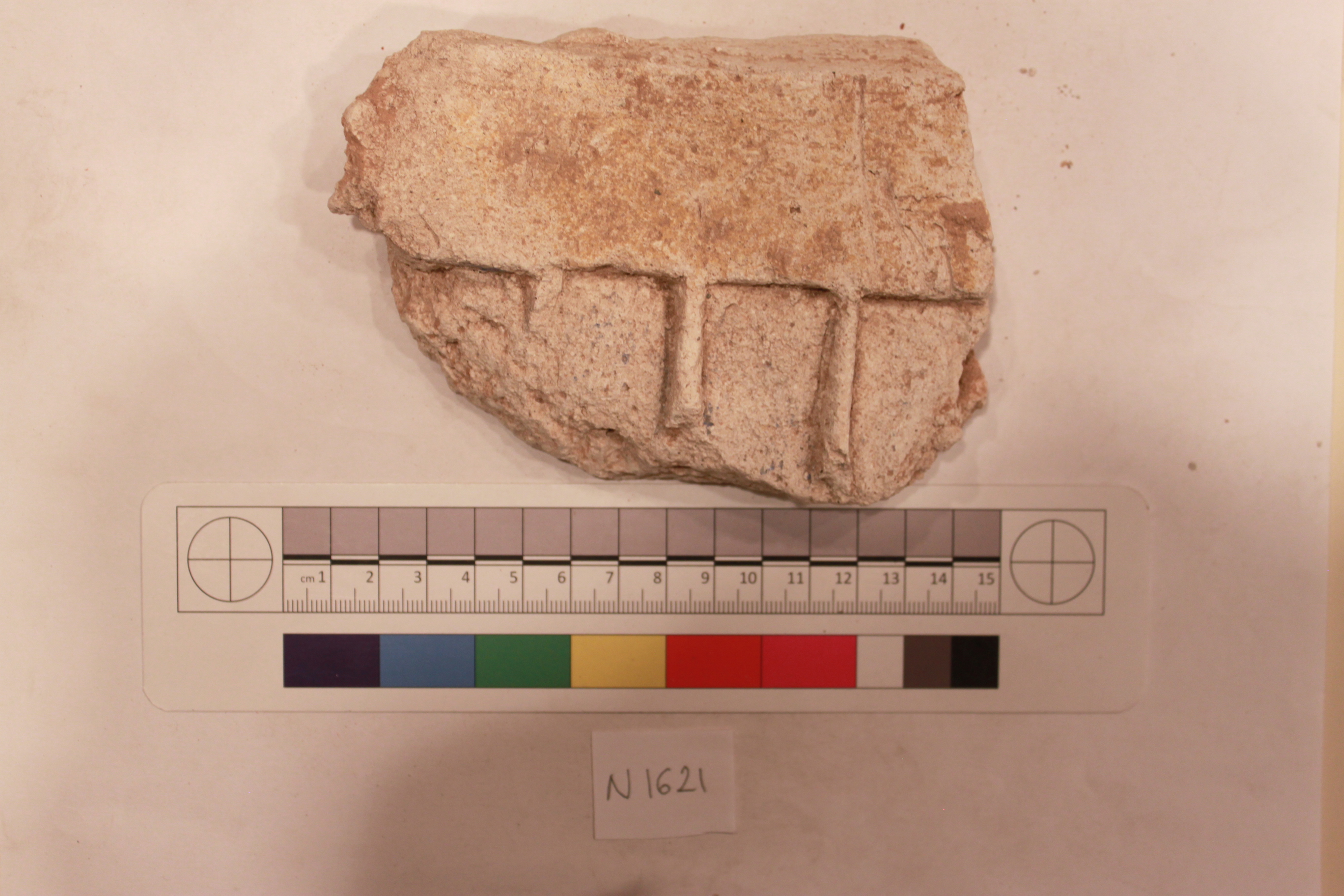
Stucco Fragment: A Couture Analysis of Material Memory
In the rarefied world of haute couture, where fabric is often the primary medium of expression, Katherine Fashion Lab’s decision to elevate a humble Stucco Fragment to the status of a standalone study represents a profound intellectual and aesthetic provocation. This analysis, drawn from the Global Heritage collection, examines a carved and painted stucco fragment not merely as an archaeological relic, but as a blueprint for a new language of luxury—one that interrogates permanence, texture, and the patina of time. The fragment, detached from its original architectural context, becomes a potent symbol of deconstruction, resilience, and the tactile poetry of decay.
Deconstructing the Material Lexicon: Stucco as Couture Substrate
At its core, stucco is a composite of lime, sand, and water—a material of humble origins, yet one that has adorned the most sacred and opulent structures across civilizations, from Roman villas to Mughal palaces. In this study, Katherine Fashion Lab repositions stucco as a couture substrate, challenging the hegemony of silk, wool, and cotton. The carved surface, with its undulating ridges and recessed planes, mimics the drape and volume of fabric, but with a geological permanence. The painted remnants—faded ochres, vermilions, and azures—speak to a chromatic history that has been weathered, not erased. This is not a pristine textile; it is a narrative of exposure, of layers added and subtracted by time, climate, and human touch.
The fragment’s standalone status is critical. By isolating it from its original wall or frieze, the Lab forces a microscopic focus on its intrinsic qualities. The carved motifs—perhaps a stylized leaf, a geometric interlace, or a fragment of a human figure—are no longer subordinate to a larger narrative. Instead, they become the narrative. This act of isolation mirrors the couture process: a designer extracts a seam, a pleat, or a stitch from a garment’s entirety, transforming it into a signature element. Here, the stucco fragment becomes a tangible metaphor for the deconstructed garment, where the material itself is the hero, not the silhouette.
The Aesthetics of Imperfection: Patina and the Luxury of Time
In contemporary fast fashion, perfection is commodified—seamless finishes, uniform dyes, and synthetic durability. The Stucco Fragment rejects this paradigm. Its beauty lies in its imperfections: the hairline cracks that trace the surface like fine creases in aged leather; the flaking paint that reveals the substrate beneath, akin to a distressed denim or a faded brocade. Katherine Fashion Lab’s analysis treats these imperfections as deliberate design elements, not defects. The patina—that subtle shift in color from oxidation and wear—is reframed as a luxury finish, one that cannot be replicated by chemical aging or artificial distressing. It is the authentic signature of time, a quality that couture houses often seek through artisanal techniques like hand-painting, shibori, or dévoré.
The painted surface, though fragmented, offers a chromatic palette that is both bold and subtle. The residual pigments, once vibrant, now exist as whispers of their former selves. This faded opulence evokes the work of designers who embrace tonal gradation and muted hues—think of the dusty rose and sage greens of a Rodarte collection or the earthy pigments of a Dior haute couture show. The fragment teaches that color is not static; it is a living entity that evolves. For the couturier, this suggests a new approach to dyeing and finishing: one that embraces the gradual fading of indigo or the subtle yellowing of silk as part of the garment’s lifecycle, not a flaw.
Structural Innovation: Carving as Draping
The carved nature of the stucco introduces a three-dimensionality that parallels the most advanced couture draping techniques. The relief carving creates shadows and highlights, a play of light that is impossible with flat textiles. Katherine Fashion Lab posits that this fragment can inspire a new form of architectural draping, where fabric is not merely cut and sewn, but sculpted. Imagine a gown where the bodice is built from layered, hand-molded organza that mimics the stucco’s ridges, or a jacket where the lapels are carved from felted wool, their surfaces textured to catch light like the fragment’s painted grooves. The fragment’s carved patterns—perhaps a repeating arabesque or a lotus petal—could be translated into jacquard weaves or laser-cut leather, creating a tactile experience that invites touch and contemplation.
Furthermore, the fragment’s standalone context emphasizes its structural integrity. It is a piece that holds its own form without external support, much like a well-constructed corset or a structured sleeve. This challenges the couture industry to explore materials that are self-supporting, reducing reliance on linings and interlinings. The stucco fragment suggests a future where garments are sculptural shells, where the material itself provides the architecture. Designers might experiment with resin-coated fabrics, metal-infused silks, or even biodegradable composites that harden into shape after molding, echoing the stucco’s original setting.
Cultural Resonance: Global Heritage as Couture Narrative
As a Global Heritage artifact, the Stucco Fragment carries the weight of multiple civilizations. Its origin is ambiguous—perhaps from a Central Asian monastery, a Mediterranean villa, or a Mesoamerican pyramid. This ambiguity is its strength. It becomes a universal signifier of human creativity, transcending geographic and temporal boundaries. In an era where cultural appropriation is a fraught topic, Katherine Fashion Lab’s analysis advocates for appreciation through abstraction. The fragment is not a costume or a direct copy; it is a source of principles—balance, texture, color harmony, and the beauty of decay. Couture houses can draw from these principles without appropriating specific symbols, instead honoring the heritage by elevating the material’s intrinsic qualities.
The fragment also speaks to the sustainability imperative. In a world of disposable fashion, the stucco’s endurance—its survival for centuries—is a lesson in longevity. Couture, by definition, is meant to last, but often the materials are delicate. The stucco fragment suggests a shift toward durable luxury: fabrics that can be repaired, repainted, or recontextualized. A garment inspired by this fragment might be designed with replaceable panels, or with a surface that can be re-treated over time, much like a fresco is restored. This is not just sustainability; it is a philosophy of care, where the garment ages with the wearer, accruing history and meaning.
Conclusion: The Fragment as Future Blueprint
Katherine Fashion Lab’s analysis of the Stucco Fragment is more than an academic exercise; it is a manifesto for a new couture ethos. By isolating a piece of carved and painted plaster from its architectural context, the Lab reveals the potential for material transcendence. The fragment teaches that luxury is not found in perfection, but in the narrative of creation and decay; that structure can be both rigid and fluid; and that global heritage is a living language, not a museum piece. For the discerning couturier, this fragment is a call to slow down, to touch, to carve, and to let time be the final collaborator. In a world obsessed with the new, the Stucco Fragment reminds us that the most profound innovations often lie in the oldest materials, waiting to be rediscovered.