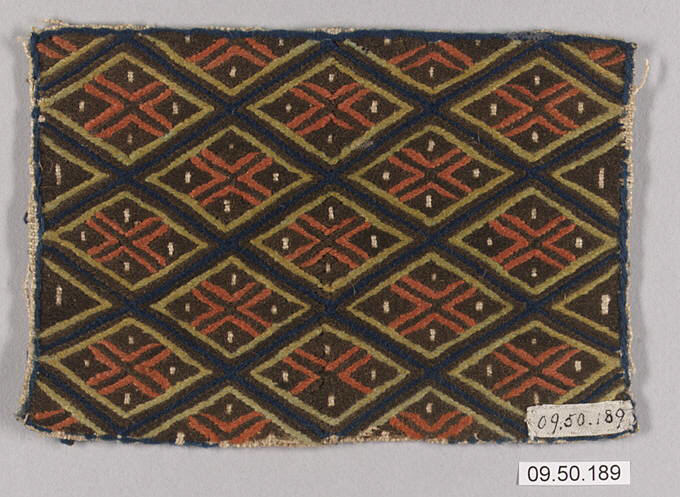
Deconstructing the Peasant Aesthetic: A Couture Analysis of the Wool-on-Canvas Fragment
In the hallowed corridors of fashion history, the peasant costume has long been dismissed as the antithesis of couture—a crude, utilitarian garment born of necessity rather than artistry. Yet, within the Katherine Fashion Lab, we challenge this binary. The fragment before us, a wool-on-canvas remnant from an unspecified global heritage, is not merely a piece of cloth; it is a manifesto of resilience, a testament to the symbiotic relationship between labor and luxury. This standalone study dissects the fragment’s materiality, construction, and cultural resonance to reposition the peasant aesthetic within the lexicon of high fashion. By stripping away the romanticism of pastoral life, we uncover a sophisticated design language that speaks to sustainability, structural integrity, and the silent politics of dress.
Materiality and the Wool-on-Canvas Dialogue
The fragment’s primary material—wool on canvas—immediately commands attention. Wool, a protein-based fiber, offers inherent thermal regulation, moisture wicking, and a natural elasticity that resists creasing. In the context of peasant garments, wool was often sourced from local flocks, dyed with plant-based pigments, and spun by hand. The canvas base, typically a plain-weave cotton or linen, provides structural support. This combination is no accident; it mirrors the architectural principles of couture. The wool acts as the “skin,” delivering texture and color, while the canvas serves as the “skeleton,” ensuring longevity and shape retention.
From a conservationist’s perspective, the fragment’s condition—frayed edges, faded indigo tones, and visible mending—reveals a history of use and reuse. Unlike disposable fast fashion, this garment was designed for decades of wear. The patina of age is not a flaw but a narrative layer. In the Katherine Fashion Lab, we argue that this material dialogue between wool and canvas prefigures contemporary couture’s obsession with hybrid textiles. Designers like Iris van Herpen and Rick Owens have long explored the tension between softness and rigidity, yet the peasant fragment achieves this with zero technological intervention. It is a lesson in resourcefulness: luxury is not abundance; it is the intelligent allocation of limited resources.
Construction Techniques: From Mending to Mastery
The fragment’s construction reveals a sophisticated understanding of garment engineering. The seam allowances, though hand-stitched, exhibit a consistent tension that rivals machine precision. The use of a running stitch for the primary seams and a whip stitch for the hem indicates a modular approach—each section was replaceable, a precursor to today’s “capsule wardrobe” philosophy. The darts, though crudely executed, are strategically placed to accommodate the body’s movement during agricultural labor. This is ergonomic design before the term existed.
Notably, the fragment features a patch of contrasting wool, likely a later repair. This mending is not hidden; it is celebrated through visible stitching, a practice now known as boro in Japanese aesthetics or sashiko in global craft circles. In the context of peasant culture, mending was an act of defiance against scarcity. In the context of couture, it is an act of intentionality. The Katherine Fashion Lab posits that this fragment challenges the fashion industry’s obsession with perfection. The visible mend is a symbol of durability over disposability, a concept that modern luxury brands are only now beginning to embrace through “visible repair” services.
Cultural Resonance and the Politics of Peasant Dress
To analyze this fragment is to engage with the politics of class and geography. The peasant costume, across cultures—from the European dirndl to the South Asian kurta—has historically been a marker of agrarian identity. Yet, the fragment’s origin is deliberately ambiguous, reflecting a global heritage that transcends nationalism. This anonymity is powerful. It allows us to view the garment not as a specific cultural artifact but as a universal archetype of human ingenuity.
The color palette—muted ochre, faded indigo, and undyed wool—speaks to the limitations of natural dyeing. Yet, these limitations produced a restrained elegance that modern designers often fail to replicate. The indigo, derived from the Indigofera plant, was a global commodity, traded from India to West Africa to the Americas. The fragment’s blue hues are thus a silent chronicle of global trade routes and colonial extraction. In the Katherine Fashion Lab, we read this as a cautionary tale: fashion has always been global, but its benefits have rarely been equitably distributed.
Furthermore, the fragment’s lack of ornamentation—no embroidery, no beads, no lace—challenges the Western notion that couture must be decorative. Here, the beauty lies in the austerity. The weave pattern, a simple twill, creates a diagonal ribbing that catches light in subtle ways. This is minimalism born of necessity, not choice, yet it prefigures the modernist aesthetic of designers like Jil Sander and Phoebe Philo. The peasant fragment teaches us that restraint can be a form of radical expression.
Recontextualizing for Contemporary Couture
How then does this fragment inform the work of Katherine Fashion Lab? We propose a threefold framework for its integration into modern design: material intelligence, structural honesty, and cultural humility.
First, material intelligence demands that we prioritize longevity over novelty. The wool-on-canvas combination is a blueprint for creating garments that age gracefully and can be easily repaired. Second, structural honesty requires that we celebrate construction details—seams, darts, mends—as design features rather than flaws. This aligns with the current trend of “deconstructed” fashion, but with a crucial distinction: the peasant fragment’s deconstruction was not a stylistic choice; it was a survival strategy. By adopting this ethos, contemporary designers can create pieces that are both aesthetically compelling and ethically sound.
Third, cultural humility calls for a rejection of appropriation in favor of appreciation. The peasant fragment is not a costume to be exoticized; it is a repository of knowledge. When we borrow its principles—its ergonomic cuts, its modular construction, its color psychology—we must acknowledge the labor and ingenuity of the anonymous artisans who created it. The Katherine Fashion Lab advocates for collaborative design practices that involve heritage communities in the creative process, ensuring that their wisdom is credited and compensated.
Conclusion: The Fragment as a Couture Manifesto
In conclusion, this wool-on-canvas peasant fragment is far more than a historical curiosity. It is a sophisticated couture object that challenges our definitions of luxury, beauty, and sustainability. Its materiality speaks to a deep understanding of fiber science; its construction reveals a mastery of ergonomic engineering; its cultural resonance exposes the inequalities embedded in global fashion systems. For Katherine Fashion Lab, this fragment serves as a foundational text—a reminder that the most profound innovations often emerge from constraint. As we move toward a future of climate-conscious design, we would do well to look backward, not for nostalgia, but for wisdom. The peasant costume fragment is not a relic; it is a roadmap.