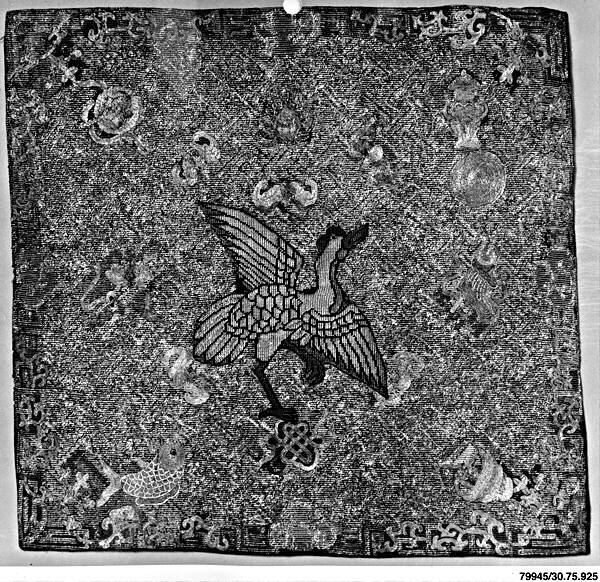
Deconstructing Status: The Rank Badge with Crane at Katherine Fashion Lab
The Rank Badge with Crane, a singular artifact from late imperial China, is far more than a decorative textile. It is a meticulously codified system of visual authority, a testament to the sophisticated interplay between material culture, sumptuary law, and personal identity. At Katherine Fashion Lab, we approach this piece not as a mere historical relic, but as a masterclass in strategic design communication—a garment that simultaneously declares power, lineage, and aesthetic refinement. This analysis deconstructs the badge’s materiality, iconography, and contextual significance, revealing its enduring relevance as a model for status-driven design in the luxury sector.
Materiality as a Language of Prestige
The choice of silk as the primary substrate is itself a declaration of exclusivity. In Ming and Qing dynasties, silk production was a state-controlled monopoly, with its use in official regalia reserved for the imperial court and the highest echelons of the civil bureaucracy. The badge’s construction on a canvas base—a dense, structured weave—further underscores its purpose: not for casual wear but for ceremonial display, where rigidity and durability signified permanence and authority. The metallic thread, likely gold-wrapped silk or gilded paper, introduces a luminous counterpoint to the matte silk. This interplay of textures—the soft, absorbent ground against the reflective, rigid metal—creates a visual hierarchy that draws the eye directly to the central motif. In luxury design, such material contrasts are not accidental; they are deliberate tools to direct attention and amplify perceived value. The metallic thread, tarnished with age, now tells a story of time’s passage, adding a layer of historical authenticity that no contemporary synthetic finish can replicate.
The Crane as a Signifier of Civil Authority
At the heart of the badge is the crane, a bird of profound symbolic weight. Within the Chinese bureaucratic system, the rank badge—or buzi—was a standardized garment component that identified the wearer’s position in the nine-rank civil hierarchy. The crane was assigned to the first rank, the highest attainable, representing not only political power but also moral and intellectual superiority. The crane’s association with longevity, purity, and celestial wisdom—rooted in Daoist and Confucian traditions—imbues the badge with a dual function: it is both a legal identifier and a talisman of virtuous governance. The bird is typically depicted in flight or poised in a dynamic stance, often with wings outstretched, suggesting perpetual vigilance and transcendence. This iconographic choice is strategic: it communicates that the wearer is not merely an administrator but a guardian of cosmic order. For the modern luxury strategist, this demonstrates how a single visual element can encode multiple layers of meaning—status, ethics, and aspiration—into a cohesive brand statement.
Composition and the Art of Hierarchical Framing
The badge’s composition follows a rigidly symmetrical layout, a hallmark of Chinese imperial design that mirrors the Confucian emphasis on order and hierarchy. The crane occupies the central axis, flanked by clouds, waves, or stylized rocks—each element carrying its own semantic load. Clouds signify the heavens and the emperor’s mandate, while waves represent the earth and the bureaucrat’s role in governing the realm. The background is often a deep, saturated hue—typically blue, green, or black—that contrasts sharply with the metallic threads and the bird’s white plumage. This contrast is not merely aesthetic; it is a visual equivalent of the social distance between the wearer and the viewer. The badge’s placement on the chest and back of the official’s robe ensures that it is always visible, functioning as a non-verbal announcement of rank. In contemporary terms, this is akin to a luxury brand’s logo placement: a deliberate, unapologetic assertion of identity that demands recognition.
Contextualizing the Badge: From Sumptuary Law to Personal Legacy
Understanding the badge requires situating it within the broader system of sumptuary regulations that governed Ming (1368–1644) and Qing (1644–1912) China. These laws dictated not only the badge’s motif but also the color, fabric, and even the number of buttons on a robe. Violations could result in demotion or corporal punishment. This regulatory framework transformed the badge into a binding contract between the state and the individual: the wearer’s identity was literally woven into the fabric of governance. Yet, as a standalone study, the badge also reveals the personal agency of the wearer. Variations in embroidery technique—such as the use of kesi (silk tapestry) versus xiu (embroidery)—or the inclusion of auspicious symbols like bats (for fortune) or peaches (for longevity) suggest that officials could subtly personalize their badges within the constraints of law. This tension between conformity and individuality is a critical lesson for luxury brands today, which must navigate the dual demands of heritage and innovation.
Preservation and the Ethics of Display
At Katherine Fashion Lab, we treat the Rank Badge with Crane as a living document rather than a static artifact. Its condition—the fading of silk, the oxidation of metallic thread—is not a flaw but a record of its journey through time. Conservation ethics demand that we prioritize minimal intervention, allowing the badge to “speak” through its patina. This approach aligns with the contemporary luxury discourse on authenticity and sustainability: the badge’s wear tells a story that no pristine reproduction can. When displayed, it is mounted on a neutral, archival-grade backing to avoid visual distraction, and lighting is calibrated to minimize UV damage while highlighting the metallic threads’ subtle luster. This curatorial strategy mirrors the badge’s original function: to be seen, understood, and respected.
Implications for Modern Couture and Brand Strategy
The Rank Badge with Crane offers profound insights for the fashion industry’s current fascination with heritage and status. First, it exemplifies how symbolic density can elevate a garment from commodity to icon. A single motif—the crane—carries political, spiritual, and social weight, creating a narrative that transcends time. Second, the badge’s integration of sumptuary law demonstrates that constraints can drive creativity. The strict regulations did not stifle artistic expression; they channeled it into meticulous craftsmanship and nuanced personalization. Finally, the badge’s materiality teaches us that value is not inherent but constructed—through rarity, cultural resonance, and the perceived authenticity of the object’s history. For a luxury house seeking to build a collection around cultural heritage, the badge is a blueprint for how to balance tradition with contemporary relevance.
In closing, this rank badge is a microcosm of a civilization’s approach to power, beauty, and identity. At Katherine Fashion Lab, we see it as a reminder that the most enduring fashion statements are those that speak in multiple registers—to the eye, the mind, and the spirit. The crane still flies, and its message endures.