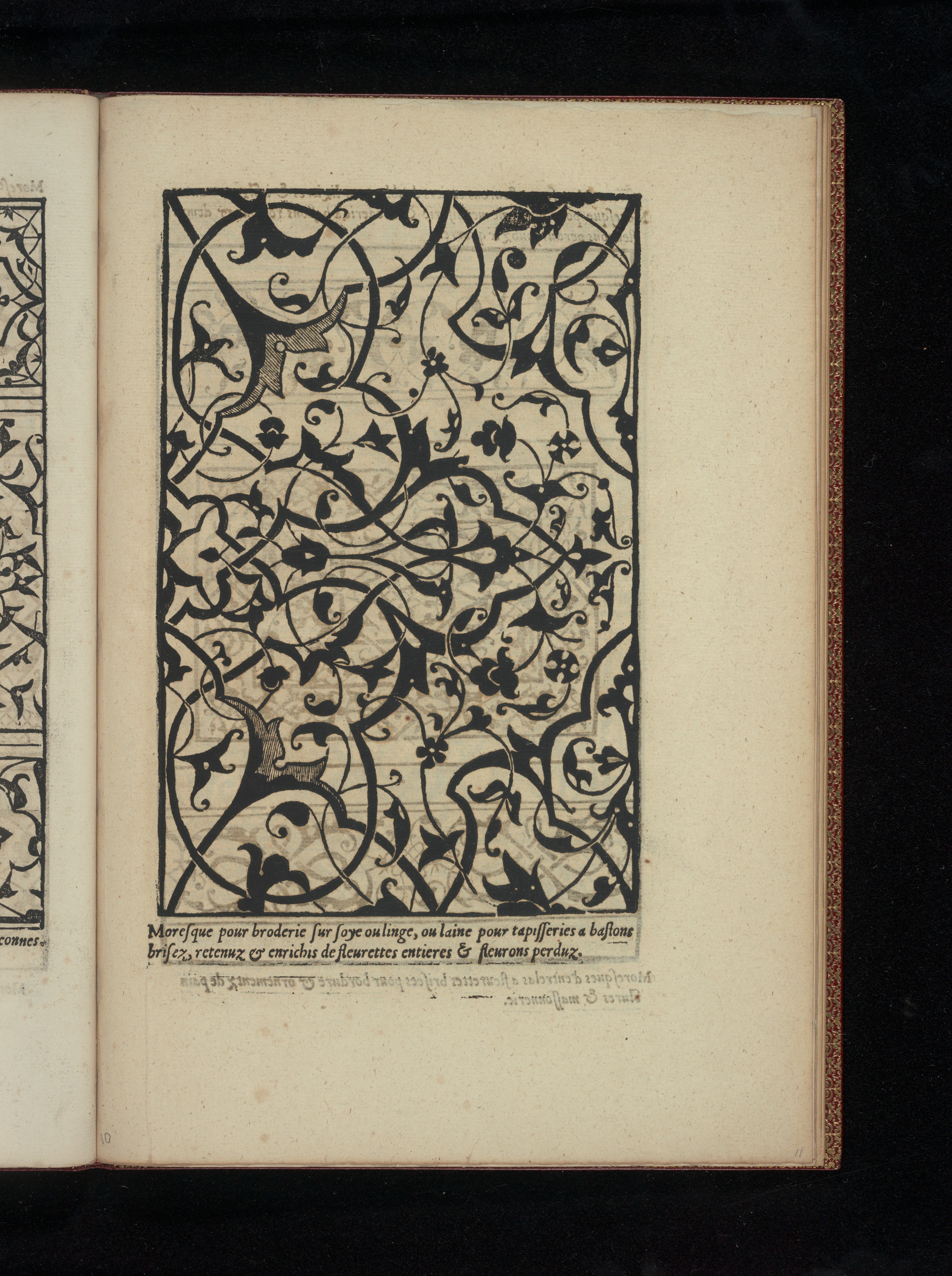
Heritage Analysis: Livre de Moresques, Page 11 (Recto)
This strategic standalone research paper examines a singular artifact—page 11 (recto) from the Livre de Moresques—as a foundational cipher for Katherine Fashion Lab’s 2026 high-end luxury strategy. Originating from the 16th century, this woodcut print is not merely a decorative pattern but a sophisticated document of cultural transmission, symbolic power, and historical adornment. By decoding its visual language, we extract a core set of principles that can be translated into a contemporary luxury narrative centered on spiritual meaning, intellectual exclusivity, and timeless authority. This analysis positions the artifact as a direct progenitor of the Lab’s aesthetic and philosophical DNA, providing an authentic and defensible heritage platform.
Decoding the Artifact: Symbolic Power and Historical Adornment
The Livre de Moresques, published in Lyon circa 1550, served as a pattern book disseminating the intricate, interlace-based designs often termed "Moresque" or "Arabesque" across Europe. Page 11 (recto) presents a masterclass in balanced complexity. As a woodcut, its medium is significant: it represents the democratization and standardization of a once-exclusive ornamental language, transferring motifs from hand-wrought metal, leather, and textile into a reproducible, yet still prestigious, format. The design itself is a symphony of rhythmic abstraction, featuring sinuous, biomorphic vines that intertwine with geometric precision, potentially enclosing symbolic forms or sacred geometries now abstracted by time and cultural translation.
This page embodies historical adornment at its most intellectually elevated. Adornment here transcends mere surface decoration; it is a structural philosophy. The interlace, with no beginning and no end, symbolizes infinity and the interconnectedness of all things—a concept prevalent in both Islamic spiritual thought and Renaissance Neoplatonism. When applied to objects of luxury—book bindings, weaponry, ceremonial garments—this pattern did not just beautify; it conferred a symbolic power upon the wearer or owner. It signaled an understanding of esoteric knowledge, a connection to distant, sophisticated civilizations (the "Orient" as imagined by Europe), and a possession of items whose value lay in both craftsmanship and concealed meaning. The adornment becomes a talisman, a visual incantation of order, harmony, and perpetual life.
The Spiritual Meaning: Abstraction as Transcendence
At the heart of this pattern's enduring resonance is its spiritual meaning, achieved through deliberate abstraction. Unlike figurative art, which directs interpretation, the non-representational nature of the Moresque invites contemplative immersion. It avoids idolatry, focusing instead on principles of cosmic order. The rhythmic repetition induces a meditative state, while the complex, path-like lines can be seen as metaphors for spiritual journey or the labyrinth of the soul. This aligns with the horror vacui (fear of empty space) often observed in sacred art, where every space filled with pattern signifies the omnipresence of the divine.
For Katherine Fashion Lab, this spiritual dimension is the critical differentiator. In a 2026 luxury landscape saturated with overt branding and logo-mania, true exclusivity will pivot toward the intangible and the experiential. The spiritual meaning encoded in this artifact offers a framework for what we term "Quiet Transcendence." It is not about religious iconography, but about creating pieces that serve as tools for mindfulness, personal sanctuary, and intellectual refuge. The pattern’s inherent balance offers a visual antidote to digital chaos, making its wearer a curator of calm and a bearer of secret, ancient knowledge.
Strategic Translation: The 2026 High-End Luxury Imperative
The 2026 luxury consumer will seek depth, authenticity, and transformative value. Katherine Fashion Lab’s strategy, derived from this heritage analysis, must operationalize the artifact’s principles into a cohesive brand ecosystem.
Product Philosophy: Adornment as Architecture
Moving beyond appliqué, the Moresque principle demands that pattern become structure. For 2026, we propose a collection titled "Lignum Vitae" (The Tree of Life), where the interlace is engineered into the very architecture of garments. Imagine laser-cut leather where negative and positive space form the pattern; jacquard weaves where the motif emerges from three-dimensional texture; and tailored pieces where seams and darts follow the flow of the ancient vine. Materials will be paramount: waxed linens recalling parchment, hammered silks mimicking tooled leather, and metallic threads echoing lost gilding. Each piece is not printed with a pattern but constructed from it, reviving the historical authenticity of adornment as integral to the object’s value and identity.
Brand Narrative & Client Experience: Curating the Cipher
The narrative will position the client not as a buyer, but as an initiate and curator. Marketing and communications will employ the language of archeology, cryptography, and contemplative art. The collection will be presented in environments that mirror the artifact’s spiritual roots—serene, minimalist spaces where the intricate detail of the clothing provides the sole visual complexity. Accompanying each piece will be a "Cipher Document," a modern-day exegesis on parchment-style paper, explaining the heritage source (Page 11, recto) and its symbolic meanings. This transforms the act of purchase into an acquisition of cultural capital and personal meaning.
Exclusivity Model: Knowledge as Access
In line with the artifact’s origin as a pattern book for elites, access will be tiered through knowledge. The core collection will be publicly presented, but deeper engagement—such as commissions for bespoke interlacing patterns personalized with symbolic elements meaningful to the client, or private viewings of the source material’s digital reconstruction—will be reserved for top-tier clients. This creates a hierarchy based on cultural engagement, not just spending power, fostering a community of connoisseurs around the Lab’s intellectual heritage.
Conclusion: From Woodcut to Worldview
Page 11 (recto) of the Livre de Moresques is far more than an old pattern. It is a conceptual blueprint for a luxury brand built to thrive in 2026. It provides Katherine Fashion Lab with an authentic, pre-industrial heritage rich in symbolic power, a profound philosophy of historical adornment, and a deep well of spiritual meaning. By translating its principles of infinite interconnection, contemplative abstraction, and structured harmony into a modern product philosophy and client experience, the Lab can articulate a new luxury paradigm. This paradigm answers the future demand for substance, sanctuary, and intelligent beauty, establishing the brand not as a follower of trends, but as a curator of timeless human truths encoded in form. The woodcut’s journey from artisan’s hand to printed page mirrors our strategic ambition: to standardize a language of exclusive meaning, making it legible only to those who seek to read it.