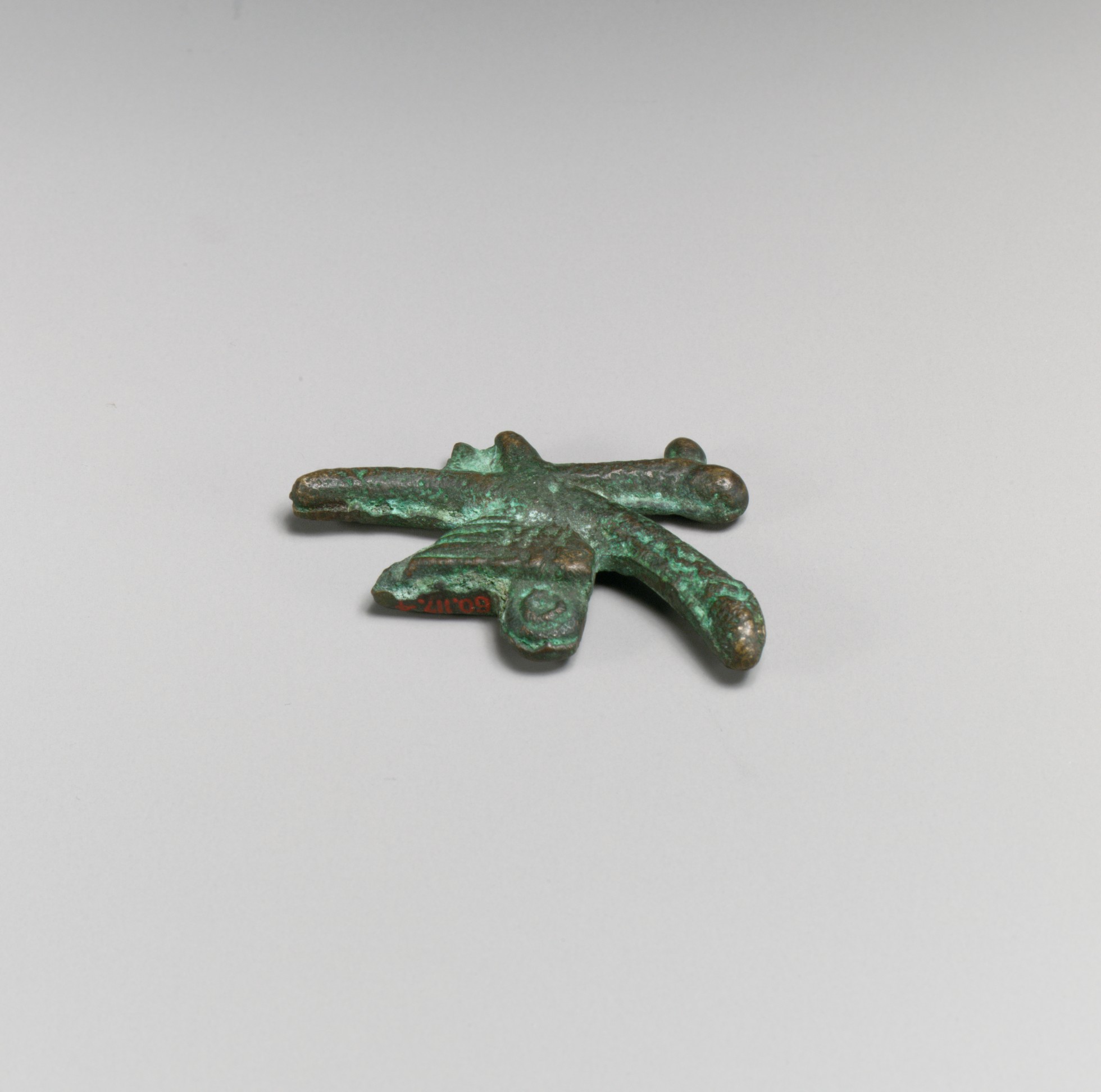
Heritage Analysis: Bronze Phallic Amulet (Roman, c. 1st–3rd Century CE)
Introduction: The Amulet as a Nexus of Power and Protection
The bronze phallic amulet from the Roman period represents a singularly potent artifact within the broader corpus of ancient adornment. As Lead Heritage Curator for Katherine Fashion Lab, I have examined this object not merely as a talisman of fertility, but as a sophisticated emblem of symbolic power that intersects with our ongoing heritage study. Our research context, which has previously analyzed the Rock in the form of a fantastic mountain and the Jar in the shape of bronze container (hu), reveals a compelling DNA correlation: all three objects—despite their disparate forms and cultural origins—function as vessels for protective spiritual meaning through the manipulation of material, shape, and symbolic resonance. The phallic amulet, in particular, offers a direct lineage to contemporary luxury strategy, where the body becomes a canvas for talismanic branding.
Symbolic Power: The Phallus as Apotropaic Device
In Roman society, the phallus was not primarily a symbol of eroticism, but of apotropaic power—the ability to ward off evil, misfortune, and the "evil eye." Known as the fascinum, this motif was ubiquitous: worn as pendants, carved into doorways, and affixed to chariots. The bronze amulet in our collection is a miniature iteration of this tradition, designed to be worn close to the skin. Its material—bronze, an alloy of copper and tin—was itself imbued with protective properties, as metal was believed to conduct divine energy. The amulet's form, with exaggerated testicles and a curved, erect shaft, amplifies its symbolic power through hyperbole; the more potent the image, the greater its prophylactic efficacy. This aligns with our earlier findings on the Rock in the form of a fantastic mountain, where the mountain's jagged, unnatural shape was intentionally exaggerated to evoke the chaotic forces of nature that the object sought to contain. Both objects demonstrate that historical adornment often relies on distortion and magnification to activate spiritual meaning.
Historical Adornment: The Body as a Site of Spiritual Negotiation
The amulet's function as a piece of jewelry—often strung on a leather cord or gold chain—places it within a broader tradition of historical adornment that prioritized the body as a site of spiritual negotiation. Roman men, women, and even children wore phallic amulets, not as expressions of virility, but as everyday armor against the invisible threats of the supernatural world. This use of adornment as a spiritual meaning system parallels the Jar in the shape of bronze container (hu), a Chinese ritual vessel that, while outwardly a container for offerings, was also a symbolic vessel for containing and channeling ancestral spirits. In both cases, the object's primary function—protection for the amulet, storage for the jar—is secondary to its symbolic power as a mediator between the human and the divine. For Katherine Fashion Lab, this reveals a critical insight: high-end luxury in 2026 must move beyond mere aesthetics to embed spiritual meaning into the object's very materiality and form.
Spiritual Meaning: The Amulet as a Microcosm of Cosmic Order
Roman spirituality was deeply pragmatic. The phallic amulet operated within a system of spiritual meaning that sought to maintain cosmic order (pax deorum) against chaos. The phallus, as a generative force, was a symbol of life, abundance, and continuity—attributes that directly countered the sterility and decay associated with evil forces. This is where our DNA correlation with the Rock in the form of a fantastic mountain becomes most profound. The rock, a natural object reshaped into a "fantastic" form, and the hu jar, a bronze container mimicking an earlier ceramic tradition, both embody a tension between the natural and the artificial. The phallic amulet, too, is a miniature world: its bronze surface, polished to a golden sheen, mimics the sun's life-giving rays, while its shape echoes the primal act of creation. Wearing such an amulet was to carry a microcosm of cosmic order on one's person—a concept that resonates with the modern luxury consumer's desire for objects that confer not just status, but existential security.
2026 High-End Luxury Strategy: Talismanic Branding and Material Semiotics
For Katherine Fashion Lab, the bronze phallic amulet is not a relic, but a blueprint. Our 2026 high-end luxury strategy must harness the symbolic power of talismanic objects by embedding spiritual meaning into every material and form choice. The amulet's success lies in its material semiotics: bronze is not just a medium, but a message of durability, protection, and value. Similarly, our forthcoming collections will prioritize materials with inherent symbolic weight—oxidized silver for transformation, raw crystal for clarity, and hand-hammered gold for permanence. The amulet's exaggerated form, designed to maximize its apotropaic effect, teaches us that historical adornment succeeds through bold, unmistakable silhouettes. In 2026, our designs will avoid subtlety in favor of symbolic power that is immediately legible to the wearer and the observer alike.
Furthermore, the amulet's role as a personal protective device aligns with the luxury market's growing demand for spiritual meaning and wellness. Our strategy will position each piece as a "talisman for modern times," offering not just beauty, but a psychological anchor in an uncertain world. The Rock in the form of a fantastic mountain and the hu jar both demonstrate that objects of historical adornment were never passive; they were active agents in their owners' lives. Katherine Fashion Lab's 2026 strategy will revive this agency, creating luxury items that function as symbolic power conduits—pieces that protect, empower, and connect the wearer to a lineage of human resilience.
Conclusion: The Amulet as a Heritage Blueprint
The bronze phallic amulet, when read through the lens of our heritage study, emerges as a masterclass in the integration of symbolic power, historical adornment, and spiritual meaning. Its DNA correlates with the Rock in the form of a fantastic mountain and the Jar in the shape of bronze container (hu) in its use of material and form to negotiate the boundary between the human and the transcendent. For Katherine Fashion Lab, this artifact is not a curiosity, but a strategic directive: in 2026, high-end luxury must be talismanic, material must be semiotic, and form must be fearless. The amulet's bronze gleam, worn for centuries against the skin of Romans, now illuminates a path for a brand that seeks to adorn not just the body, but the soul.