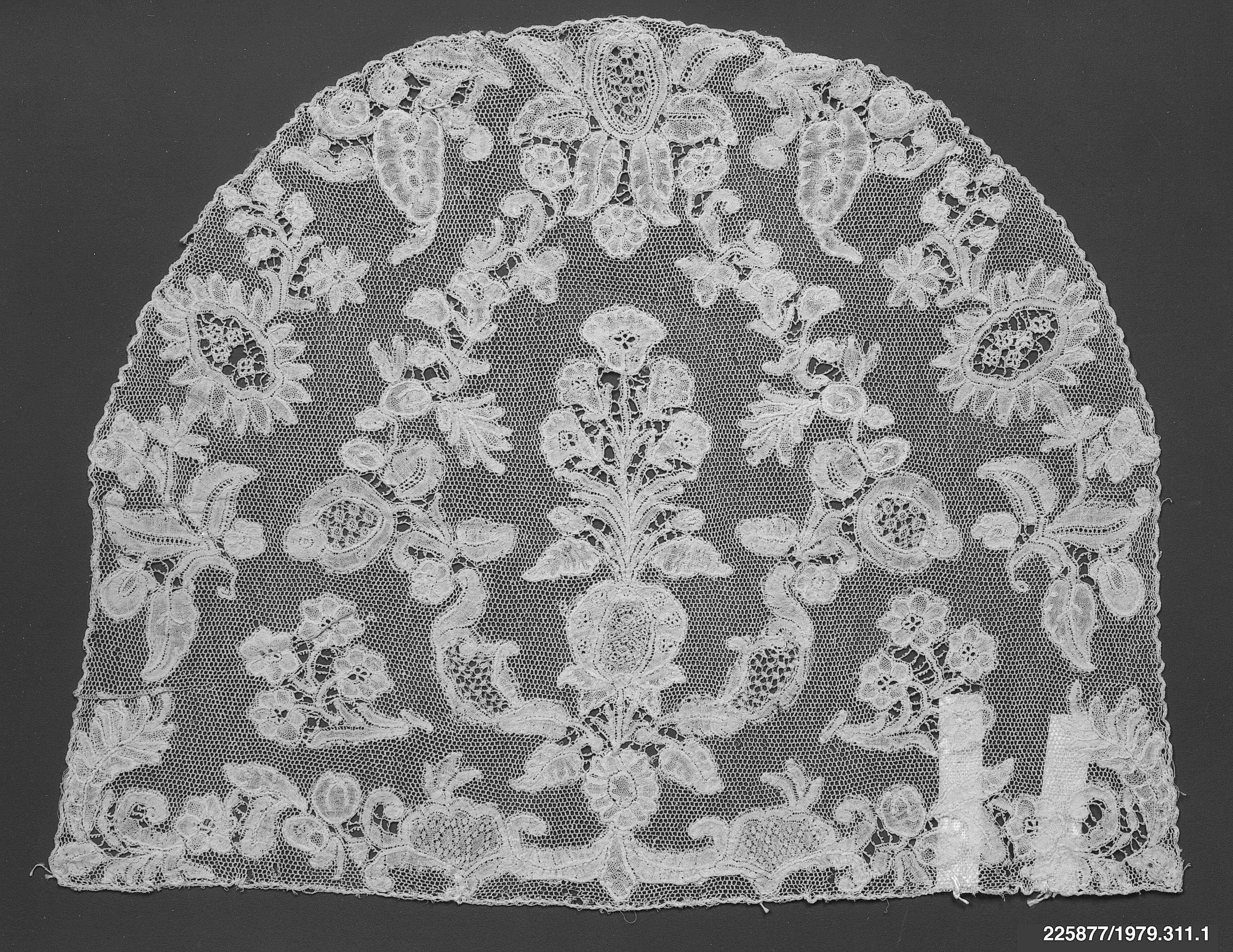
The Cap Crown: A Study in Architectural Lace and Global Heritage
The cap crown, a seemingly modest accessory, has long served as a canvas for the most intricate and culturally resonant expressions of textile artistry. In the hands of Katherine Fashion Lab, this humble form is elevated to a subject of profound couture analysis, where the interplay of material, technique, and heritage becomes a standalone study in luxury and craftsmanship. This analysis delves into the cap crown as an object of sartorial architecture, focusing on the use of bobbin lace—specifically Brussels bobbin lace, point d’Angleterre, and linen—to explore how global heritage is woven into a singular, transcendent piece.
Deconstructing the Cap Crown: Form and Function in Couture
In the lexicon of fashion, the cap crown is not merely a covering but a structural statement. It defines the silhouette of a hat, capping the head with a precise geometry that balances volume and fit. For Katherine Fashion Lab, the cap crown is treated as a micro-architecture: a dome that must support both visual weight and tactile delicacy. The choice of bobbin lace as the primary material introduces a paradox of strength and fragility. Bobbin lace, created by twisting and braiding threads over a pillow, produces a fabric that is simultaneously open and resilient. This duality is central to the cap crown’s allure, as it allows for a structure that feels airy yet holds its form against the contours of the head.
The standalone study of this piece requires a shift in perspective—viewing the cap crown not as an accessory but as a primary artifact. Here, the crown becomes a lens through which to examine the intersection of technique and tradition. The use of linen as the base thread adds a layer of earthy sophistication, grounding the ethereal lace in a material known for its durability and natural luster. Linen’s crispness provides the necessary tension for the lace to maintain its shape, while its subtle sheen catches light in a way that synthetic fibers cannot replicate. This material choice honors the heritage of lace-making, where linen was historically prized for its longevity and ability to hold intricate patterns.
Brussels Bobbin Lace: The Heart of European Lace-Making
Brussels bobbin lace, or Brusselse kant, stands as a pinnacle of European textile craftsmanship. Originating in the 16th century in the Low Countries, particularly in and around Brussels, this lace is characterized by its use of a continuous thread technique that allows for fluid, unbroken designs. In the cap crown, Brussels bobbin lace is employed to create a seamless, almost sculptural surface. The lace’s hallmark—a fine, mesh-like ground interspersed with floral or geometric motifs—lends itself beautifully to the crown’s curved form. The artisans at Katherine Fashion Lab have adapted this traditional technique to modern couture, using a combination of point d’Angleterre and Brussels lace to achieve a texture that is both dense and transparent.
Point d’Angleterre, despite its name, is not English but a Flemish innovation that became synonymous with high-end lace in the 18th century. It is distinguished by its raised, corded outlines (often called gimp or cordonnet), which add a three-dimensional quality to the pattern. In the cap crown, point d’Angleterre is used to delineate the crown’s structural seams and edges, creating a visual rhythm that guides the eye around the form. This technique requires immense skill: the corded outlines must be applied with perfect tension to avoid puckering or distorting the crown’s shape. The result is a piece that feels both historical and avant-garde, as if the lace has been lifted from a 17th-century Flemish painting and reimagined for contemporary wear.
The Role of Linen: A Global Heritage Material
Linen’s inclusion in this analysis is not incidental; it is a deliberate nod to the global heritage of textile production. Flax, from which linen is derived, has been cultivated for millennia, with evidence of its use in ancient Egypt, Mesopotamia, and the Indus Valley. In the context of the cap crown, linen serves as a neutral backdrop that allows the lace to sing. Its pale, off-white hue—often described as écru—provides a soft contrast to the intricate patterns of Brussels lace and point d’Angleterre. This choice also speaks to sustainability, as linen is biodegradable and requires less water to produce than cotton, aligning with Katherine Fashion Lab’s commitment to ethical luxury.
The global heritage of linen is further reflected in the dyeing and finishing processes. The cap crown is left undyed, celebrating the natural color of the flax fiber. This minimalist approach forces the viewer to focus on the lace’s structure rather than any chromatic distraction. The linen thread is also pre-washed to ensure it does not shrink after the lace is formed, preserving the crown’s precise dimensions. This attention to detail underscores the piece’s standalone status: it is not a prototype or a sample but a fully realized object of study, intended to be analyzed for its technical and aesthetic merits.
Technique as Narrative: Weaving Heritage into Form
To fully appreciate the cap crown, one must understand the labor behind its creation. Bobbin lace-making is an art that demands patience and precision. Each thread is pinned to a pillow, and the lace is built row by row, with dozens of bobbins manipulated simultaneously. For the cap crown, this process is adapted to a three-dimensional form. The lace is not made flat and then shaped; rather, it is constructed directly on a crown mold, with the pins placed to accommodate the curve. This technique, known as needlepoint lace in some contexts, allows the lace to follow the crown’s geometry without distortion. The result is a seamless integration of form and material, where the cap crown’s shape is not imposed on the lace but emerges from it.
This method also pays homage to the historical use of cap crowns in ecclesiastical and royal contexts. In 17th-century Europe, lace-trimmed caps were symbols of status, worn by clergy and nobility. The bobbin lace used in those pieces often featured religious or heraldic motifs. Katherine Fashion Lab’s cap crown reinterprets this tradition with abstract patterns that evoke organic forms—leaves, waves, and spirals—drawn from the natural world. This abstraction allows the piece to transcend its historical roots, becoming a universal symbol of craftsmanship.
Contextualizing the Standalone Study
As a standalone study, the cap crown is presented without the context of a full outfit or collection. This isolation is intentional: it forces the observer to confront the object on its own terms, examining every thread and twist. In a museum or atelier setting, such a piece would be displayed under controlled lighting, with magnification tools available to study the lace’s minute details. The cap crown becomes a case study in couture analysis, where the focus is on the how rather than the what. How does the Brussels bobbin lace interact with the point d’Angleterre? How does the linen base support the lace without adding bulk? These questions drive the analysis, revealing the piece’s technical sophistication.
Moreover, the cap crown challenges the notion of fashion as ephemeral. By using materials and techniques that have endured for centuries, Katherine Fashion Lab positions the cap crown as a relic of the future—an object that will outlast its wearer. The linen will age gracefully, developing a patina that tells the story of its handling. The lace, if cared for, will remain intact for generations, a testament to the skill of its makers. This longevity is a key aspect of the piece’s heritage narrative, linking it to the global tradition of heirloom craftsmanship.
Conclusion: The Cap Crown as a Masterclass in Materiality
In conclusion, the cap crown from Katherine Fashion Lab is far more than a hat. It is a masterclass in the use of bobbin lace, Brussels lace, point d’Angleterre, and linen—a convergence of materials that span continents and centuries. Through its architectural form and meticulous construction, the cap crown invites a deeper understanding of how heritage can be preserved and reinterpreted in couture. For the discerning analyst, this piece offers a wealth of insights into the interplay of structure, texture, and tradition. It stands as a testament to the enduring power of handcraft, proving that even the smallest accessory can hold the weight of history.